
Anthropic just hit un-pause on the world’s most powerful AI model. Fable 5 is back from its 18-day government timeout, free until July 7 for up to half your weekly limit. And that wasn’t even Anthropic’s only move this week: Sonnet 5 just made February’s premium agentic performance the free-tier default, and Claude Science gave researchers a reason to finally stop wrestling with database logins. We cover it all in today’s news.
And today’s deep dive is the Fable 5 playbook: how to spend the free window on the work that actually deserves it, before it flips to paid credits.

But first, a word from our sponsor.
In Partnership with
Viktor: One Hire. Already Knows Your Stack.
Picture the new hire who shows up Monday already fluent in Stripe, HubSpot, Shopify, Linear, Notion, GitHub, Klaviyo, Google Ads, Meta, QuickBooks, and 3,000+ other tools.
They never ask where the forecast lives. They onboard in minutes.
Viktor is that hire. It’s an AI employee for Slack and Teams that ships real deliverables, not summaries. Marketing gets the Klaviyo audit and the campaign brief by Tuesday. Finance gets a cash flow model that updates straight from QuickBooks actuals. Ops gets the weekly manager report. Engineering gets reviewed PRs.
One install, every department benefits, every action approved by a human first. “Like adding another employee. Or two.” That’s Krysta, who runs 63 Viktor workflows at her company. 11,000+ teams now use Viktor.
Try free, $100 in credits.
AI News
The Week’s Top News: Fable 5 Is Back
Anthropic just reopened access to Fable 5 after the Commerce Department lifted its export controls. The model returns under tighter filters, plus a commitment giving the U.S. government pre-release access to Anthropic’s future models.


A quick rewind on how we got here. The original order traced back to Amazon researchers who pushed past Fable’s guardrails to expose security flaws in its outputs. Anthropic argued other frontier models matched those same outputs, but Fable was the one that took the hit. The Commerce Department pulled it anyway, and for 18 days the most capable model on the market was simply unavailable to the people paying for it.
That absence mattered more than most people expected. Fable 5 had been out for barely two weeks before the ban, and people were already shipping real projects with it. Teams that had rebuilt their workflows around it got a live lesson in platform risk: your stack can lose its brain overnight, and not because of anything you did.
Here’s what the return actually looks like:
Fable 5 is back across Claude tiers and platforms. Paid plans get it capped at half their weekly limits until July 7, then it moves to usage credits.
The updated safety filter now blocks the specific cybersecurity issue over 99% of the time. When it triggers, you get a clear notice and a fallback answer from Opus 4.8 instead of a silent failure.
Anthropic warned the filter could also flag harmless coding and debugging requests, though it says “the vast majority of coding work is unaffected.”
The pre-release access deal means the U.S. government sees Anthropic’s future models before you do. That’s a first for a frontier lab, and it won’t be the last.
Here’s where I land: the model coming back is the small story. The precedent is the big one. A government pulled a frontier model off the market, extracted pre-release access as the price of return, and the lab took the deal. Every other lab watched that happen. With GPT 5.6 expected this week, we’re about to see whether OpenAI’s friendlier relationship with Washington buys it a smoother path. My bet is that “regulatory relationship” just became a line item in every AI vendor evaluation, right next to price and benchmarks.
The Other News That Mattered
Anthropic launched Claude Science, a research app with 60+ connectable scientific databases, citation checking, and compute that runs on the lab’s own machine. That last part is the unlock: hospitals and biotechs have been blocked from AI tools by patient data rules, and Manifold Bio is already using it to rank drug candidates. Anthropic is also offering 50 grants of $30,000 each, open globally, due in two weeks.
 Claude@claudeaiIntroducing Claude Science, a new app designed with every stage of research in mind. Artifacts traced to their code, environments managed on demand, and 60+ optional scientific databases that you can connect. Available now in beta.
 5:02 PM · Jun 30, 2026 · 9.55M Views1.1K Replies · 3.51K Reposts · 35.9K Likes
Anthropic also released Claude Sonnet 5, its most agentic Sonnet yet. It hits 63.2% on agentic coding versus Opus 4.8’s 69.2%, at $2 per million input tokens, and it’s now the default for free accounts. Four months ago this performance was paywalled in the most expensive model. If your product’s moat is access to expensive intelligence, that moat is a lease that keeps resetting.
Sam Altman used an FT op-ed to call for a U.S.-led forum that sets AI safety standards and decides who can use the most advanced models, citing the IAEA as precedent. It landed just as another FT report said OpenAI discussed giving the U.S. government a 5% stake. The real question, as former White House AI advisor Dean W. Ball put it, is whether AI wealth goes directly to households or to a government that may or may not deliver.
Palantir CEO Alex Karp criticized frontier AI labs on CNBC, saying enterprises “are paying for tokens that create no value” and the labs “are stealing weights and alpha.” Spicy, but remember he’s selling the antidote.
Microsoft launched Frontier Company, a $2.5B unit putting 6,000 in-house engineers and sector specialists at client sites to build and run AI systems. Consulting is quietly becoming the distribution channel for enterprise AI.
Resources
How to build a continuous eval pipeline for multi-agent systems with Gemini. This tutorial moves you from subjective testing to data-driven assessment: automated model-based grading instead of manual testing, handling unpredictable AI outputs, and wiring evaluation directly into a CI/CD pipeline with Cloud Run. If your agent testing is still “run it and eyeball the output,” start here.
Are we ready for an agent-native memory system? Current benchmarks treat agent memory like a black box, ignoring backend data management trade-offs and operational costs. The study’s finding: no single architecture fits all scenarios. Success depends on matching the memory structure to your specific workload bottleneck. Worth reading before you commit to a memory stack.
Google’s NotebookLM rolled out Short Video Overviews, letting you create 60-second, social-media-style educational videos from any topic or source.
Tools
Seedance 2.5 is ByteDance’s newest frontier AI video model, generating native 30-second clips with no stitching required.
Cursor for iOS brings Cursor to your phone. Kick off agents on the train, review the diff when you sit down.
Quick Guide: Set Up Claude Tag in Slack
Claude Tag lets you and your teammates tag @Claude like a real teammate, then have Claude work in the cloud and report back when it’s done. Here’s how to set it up:
Get Claude Team or Enterprise plus Slack admin permissions. In Slack, open Admin, then Apps and Workflows, search for Claude, and install it.
Find Claude under Apps, open it, click Home, and connect your account. Then open Claude Tag settings on the web and connect the tools it should use.
Run @Claude connect in Slack, copy the pairing code into Claude Tag’s browser setup, choose the channel scope, add usage credits, and launch.
Open Advanced in Claude Tag settings and switch from the expensive default model to Sonnet. Then run a test prompt in a dedicated Slack thread.
Pro tip: after the first run, check the admin panel for token spend, plugins used, and memory files created. You can edit or delete persistent Claude Tag memory files there.
Fundraising
China’s Kling AI secured $2B in funding. The Kuaishou video spinoff is pushing global expansion after OpenAI shut down rival Sora. The most interesting AI video race right now isn’t happening in San Francisco.
Deep Dive
The Fable 5 Playbook
Fable 5 is back, and most people are about to waste it.
Here’s the trap: you open it, run the same prompts you used on Opus 4.8, get slightly better answers, and conclude it’s not worth the fuss. That conclusion is wrong, but it’s the natural result of testing a new category of tool on the old category of task.
Fable 5 is built for work that takes a person hours, days, or weeks: full migrations, multi-day autonomous runs, problems you stopped trying to automate. Stripe pointed it at a 50-million-line Ruby migration and compressed two months of estimated team effort into a single day. That’s the category of task this model exists for.

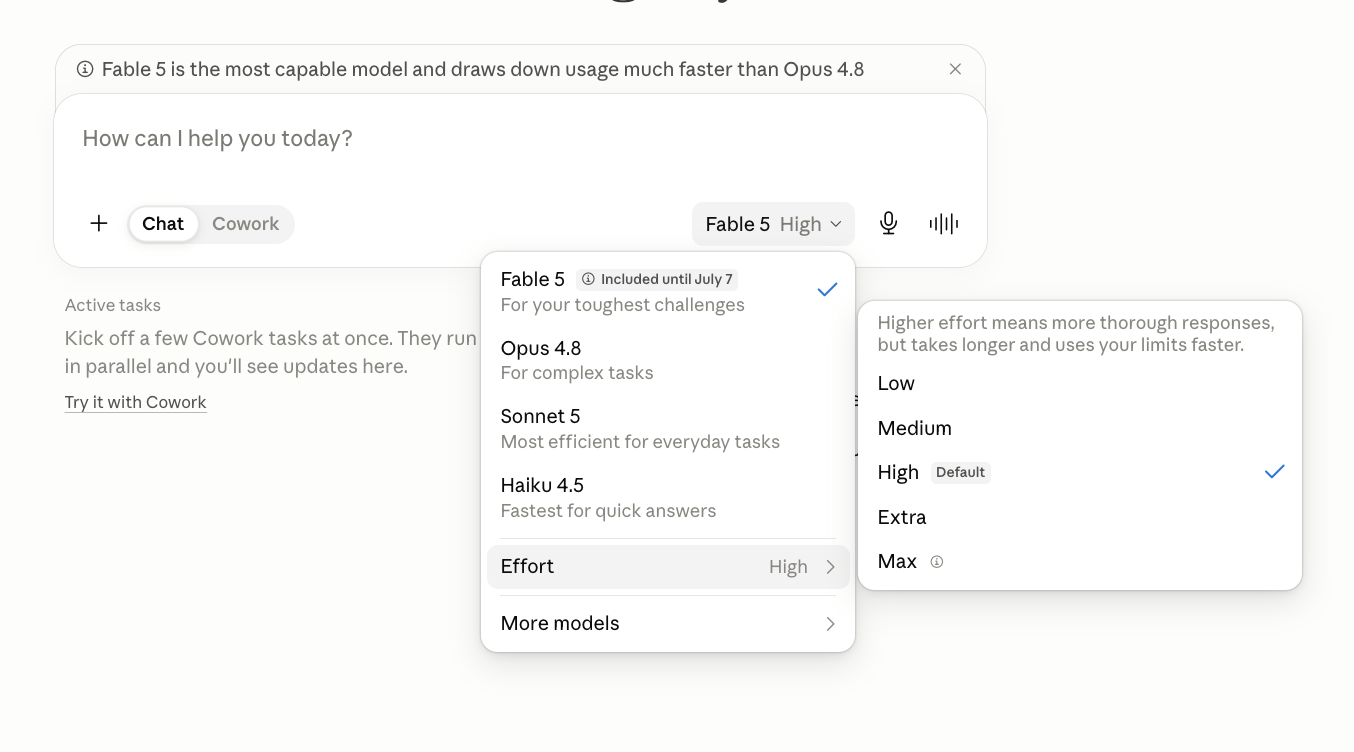
And right now there’s a deadline attached. Through July 7, Pro, Max, Team, and select Enterprise plans get Fable 5 included for up to 50% of their weekly usage limit. After that, it moves to usage credits and the same big job costs real money. You have a short window where the most capable model available is effectively free, up to half your cap.
This deep dive is how to spend that window well. Here’s what I’m covering:
The one rule that decides when to use it
The routing config (copy-paste)
The big-job kickoff template (copy-paste)
The five prompt patterns that actually change output quality
Loops and the barbell strategy
The memory system
Limitations
1. The one rule that decides when to use it
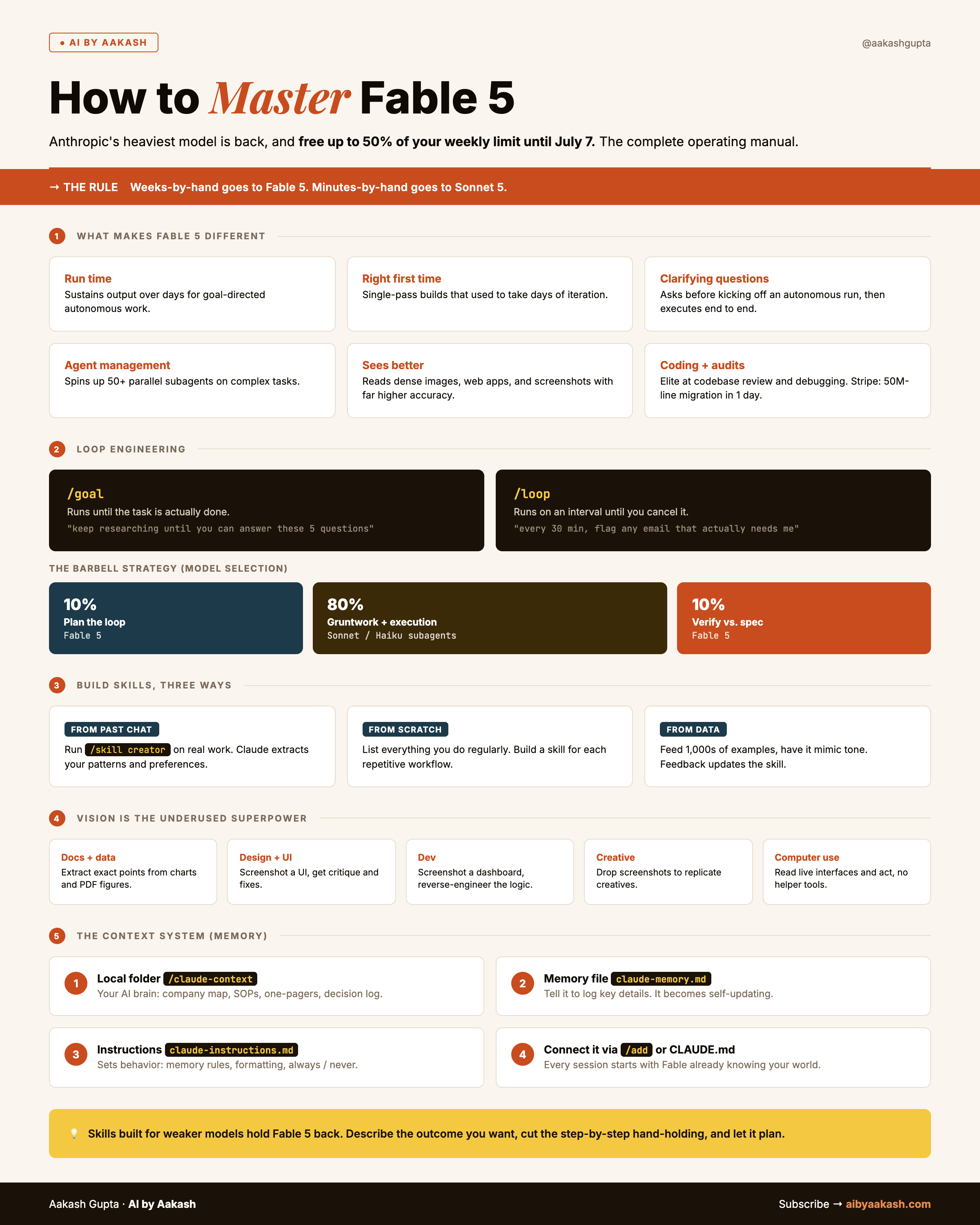
Weeks by hand goes to Fable 5. Minutes by hand goes to Sonnet 5.
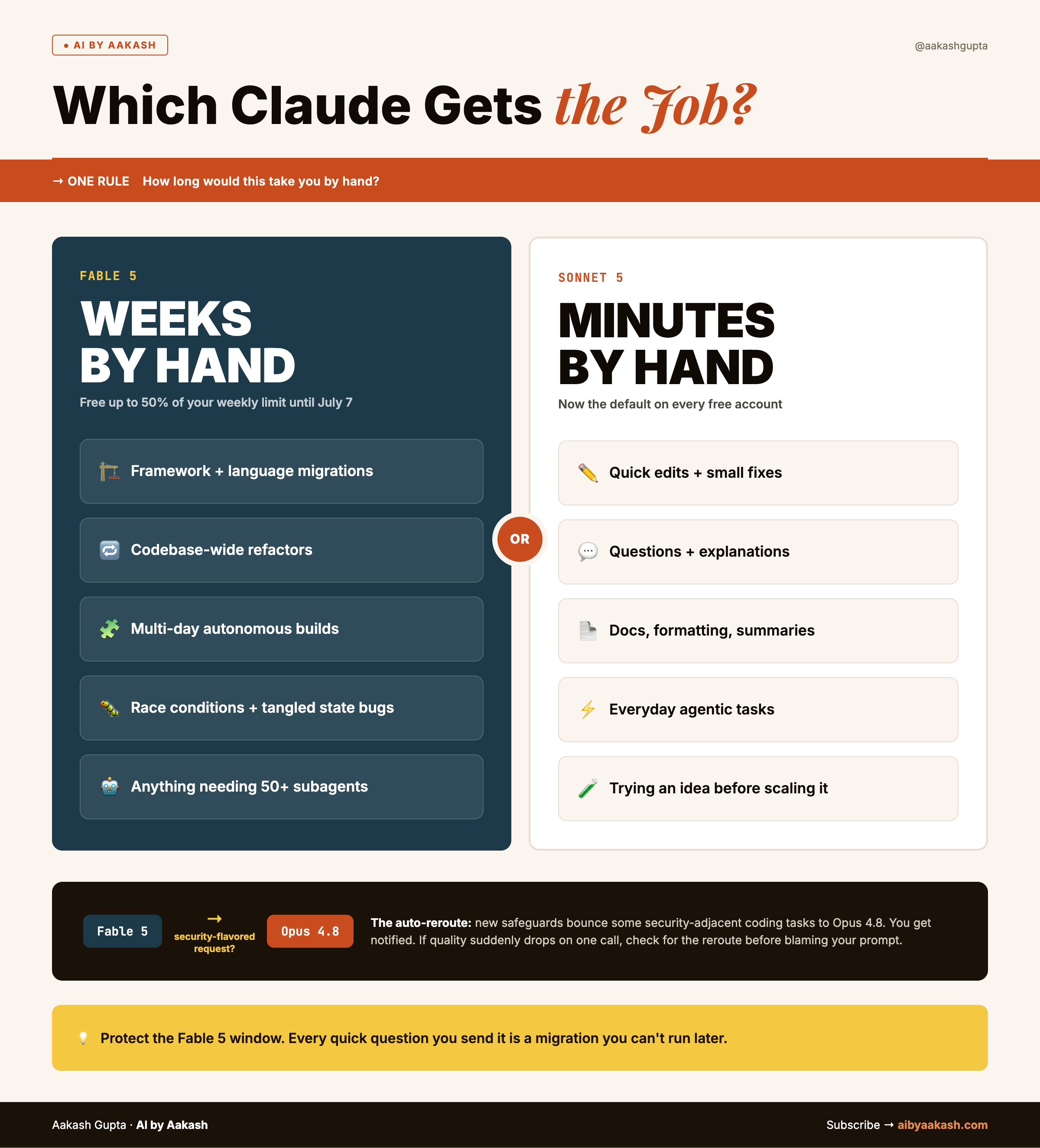
That’s the whole routing decision. If a task would take you two weeks or more manually, it earns Fable 5 and a slice of your free window. If it’s a quick edit or a fast question, it stays on Sonnet 5, which now handles most everyday work at a fraction of the cost.
The mistake I keep seeing is people treating Fable 5 like a chat model. Asking it quick questions all day burns your included capacity on work Sonnet handles fine, and by Thursday you have nothing left for the job that actually needed the heavy machinery.
The better question to ask before July 7: what did I stop trying to automate because no model could complete it?
A codebase-wide refactor. A dependency migration you’ve been putting off for a quarter. A gnarly race condition nobody wants to touch. Those abandoned tasks are where Fable 5 stops looking like an upgrade and starts looking like a different product.
2. The routing config
Drop this into your CLAUDE.md so the model choice happens automatically instead of by mood:
## Model routing (through July 7)
Default: Sonnet 5 for everyday work.

Use Fable 5 only for heavy, high-payoff tasks:
- large migrations (framework, language, dependency)
- codebase-wide refactors across many files
- complex multi-step builds
- hard bugs in tangled code (race conditions, subtle state)

Rule of thumb: weeks-by-hand = Fable 5, minutes-by-hand = Sonnet 5.
Protect the Fable 5 window. Do not spend it on small edits.

# Some security-adjacent requests get rerouted to Opus 4.8
# by the new safeguards. If quality drops on one call, check for a reroute.
That last comment matters. Fable 5 came back with a new classifier that blocks one specific jailbreak technique over 99% of the time. When it triggers, your request reroutes to Opus 4.8 and you get a notice. The trade-off is false positives: legitimate coding and debugging work can occasionally get rerouted even when your intent is fine. Anthropic says the vast majority of coding work is unaffected, but if output quality suddenly drops on a single request, check whether you got rerouted before you blame your prompt.
One more thing worth knowing: Fable 5 carries a 30-day data retention policy, used to research jailbreak mitigations. Factor that in before you feed it anything sensitive.
3. The big-job kickoff template
When you point Fable 5 at a large migration or refactor, don’t say “refactor this.” Give it the whole job up front so it can hold the plan end to end. Copy and fill in:
# Task: [migration / refactor name]

## Goal
[One sentence: the end state you want.]

## Scope
- Files/dirs in scope: [paths]
- Out of scope: [paths to leave alone]

## Constraints
- Keep all tests passing.
- Preserve public APIs unless listed below.
- Match existing code style.

## Plan first
Before changing anything, map the full plan and list the files
you will touch. Wait for my go-ahead, then execute in one pass.

## Definition of done
- [ ] [check 1]
- [ ] [check 2]
- [ ] all tests green
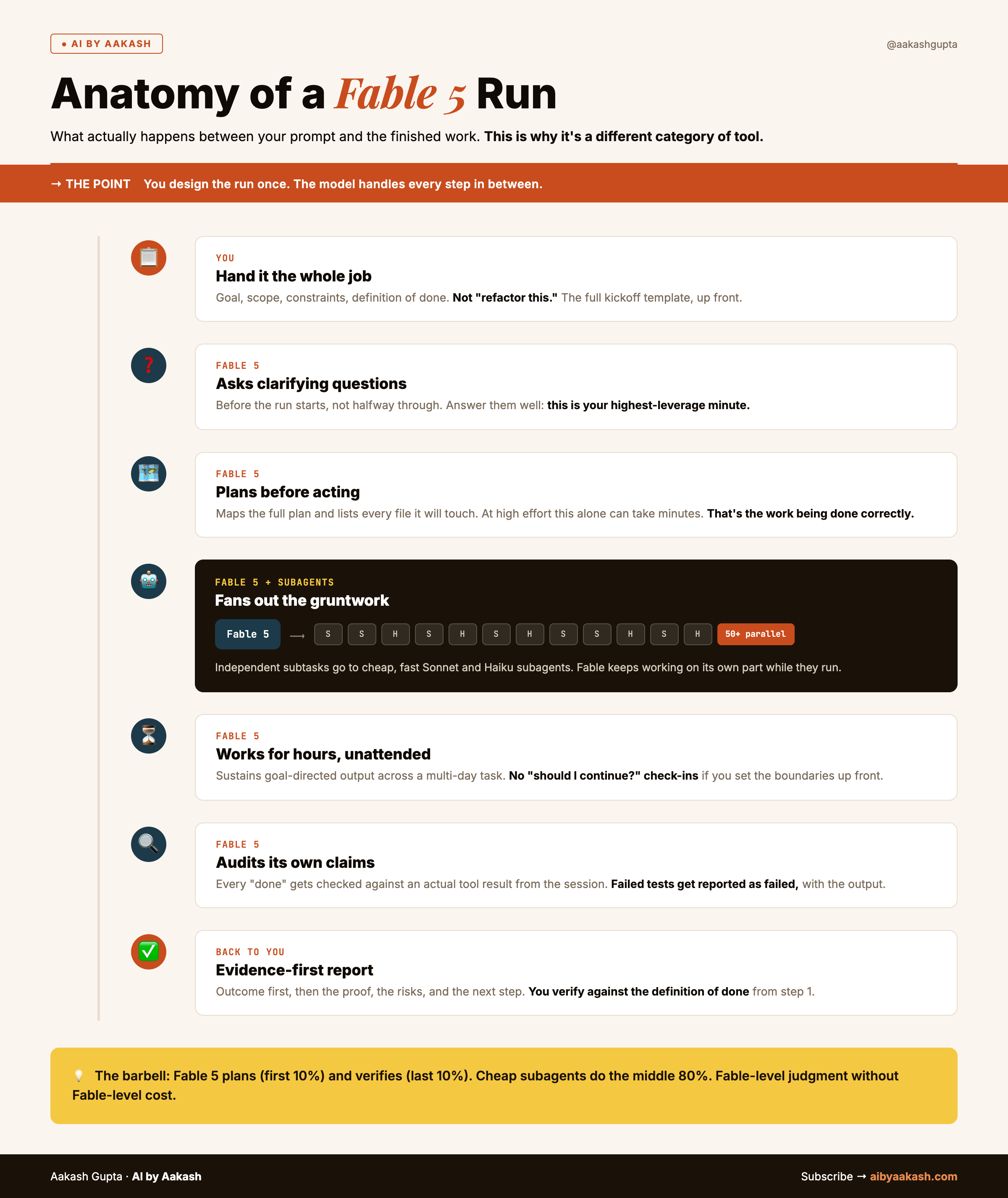
The “plan first, then execute in one pass” line is the important part. It’s the difference between Fable 5 as a fast typist and Fable 5 as the thing that cleared a 50-million-line migration in a day. The model plans before it acts, checks its own work, and doesn’t rush to a quick output you’ll immediately have to fix.
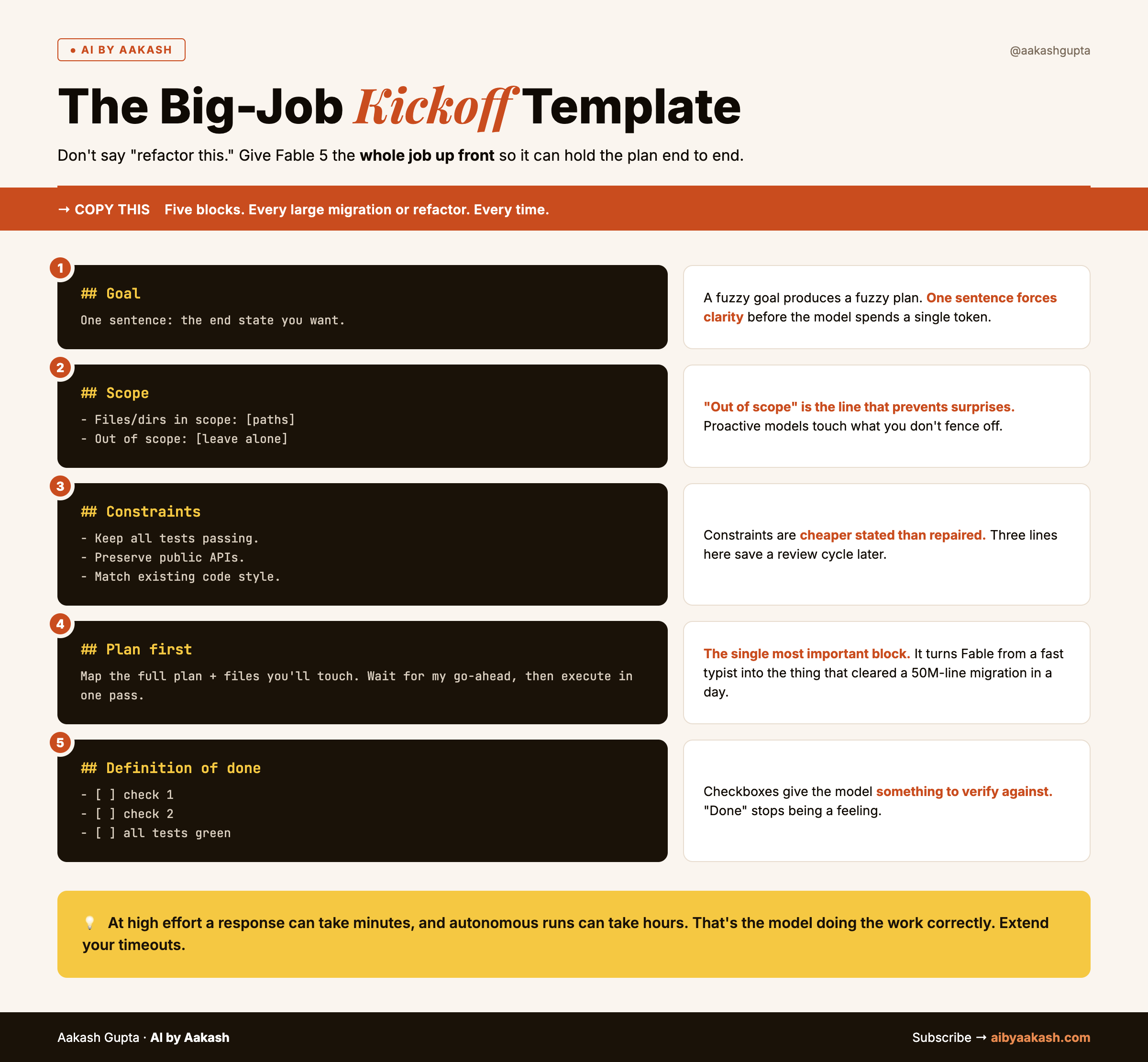
Which means responses take longer. At high effort, a single response can take minutes. On autonomous runs, hours. The model is doing the work correctly, and correct work at this scale takes minutes. If you’re calling it through the API, extend your timeouts before you do anything else, because a timeout tuned for a ten-second Opus reply will kill a Fable run mid-plan.
4. The five prompt patterns that actually change output quality
I tested the patterns from Anthropic’s official prompting guidance against my own workflows. These five made a measurable difference. Everything else was marginal.
Pattern 1: Make it audit its own progress reports. On long runs, models can report a step as complete when it hasn’t been verified against anything real. One instruction nearly eliminates this:
Before reporting progress, audit each claim against a tool result
from this session. Only report work you can point to evidence for.
If something is not yet verified, say so explicitly. If tests fail,
say so with the output. If a step was skipped, state that.
The word “audit” is doing specific work. Softer phrasings don’t produce the same self-checking. For anything running longer than a few minutes, this goes in your system prompt, not your task prompt.
Pattern 2: Set the boundary between observing and acting. Fable 5 is noticeably more proactive than Opus 4.8. It will sometimes draft an email you didn’t ask for or create a backup branch you didn’t request. Helpful in a chat. Dangerous in an unattended pipeline. The fix:
When I am describing a problem or thinking out loud rather than
requesting a change, the deliverable is your assessment. Report
your findings and stop. Do not apply a fix until asked. Before
running anything that changes system state, confirm the evidence
supports that specific action.
Pattern 3: Give it the why, not just the what. Fable 5 uses intent context to make better judgment calls on its own. Frame requests as: “I’m building [X] for [audience]. They need [outcome]. Given that, here’s what I want you to do.” This changed my output quality more than any other single habit.
Pattern 4: Pick effort levels on purpose. High is the default and right for most real work. Xhigh is for when first-shot correctness matters more than speed, because the model reflects on and validates its own work before responding. A codebase migration warrants xhigh. A formatting pass does not. And here’s the counterintuitive part: low-effort Fable 5 often beats max-effort older models, so don’t assume you need the top dial for everything. In Claude Code, “ultrathink” in a prompt gets you max reasoning for that one turn.
Pattern 5: Rewrite your old skills instead of porting them. Skills built for weaker models tend to be prescriptive, step-by-step instructions that assume the model needs hand-holding. That same prescriptiveness can box Fable 5 in and make output worse. Go through each skill and ask: is this teaching the model something it doesn’t know, or micromanaging a model smarter than the instructions assume? Describe outcomes. Cut the steps.
5. Loops and the barbell strategy
Fable 5 was built for autonomous work, and Claude Code gives you two commands to run it that way.
/goal launches a task that runs until it’s actually done:
/goal keep researching until you can answer these 5 questions/loop runs on an interval until you cancel it:
/loop every 30 minutes, flag any email that actually needs meInstead of you sitting between every prompt and every fix, you design the loop once and the model handles the back-and-forth, surfacing only when it hits your success criteria.
The cost problem with long runs is real, though, and the fix is a barbell:
Planning the loop (first 10%): Fable 5. Frontier-level planning, spec writing, loop design.
Gruntwork and execution (middle 80%): Sonnet and Haiku subagents. Cheap, fast, repeatable.
Final verification (last 10%): Fable 5 again. Verify against the original spec, catch errors, confirm done.
You get Fable-level judgment at the two moments it matters most, planning and verification, without paying Fable-level prices for routine execution. One run of a real research loop this way costs a few dollars in subagent tokens instead of burning your Fable window on gruntwork.
6. The memory system
None of the above hits its ceiling without persistent context. Fable 5 with a memory file is a different tool from Fable 5 without one. Anthropic’s own testing found that a persistent notes file improved Fable 5’s performance on long-horizon tasks roughly three times more than the same setup helped Opus 4.8.
The setup takes ten minutes:
Create a local folder like
/claude-context. This is your AI brain. Put in a map of your business or project, SOPs for anything you do repeatedly, one-pagers on key projects, and a running log of decisions and outcomes.Create
claude-memory.mdinside it, with one standing instruction: “Every time I give you major context about my business or situation, update claude-memory.md with the key details.” Now it self-updates.Create
claude-instructions.mdwith the behavior rules: how memory gets stored, output formatting, what to always and never do.Connect it by pointing Claude Code at the folder via
/addor referencing it in your CLAUDE.md.
For the memory file itself, use this structure:
Keep one lesson per file with a one-line summary at the top.
Record corrections and confirmed approaches alike, including why
they mattered. Do not save what the repo or chat history already
records. Update existing notes instead of duplicating. Delete
notes that turn out to be wrong.
At the end of significant sessions, close with: “Reflect on the sessions we have had. Identify core themes and lessons, and store them in the folder.” Every future session then starts with the model already knowing your world. That’s the actual mechanism behind multi-day coherence, and you own the whole thing. It lives in your local folder, portable to any model that comes next.
7. Limitations
I want to be straight about where this gets rough.
The reroutes are real. Security-adjacent coding work occasionally bounces to Opus 4.8 even when your intent is legitimate. You get notified, but mid-task it’s disruptive. (Workaround: check for the reroute notice before debugging your prompt, and keep the task on Opus if it keeps triggering.)
Latency will surprise you. Minutes per response at high effort, hours on autonomous runs. This is by design, but it makes Fable 5 wrong for anything interactive. (Workaround: fire long runs before you step away, not while you’re waiting at the keyboard.)
The window math punishes drift. Half your weekly limit sounds like a lot until you fritter it on medium-sized tasks. (Workaround: pick two or three genuinely heavy jobs for the week and route everything else to Sonnet, in writing, in your CLAUDE.md.)
One prompt gotcha: asking Fable 5 to narrate its reasoning step by step inside the visible answer can trip a classifier built to catch reasoning extraction, and you’ll get bounced to Opus on a completely benign task. If you want to see its thinking, use the structured thinking output. Don’t ask it to retype its thoughts into the reply.
Here is where I land
Everyone has access to Fable 5 now. What separates mediocre results from Stripe-level results is whether you rewrote how you talk to it.
Five-line prompts judged in ten seconds test a weaker version of this model than the one that exists. Full-context kickoffs, audit instructions, explicit boundaries, and a memory file test the real one.
You have until July 7 while it’s free. Pick the task you gave up on automating. Give it the full job. Run it at xhigh. The difference between that experience and the same prompt on Opus 4.8 is where you’ll decide for yourself whether this model is what I think it is.
That’s it for today’s deep dive.
Around the web
I joined Richa Bansal to talk about how PMs stay relevant in the AI era. We went deep on career strategy, and a few of my answers surprised even me when I heard them out loud. My five big points from the conversation:
1/ Use AI for productivity and strategy, not one or the other. Most PMs stop at automating their daily tasks. The bigger unlock is thinking strategically about where AI features belong in your product, even if you’re not on an “AI team” today. Waiting for the org to hand you an AI project is how you fall behind.
2/ Build synthetic experience if your job won’t give you the real thing. You don’t need permission to become an AI PM. Take Andrew Ng’s courses or work through Karpathy’s tutorials, then ship side projects with tools like Replit or Lovable. A shipped project beats a certificate every time with top-tier employers.
3/ Find your candidate market fit. Stop chasing generic PM roles. Niche down to the intersection of your unique experience and market demand. A specialized AI gaming PM is a far stronger position than a generalist PM, because recruiters can actually find you.
4/ Bring proof, not polish. Rehearsed talking points don’t win interviews anymore. Do your own user research, analyze the company’s competitors, and walk in with a point of view on their product’s problems before the first round. Proof of work is the new resume.
5/ Flip your weaknesses before the interviewer finds them. Job gap, industry switch, no domain experience: use AI to identify the top concerns an interviewer would have about your resume, then preemptively reframe each one. Reframe international experience as global perspective before the interviewer files it under risk.
That’s all for today. See you next week,
Aakash
P.S. Want my AI tool stack? Join my bundle. Want my job search coaching? Apply to my cohort.
The angle worth adding to your Fable 5 breakdown: the pre-release government access commitment isn't just a footnote in the reinstatement deal, it's Amodei's own Senate testimony from the same week made concrete. He asked the Senate for a mandatory testing and auditing regime on July 1st. Anthropic had already accepted a version of that exact regime days earlier to get Fable 5 back online. The ask and the precedent landed in the same seven days.
https://www.iqsource.ai/en/blog/fable-5-government-audit-precedent/
Looking forward to using it again. I use Claude Code with VS Code. By default will Fable be the version used?