
Garry Tan has been running Y Combinator since 2022. He spent his nights building GBrain on the side because every AI session he had started from zero. He wanted an AI that actually knew him.
Three weeks running it, I stopped re-deriving conclusions I had already reached. So that is today’s deep dive.
But first, a word from our sponsor + the week’s AI news.

I gave one of my recurring research jobs to an agent
I built a Podcast Guest Prep agent on Hyperagent.
First run, it shipped me a briefing on Howie Liu: recent appearances, strongest public arguments, sharp question angles, and what not to ask.
Then I saved it as an agent.
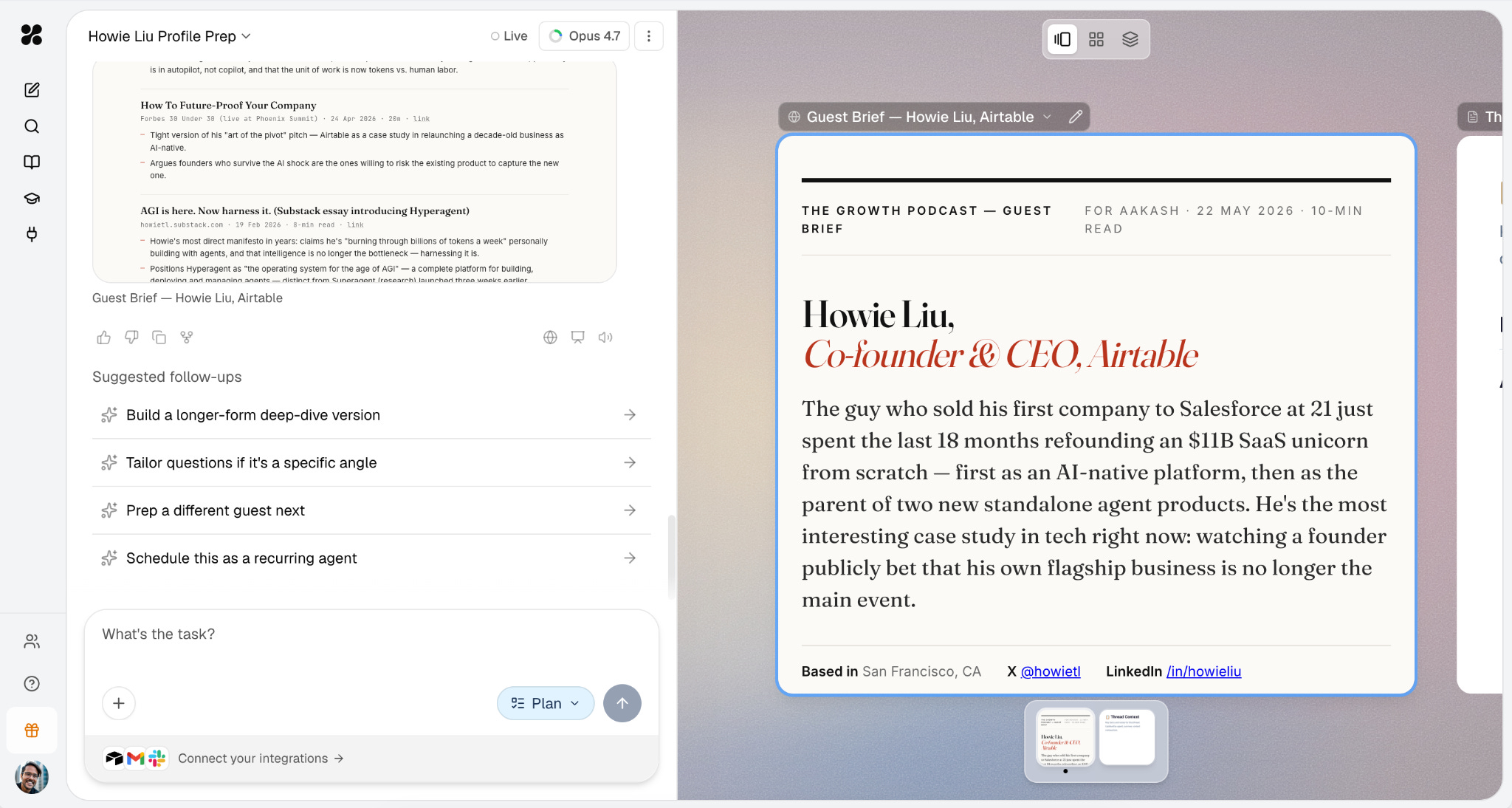
Now every time I have a new guest, I point that same agent at a name and it ships back a sharper prep doc because it has learned my taste and recurring question framings.
That is one use case. Founders and operators are using Hyperagent to build whole fleets of agents that run real parts of the business.
Built by the Airtable team. Separate product.
Hyperagent is offering $1,000 in inference credits to 1,000 of our subscribers. Claim yours here.

There’s a billion AI news articles every week. Here’s what actually mattered:
The Week's Top News: xAI Finally Has a Real Answer to Claude Code
Elon publicly admitted xAI had fallen behind on coding. Then they shipped.
Grok Build is xAI’s terminal-based coding agent, now in early beta for SuperGrok and X Premium Plus subscribers. The headline feature is plan mode: before it touches a single file, it shows you every proposed change and waits for your sign-off. That one decision tells you a lot about what they learned watching Claude Code ship.


It also runs up to eight sub-agents in parallel, each working its own branch of your codebase. You stop waiting for one pass to finish before the next one starts. The context window is 2 million tokens.
If you manage engineers or work closely with a technical team, the coding agent market just got meaningfully more competitive. Claude Code, Codex, and Grok Build are now three real options with different pricing models and different strengths. Your team will start asking which one they should standardize on. The answer matters because these tools now generate 70% of committed code at companies like Uber, and the ROI question is becoming harder to avoid.
The plan mode is the feature worth paying attention to. It forces the agent to explain its reasoning before acting. That is not just good engineering practice. It is the difference between a tool your team trusts and one they stop using after one bad deploy.
If you want a breakdown of how PMs are actually using coding agents to ship faster, Product Growth covers that in depth.
The Other News That Mattered
Anthropic released Opus-4.8, announced it is at $47B ARR, and has raised another round at a $965B valuation. It is now worth more than OpenAI. Interestingly, Opus-4.8 doesn’t beat GPT-5.5 on agentic terminal coding, as Anthropic continues to withhold Mythos-class models from us.
Andrej Karpathy joined Anthropic to work on pre-training, the compute-intensive phase that shapes Claude’s core capabilities. An OpenAI co-founder chose Anthropic over returning to OpenAI. That sequence is the signal.
Uber burned its entire 2026 AI budget in four months and the COO isn’t sure it was worth it. 95% of engineers use AI tools monthly, 70% of committed code is AI-generated, and the link to shipping more consumer features still isn’t there. This is the conversation every company will have in the second half of 2026.
OpenAI pitched GPT-5.5 Cyber to Japan for its government and private sector, covering 15 critical infrastructure sectors. The model is built specifically for cyber defense, with lower guardrails for verified defenders. AI is now a formal piece of national security deals.
Anthropic co-founder Chris Olah spoke at the Vatican alongside Pope Leo XIV’s release of his AI encyclical. Olah said frontier AI labs operate inside incentives that can conflict with doing the right thing, and the world needs critics from the outside. A striking thing to say at the Vatican. Also completely true.
Resources
Codex now supports /goal for long-running tasks, plus Computer Use for navigating Mac apps. If you’ve been waiting for it to handle actual multi-step work, this is the update to try.
Qwen 3.7 Max is Alibaba’s agent model built for long autonomous sessions. Their headline test: a 35-hour GPU optimization run with over a thousand tool calls. Take the numbers with some skepticism, but the direction is real.
Tools
PollyReach gives your AI agents their own phone numbers to make and receive real calls for lead qualification, support, and bookings. The gap between chat AI and phone AI just got smaller.
Chert (YC-backed) lets you build and deploy AI directly on iMessage. The insight: the best interface for most people is the one already open on their phone.
Funding
SpaceX is preparing the largest IPO in history at a $1.75 trillion valuation, and Google just opened talks to host data centers in orbit. Google already owns 6.1% of SpaceX, a stake now worth roughly $107 billion on paper. Anthropic, xAI, and Google are all in talks for orbital compute capacity. SpaceX goes public this summer with its biggest customers already locked in as shareholders.

Your AI Forgets Everything Between Conversations. Gbrain fixes this.
GBrain is open source, free, and built by the CEO of Y Combinator. Three weeks running it changed how I think about what AI is actually for.
Garry Tan has been running Y Combinator since 2022. He has also been building his own AI agent for most of that time. The problem he kept running into was that every session started from zero. Context he had built over weeks was gone. People he had introduced it to were strangers again. Decisions he had worked through were unrecognised.
He spent his nights building a fix. He called it GBrain.

Most people hit this wall and assume it is just how AI works. You explain your situation. You get a good answer. You come back the next day and explain it again from scratch. You are the only one with memory in the relationship. The AI is always meeting you for the first time.
GBrain changes the structure. It builds a persistent brain on top of your agent (Hermes or OpenClaw) from everything you talk about, save, and think through. Every session adds to it. The thing you mentioned three months ago is searchable today.
Last month I was sitting on a complicated situation I had been circling for weeks. Notes in different apps. Articles saved but not connected. Thoughts I had written down and promptly lost. I asked Hermes to pull together what I actually knew about it. In under a minute it returned a clear synthesis with sources going back six weeks. I had been using it as a sounding board. The whole time it had been keeping score.
That is the shift GBrain makes. Here is how to build it.
Today’s Post
What GBrain Actually Is
One Install. Then It Grows Every Night.
Three Things That Change When It Runs
The Ideas Your Notes Are Hiding From You
Here Is Where I Land
1. What GBrain Actually Is
GBrain is a memory system that builds itself from how you already work.
Every time you talk to Hermes, it listens. You mention someone you know. Their page starts building in the brain. You share an article. It gets read, summarised, and filed. You describe a decision you are sitting on. It gets stored in your exact words. You record a call. It gets transcribed, broken into people and topics, and added to every relevant page.
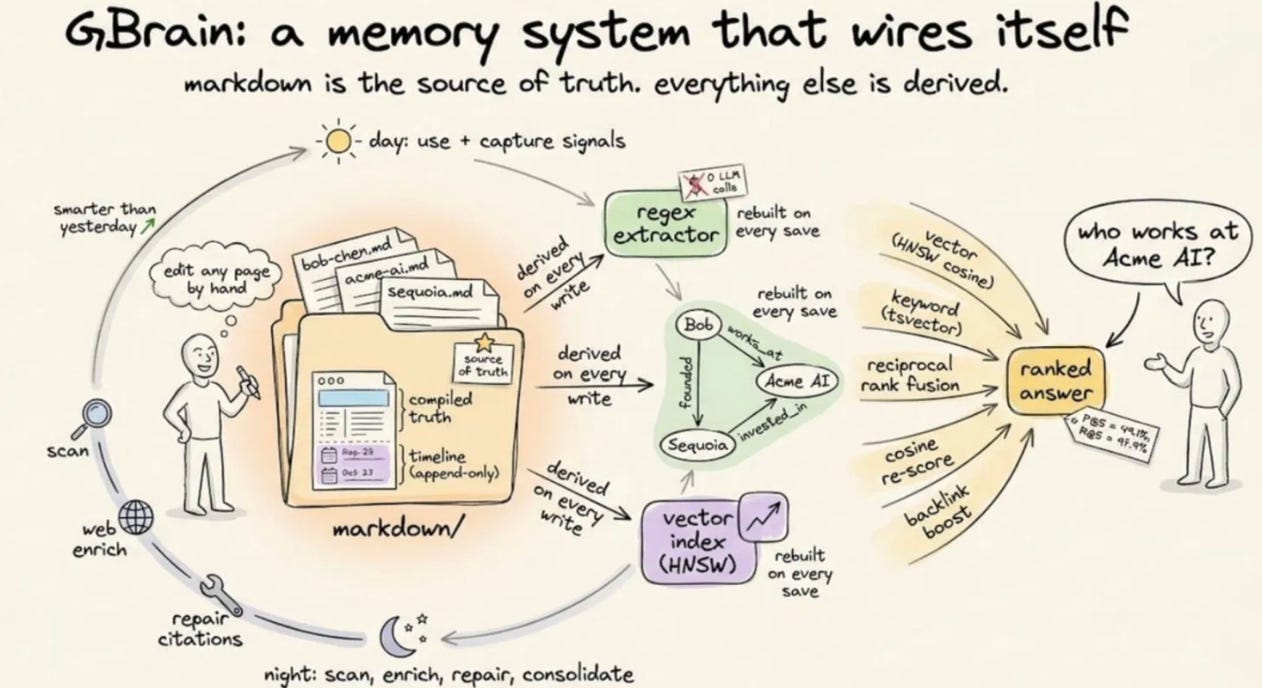
At night it runs a maintenance cycle on everything that came in. It updates what it thinks it knows when new information contradicts the old. It flags when two things you saved say different things about the same topic. By morning the pages are current.
When you ask it something, it searches those pages. Your pages. The ones built from your actual conversations and reading. Then it writes you an answer with a citation back to the exact source it drew from. If it does not have the information, it says so. It never guesses.
Every AI tool you have used knows the internet. GBrain knows your life.


I have been covering how this category evolves. Karpathy’s autoresearch was the first version that felt genuinely different. Then his wiki pattern. Karpathy’s system stored what you put in. GBrain builds its own understanding of what you put in. That is a different thing.
2. One Install. Then It Grows Every Night.
GBrain runs inside Hermes Agent or OpenClaw on Telegram. It does not work standalone. If you have not set up Hermes yet, start there first: [link to Hermes setup].
Once Hermes is running:
bun install -g github:garrytan/gbrain
gbrain init --pglite
gbrain skillpack scaffold --all
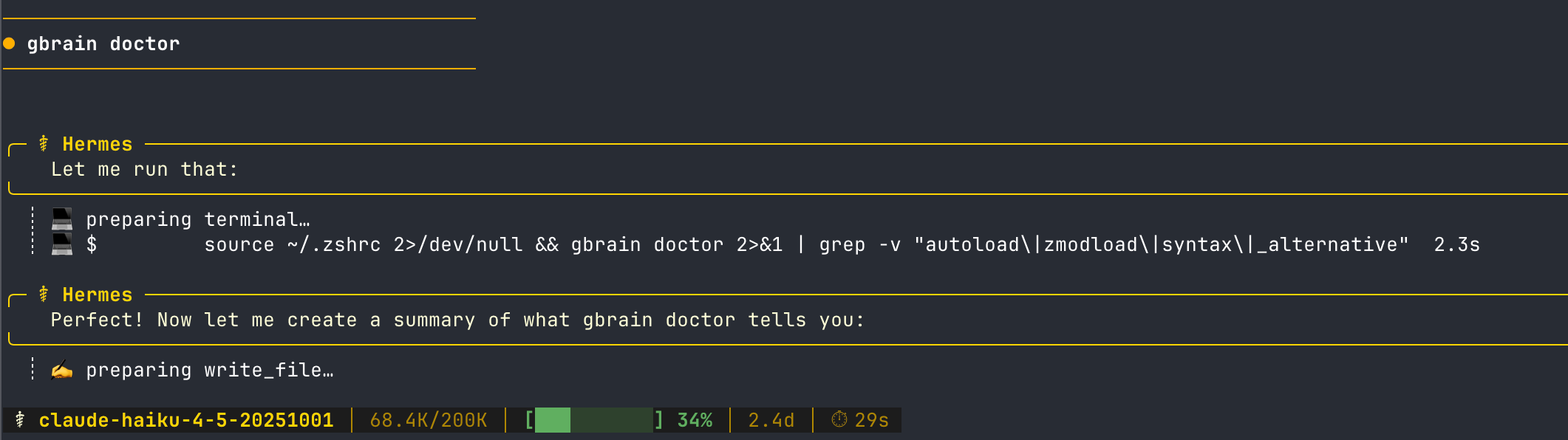
gbrain doctor
gbrain doctor shows a health score out of 100. A healthy brain scores 70 or above.
Install the night cycle before anything else:
gbrain autopilot --installWithout this, the brain stops growing after you close Hermes. The autopilot schedules an overnight maintenance run that updates pages, repairs citations, and flags contradictions between sources. This is what makes it compound.
gbrain integrationsFind the meeting-sync recipe. Every call you have from that point gets added to the brain automatically. Every person gets a page. Every topic discussed gets a timeline entry.

The brain starts empty. From the first message you send to Hermes, the signal detector starts filing. You mention someone. Their page starts building. You describe a decision. It gets filed in your exact words. You share a link. It becomes a brain page with analysis. You do not have to do anything deliberately. Just talk to Hermes normally.
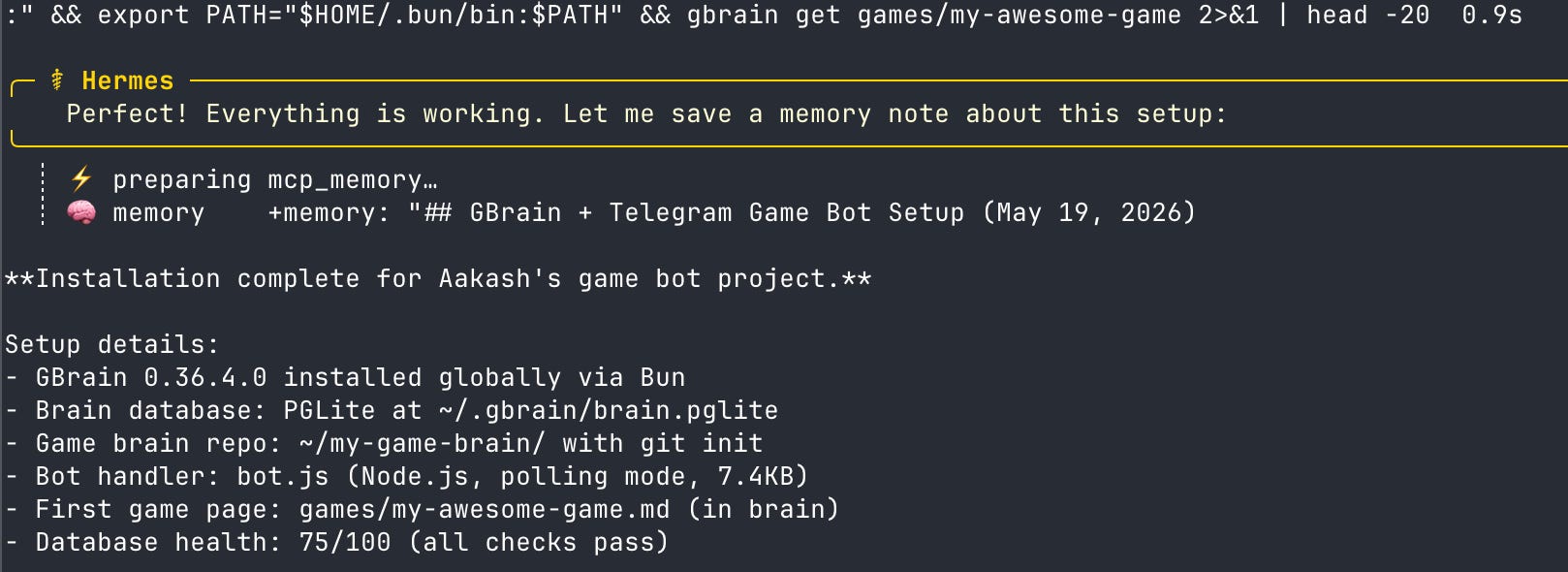
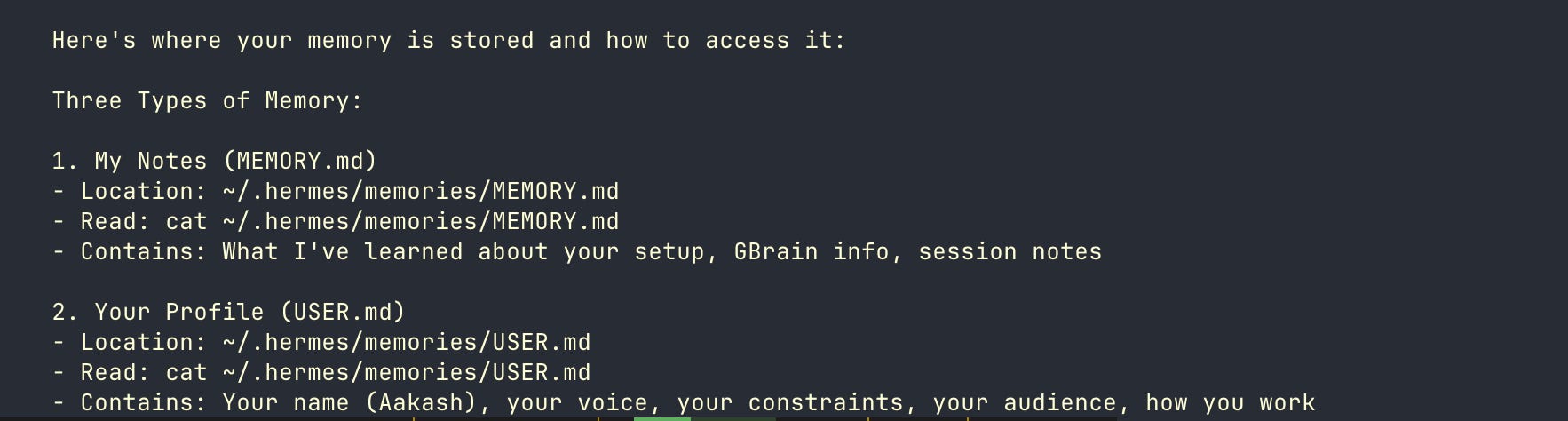
By week two the brain has enough density to start returning useful answers. The outputs in this post reflect three weeks of normal use.
3. Three Things That Change When It Runs
The prompts below are the exact messages to send Hermes on Telegram. Run them from week two onward.
Use Case 1: The Shopping Agent That Already Knows You
Every time you shop for something you explain your preferences from scratch. GBrain builds a preference profile from your natural conversations. You mention you loved a jacket. Filed. You say you are done with fast fashion. Filed. You describe the running shoe that destroyed your knees. Filed. Three months later you ask what you already know.
Prompt:
“I’m looking for a new everyday bag. Based on everything I’ve said about how I work and travel, what should I actually be looking for?”
What comes back:
Every constraint you have mentioned across every conversation: the things that have broken, the sizes that have not worked, the material you said you were done with, the feature you said you wanted to try next time. Synthesised and cited.
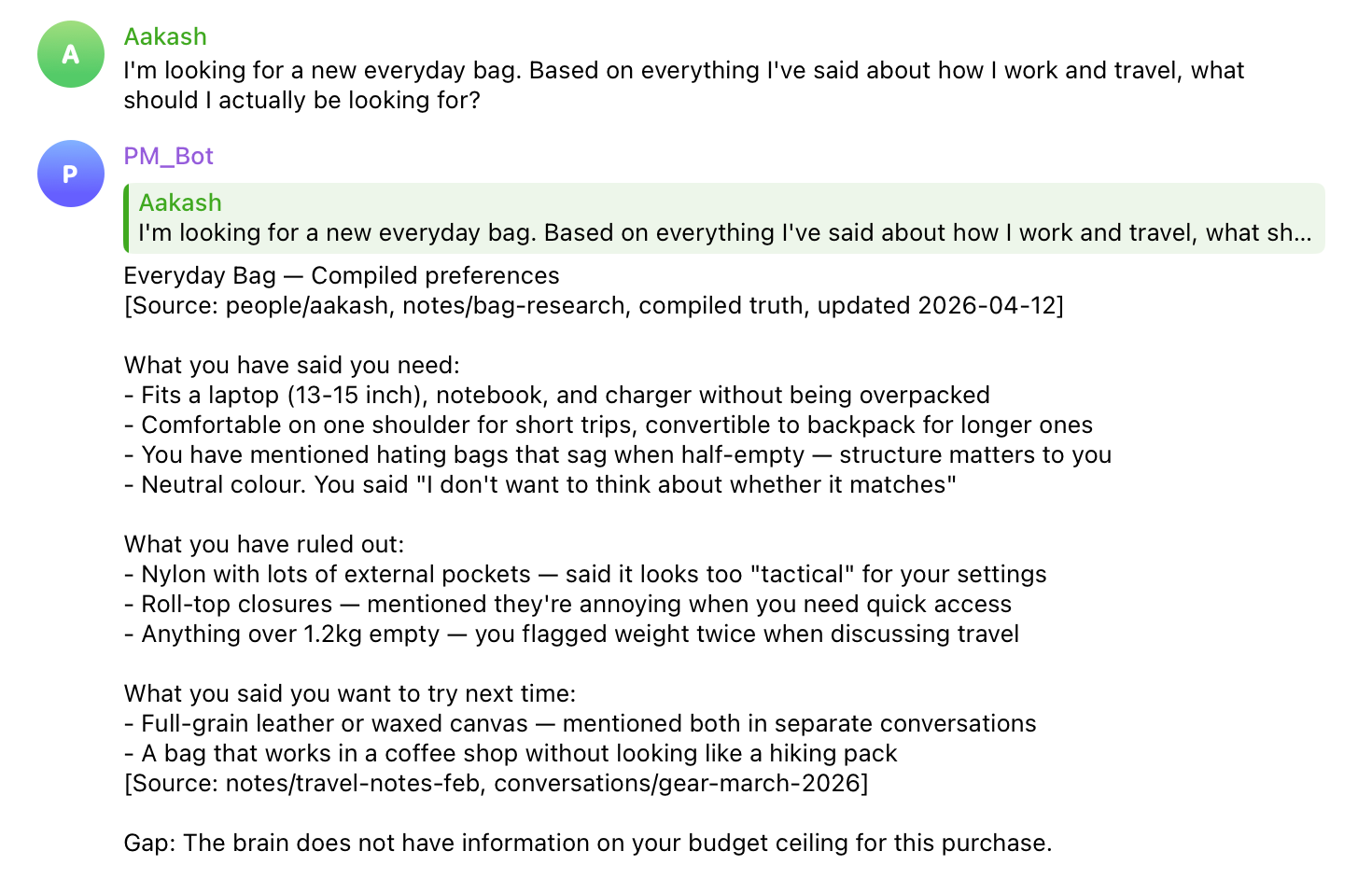
You are not describing your preferences again. You described them once. The brain kept them.
More prompts to run:
“What have I said I hate about bags I have owned?”
“I loved the last [jacket / shoes / bag] I bought. What did I say made it work?”
“What did I rule out last time I was shopping for [item] and why?”
Use Case 2: When You Have Been Reading About Something for Weeks and Cannot Synthesize It
You have been following the AI agent space for two months. Demos, threads, papers, conversations with people building with it. The signal is real but it is scattered. You have tabs open from six weeks ago. Notes that do not connect to each other. No clear picture.
The brain has been building one the whole time.
Prompt:
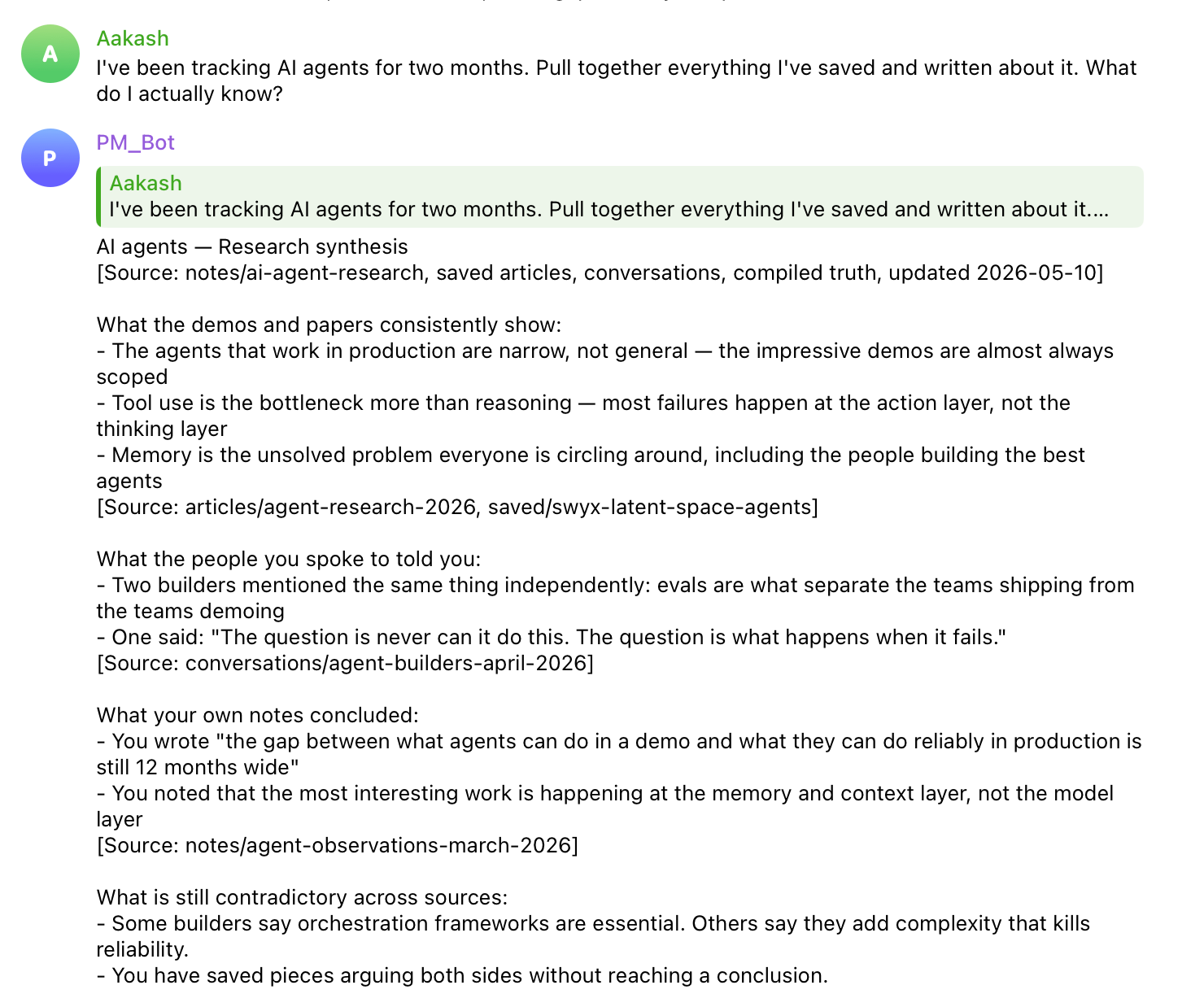
“I’ve been tracking AI agents for two months. Pull together everything I’ve saved and written about it. What do I actually know?”
What comes back:
A synthesis across every page the brain built on the topic. What the demos showed. What the people you spoke to believed. What your own notes concluded. Where the sources contradict each other. All cited.
You already did the research. The brain just never let you lose it.
More prompts to run:
“What’s the gap between what I’ve been reading about AI agents and what I actually believe?”
“What keeps coming up every time I research [a new space I’m following]?”
“What did I conclude and then stop acting on?”
Use case 3: The Conclusion You Keep Losing and Re-Deriving
Three years ago you figured out you do your best thinking before 9am with no meetings. It took you two years to get there. You have since let it erode. Every six months you rediscover it and start protecting the mornings again. Then it erodes again.
That conclusion lived in three different notebooks, a deleted app, and a journal you no longer use. It was never searchable. You keep re-deriving the work you already did.
GBrain holds it. The reasoning, the evidence, the date you figured it out.
Prompt:
“What have I figured out about how I work best? I know I’ve mentioned this before.”
What comes back:
Every insight you have mentioned about your own patterns, pulled from across every conversation. Ranked by how often the same conclusion appears in different places. The brain returns the evidence that built it, not just the conclusion.
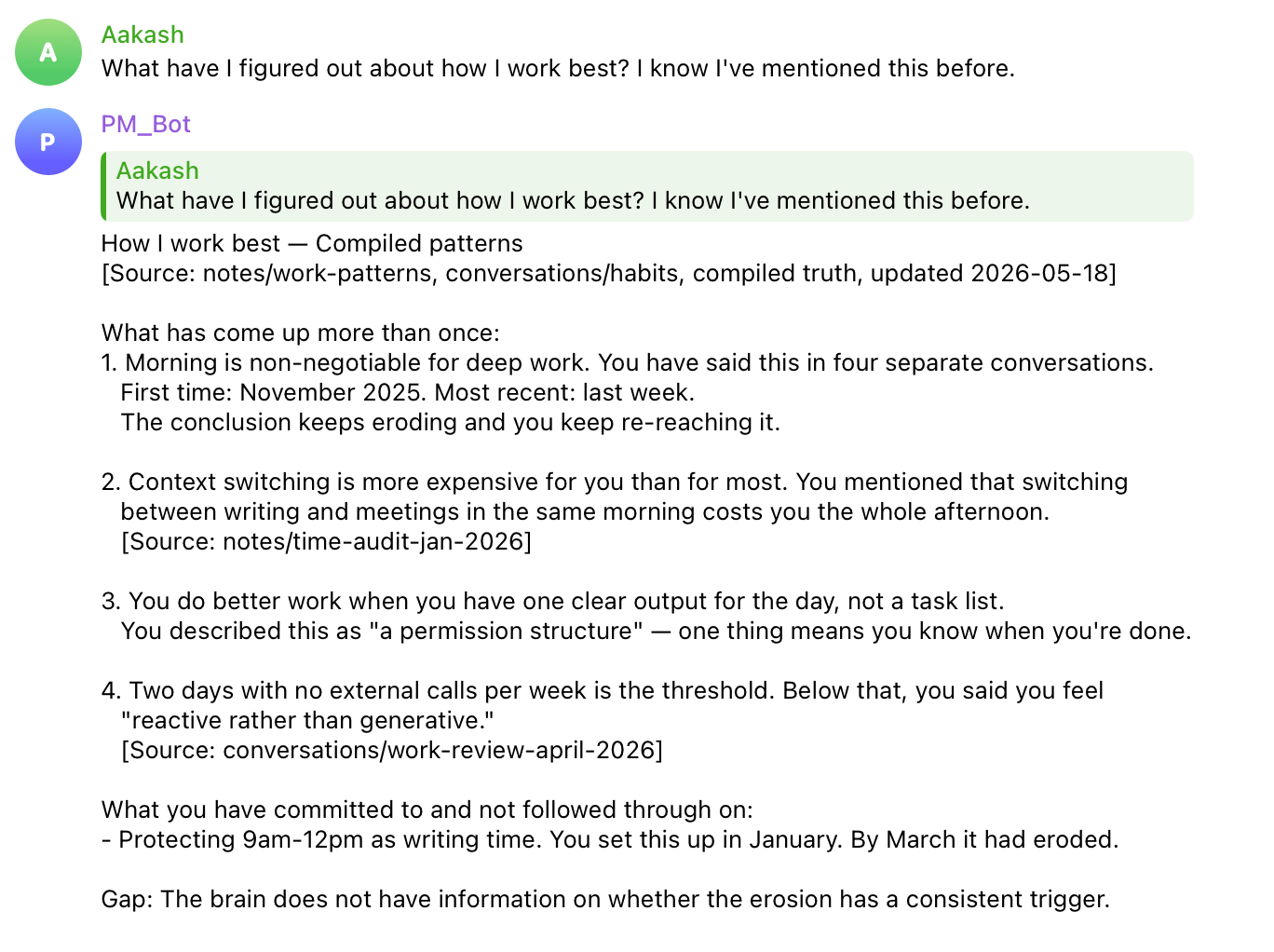
The insight you keep rediscovering becomes something you only had to discover once.
More prompts to run:
“What patterns have I noticed about the decisions I end up regretting?”
“What did I figure out about my energy levels that I keep ignoring?”
“What’s something I told myself I would do differently that I still haven’t?”
4. The Ideas Your Notes Are Hiding From You
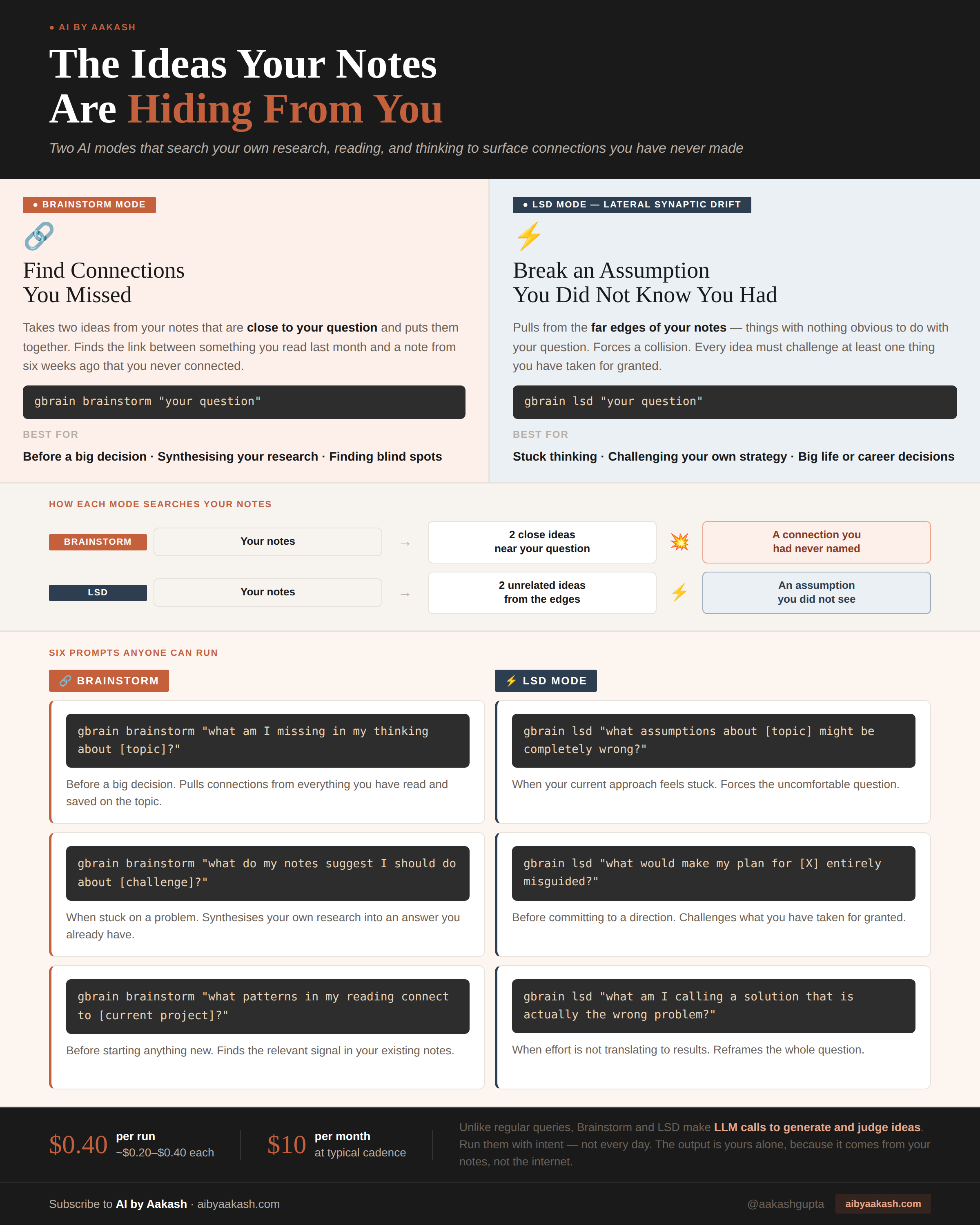
Think of your brain as a library of everything you have ever read, saved, and thought. Brainstorm mode takes two ideas from that library that are close to your question and puts them together. It finds the connection between a note you wrote in February and an article you saved in October that you never put in the same sentence. The brain had.
LSD mode, Lateral Synaptic Drift, pulls from the far edges of your library. Things that have nothing obvious to do with your question. It forces a collision. Every idea must invert at least one thing you have taken for granted. The judge in the source code rejects anything too obvious.
I ran brainstorm before making a decision I had been circling for two months. It returned a connection between something a friend said in a conversation I had ingested and a conclusion I had reached about my own work patterns. I had never put those two things in the same sentence. It took four seconds.
gbrain brainstorm "what is the thing I keep avoiding in my thinking about [decision I am sitting on]?"
gbrain lsd "what would have to be true for my plan to [X] to be completely wrong?"
Note on cost: both commands make LLM calls to generate and judge ideas. Each run costs approximately $0.20 to $0.40. Run them with intent, once a month or before any significant decision, not casually.
The output is yours alone. Nobody else’s brainstorm searches your notes.
5. Here Is Where I Land
Three weeks in, the thing I did not expect: the brain made me more deliberate. Knowing that every conversation feeds it made me more careful about what I named out loud, what observations I said to Hermes instead of just thinking them. The input got sharper because the output was permanent.
I have covered this category since Karpathy’s autoresearch post. That was the first system that actually compounded knowledge. A wiki retrieves. GBrain reasons from your history.
The people who start building this now walk into next year with two years of thinking they can actually search. The brain gets more useful the longer it runs. Every conversation adds to it. You do not have to tend it.
I wrote a complete PM deep dive that hooks GBrain up to your PM OS over on Product Growth. The paid issue includes agent instruction to make any agent get GBrain’s powers.
That’s all for today. See you next week,
Aakash
P.S. Want my AI tool stack? Join my bundle. Want my job search coaching? Apply to my cohort.
I arrived at the same conclusion a few months ago and built my own memory palace with different infrastructure.
It lives in Supabase (Postgres + pgvector) and stores conversation chunks with Voyage 4 Large embeddings (1,024 dims). Search uses HNSW approximate nearest neighbor lookup, followed by Voyage rerank-2.5 cross-attention reranking for precision, across 17 sources
https://promptedbyeric.substack.com/p/the-blank-page-is-not-deep-work?r=2u5zyx&utm_medium=ios