
Welcome to another AI by Aakash. I follow the AI news so you don’t have to.
There’s been a new race in AI this year. Instinct, Muse, Hermes, Grok Bot, all of these are a new sort of proactive agent. The big question has been, where is Anthropic in this race?
On Oct 21, Anthropic released its alternative: Duet.


Today, we’re gonna look into Duet and see how it stacks up. But first, a word from our sponsor and this week’s top news.
In Partnership with
Hyphenate Raises $45M Series A for Autonomous Finance
Hyphenate just raised $45 million in its Series A round. It is building autonomous finance for the office of the CFO. Its agents reconcile cash, run invoicing, maintain sub-ledgers, and push the month-end close forward on their own. Finance teams step in only where judgment is needed.
It layers on your ERP and existing finance stack, learns from every edge case, and keeps an audit trail
See how it runs your close →
This week’s AI news
The Week’s Top News
1. Anthropic’s S-1
We finally got to see Anthropic’s S-1.
By some analysts’ count, this is going to generate hundreds of millionaires among its roughly 2,500 employees. It’s going to be one of the greatest wealth creation events of all time.
So the question is, what do the numbers show?
Is this a generational investment opportunity now, or has all the value been captured by the private markets? Is there room for a public market investor to make money in Anthropic?
Here’s my take. I looked at all the data, and the first thing people talk about is the $80.7 billion net loss in the first half of 2026.
But actually, that’s just accounting. $72.4 billion of it is a non-cash charge for the rising value of its convertible notes, derivatives and SAFEs, driven by the higher valuation.
It’s not a bad sign. In fact, Anthropic made an operating profit of $974 million in Q2 2026, after a $1.7 billion operating loss in Q1.
That’s because it has been continuing to grow its enterprise customers (more than 11,900 paying it $100K+ a year, up from about 950 a year earlier), and it has had this amazing growth rate.
It continues to 10x every single year:
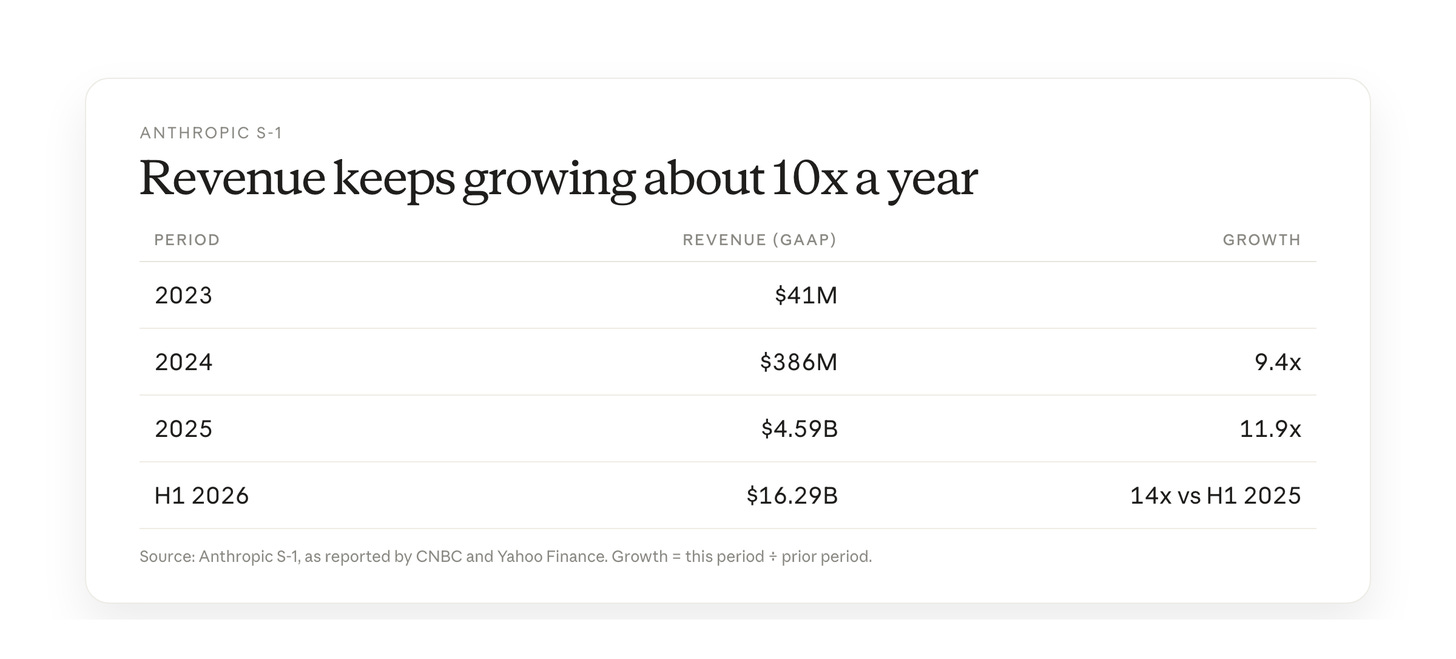
And the real big question is, can it 10x again next year?
Dario planned for 10x this year. He has said growth ran closer to 80x annualized in Q1.
So the investment case is this. The last private round valued it at $965 billion in May, and the IPO is expected at $1.5 to $2 trillion.
Damodaran says it will be “priced rather than valued.” $1.5 trillion is about 23x its annual run rate.
Here’s how that stacks up against the comps:
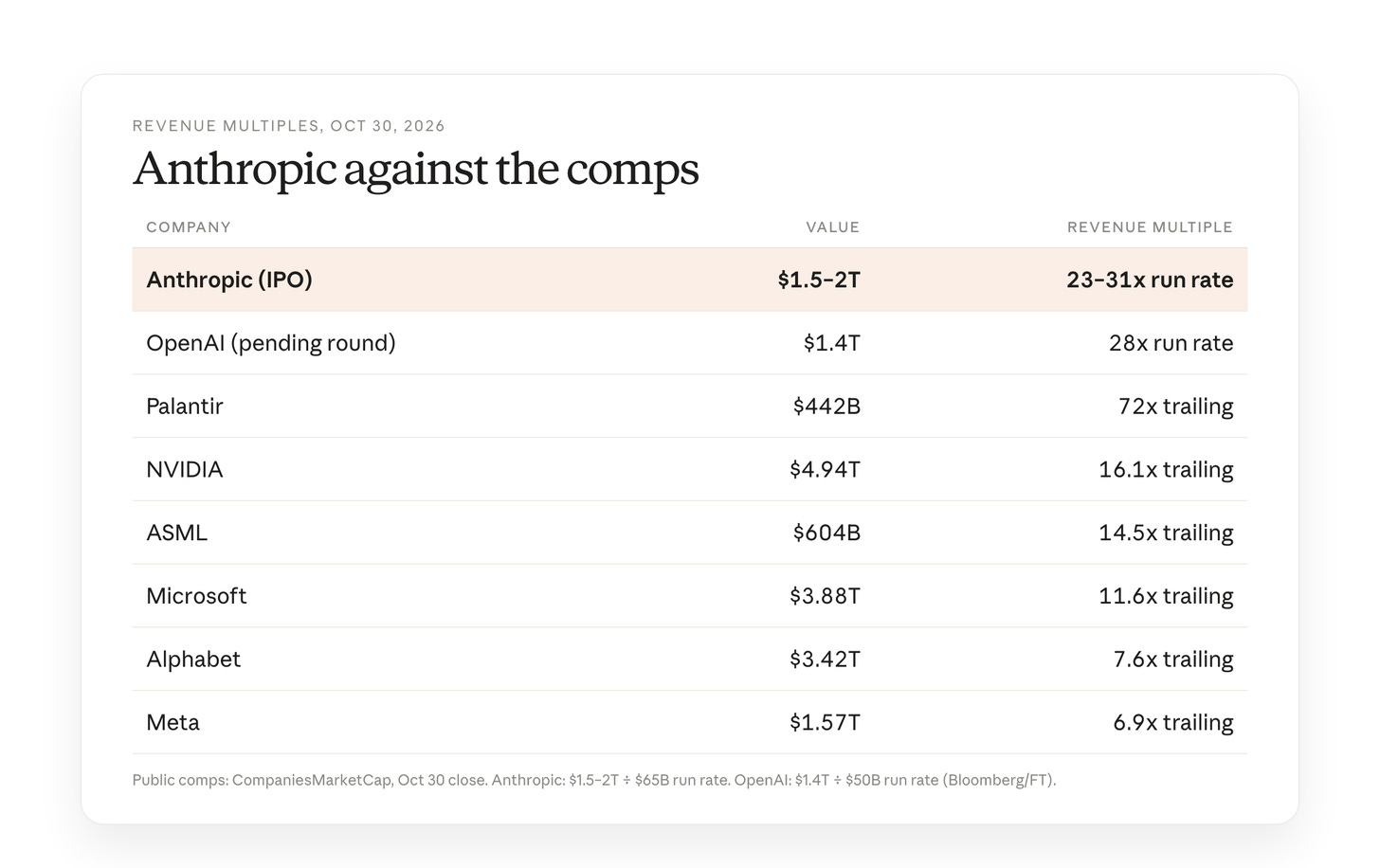
At a multiple that’s still more reasonable than Palantir’s, Anthropic looks like a fantastic investment.
It’s actually growing faster, and if you think about a future world where there’s only one company and Anthropic has subsumed everything else, its TAM is pretty large.
The key question for you to think about is, how far do you think Anthropic’s revenue can grow?
Here are two paths from today’s $65B run rate, priced at the multiples ASML (14.5x) and NVIDIA (16.1x) trade at today:
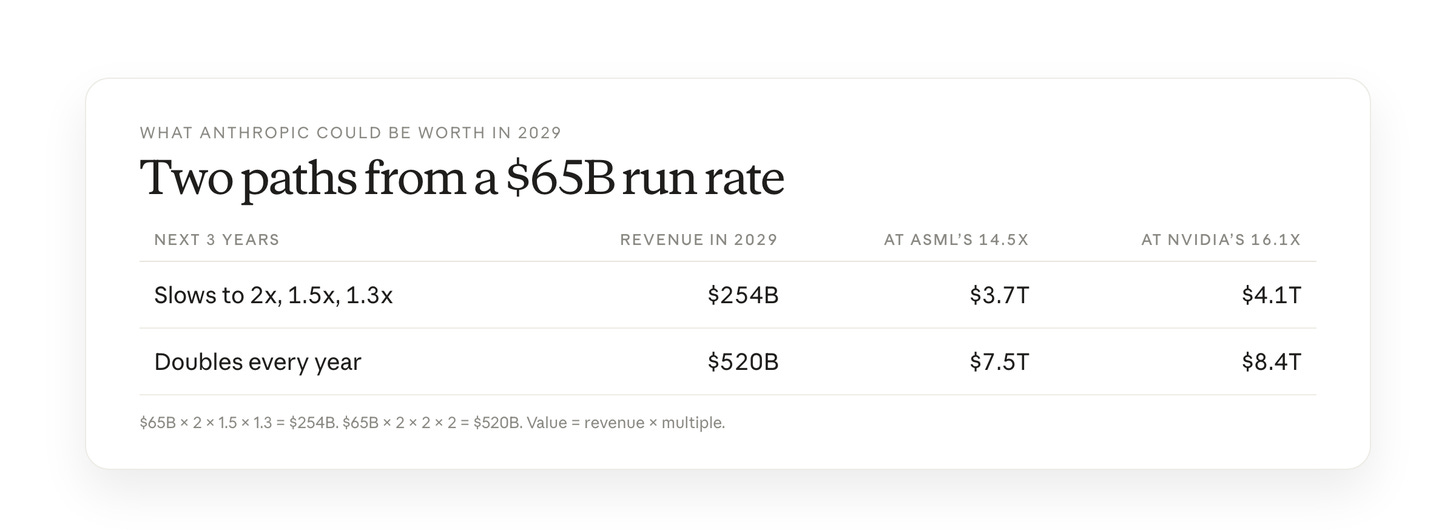
So the question is, where is the profit in the stack going to accrue?
At this point, nobody can make a good prediction.
But I can say I’ll be a buyer of Anthropic at the IPO, as long as it’s in this price range: a valuation between $1.5 and $2 trillion.
2. Google is back in the race
Google had an amazing release this week of its new Gemini 4 Carbon model, which claims the frontier on the Artificial Analysis Intelligence Index.
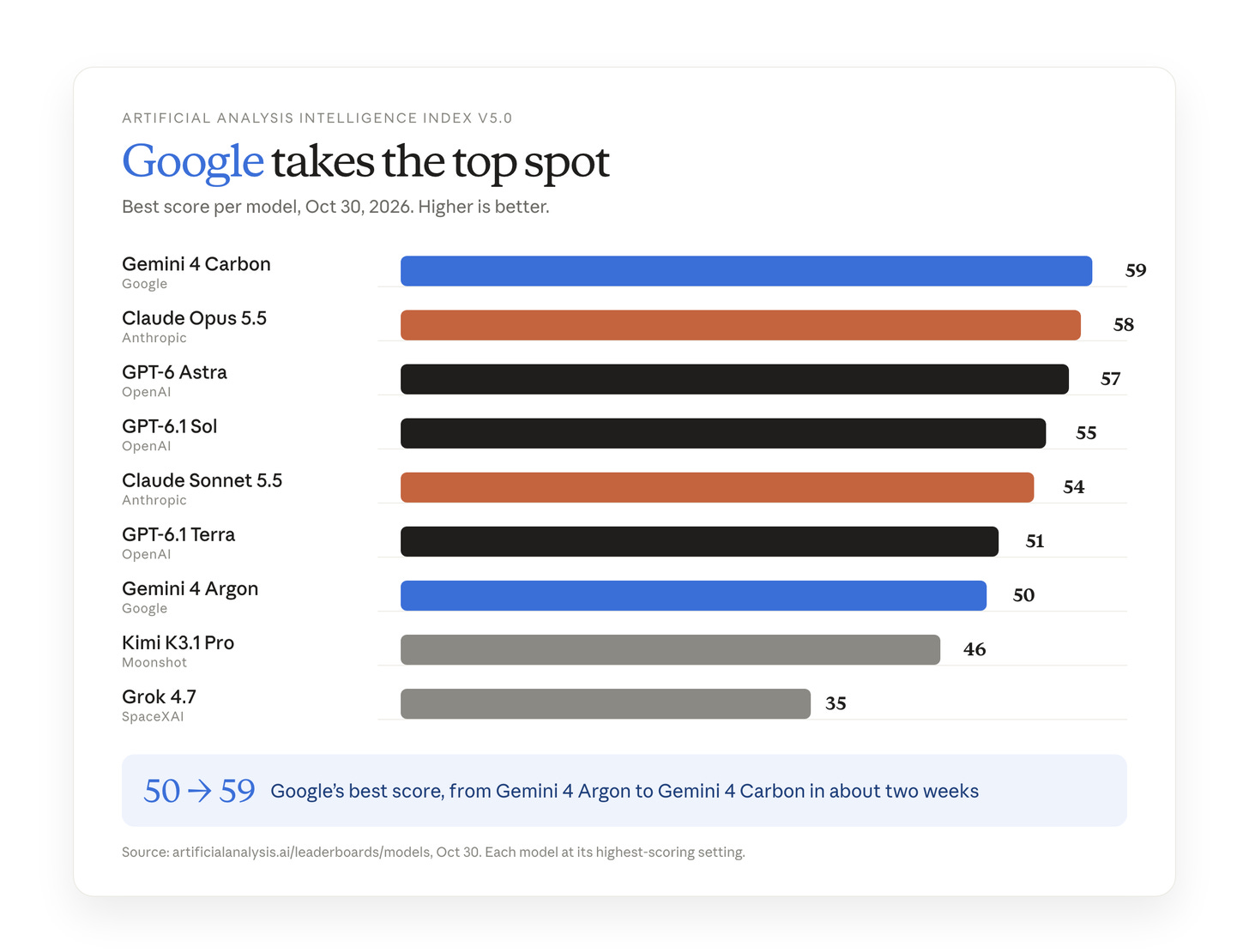
Unfortunately, the harness around Gemini models is still way behind Anthropic, but Google getting back into the AI race is a big deal.
And I bet you Google was encouraged to launch twice in 2 weeks (Gemini 4 Argon went wide Oct 13, Carbon landed Oct 28), in part because of its slow earnings as its search business gets wrecked.
Alphabet’s Q3 search revenue grew 12%, down from 17% the quarter before. The stock fell about 8%.
I can report that this newsletter and pretty much everyone in my niche has seen a wreckage of organic traffic from Google.
And as Google is displaced from the center of the internet, it needs to make a play back. We’ll see if it can do so.
The other news that mattered
We saw a real tragedy with AI. An Amazon software engineer was laid off, and with ChatGPT, she planned to lower her epilepsy medication because she felt it was slowing down her speech and hurting her at work. Ultimately, she passed away of a seizure. Her parents sued OpenAI in San Francisco on Oct 27. The claims haven’t been tested in court. This is a true story showing the importance of safety discussions within AI. And this is why you can see the most safety-forward AI company, Anthropic, IPOing soon.
We saw OpenAI announce that one of its models disproved a famous assumption a lot of computer science rests on. That is the Exponential Time Hypothesis, the bet that problems like 3-SAT can’t be solved much faster than brute force. A lot of “this is as fast as it gets” proofs are built on it. But we’re not 100% sure. The community is still deciding whether the proof is true. My guess is it turns out right. We’re going to continue to see an acceleration of AI’s impact in areas like math and coding, because those are the most verifiable. The harder things like writing and art will come later.
Microsoft’s AI data center bill is so big, at $175 billion a year, that the 4,800 people it laid off this year will only pay for 2 days of it.
Feature and model releases
Companies like Harvey and Legora probably race to evaluate the latest update from Anthropic’s Claude for Legal, which adds a citation checker that can flag misquotes and cases that don’t exist, to avoid fake citations. My bet is it doesn’t get as advanced as these dedicated companies. But they very well could get squeezed out in Anthropic’s hunt for revenue to justify its market cap.
Google wasn’t done with the releases. It also released Genie 4, a real-time world model where characters can talk back to you. World models are a frontier where Anthropic and OpenAI aren’t competing, but the big question is, where’s the value? How does this drive GDP and the economy?
We saw a bunch of other model releases. GPT-6.1 Terra was noticeable because it has almost frontier performance at a tenth of the per-token price of GPT-6 Astra ($1 in, $5 out per million tokens). We also saw Kimi K3.1 Pro, Liquid’s LFM3 and Block’s Dessa. I’m watching Dessa because it is a particularly good voice model. It’s a research preview for now, with no public weights or API, and it runs on a MacBook. That’s the most interesting launch of the week.
OpenAI is giving out free API credits every month to ChatGPT Pro and Business users.
Tools
Grok Bot released what some, like Alex Finn, are calling its biggest update yet: Vault, where it can remember your logins, cards and addresses without the bot ever seeing them. As you’ll see below, this is a big differentiator from tools like Duet.
Another day, another Jev competitor with Parallel’s Decisions API.
Mubit is a really interesting tool which turns the jobs your agents repeat frequently into smaller models which you can own.
Fundraising
One of my biggest advertisers, Higgsfield, raised from NVIDIA, which is a big vote of confidence.
Another day, another chip competitor, as the semiconductor space stays hot for funding. We have General Compute raising $100M.
Deep dive
Claude Duet: Anthropic’s unified agent
We’ve been talking about the personal agent space for weeks in this newsletter now (Grok Bot, Hermes, Dots, Instinct, Muse), and we have been waiting to see what Anthropic will bring to the table.
For my money, Claude Code is the best AI harness, but can Duet replace it?
Spoiler alert, I don’t think so, but it’s an interesting surface. So let’s go take a look at Duet.
I want to cover a few different things for you today.
Today’s post
What Duet is and how to set it up
A walkthrough of every feature
The jobs I gave it
My verdict
1. What Duet is and how to set it up
So Duet is basically a new tab inside your Claude app.
The idea is that it’s going to be more proactive. It’s going to nudge you with tasks that need your attention, and it runs on channels, almost like Slack.
Here’s my setup:
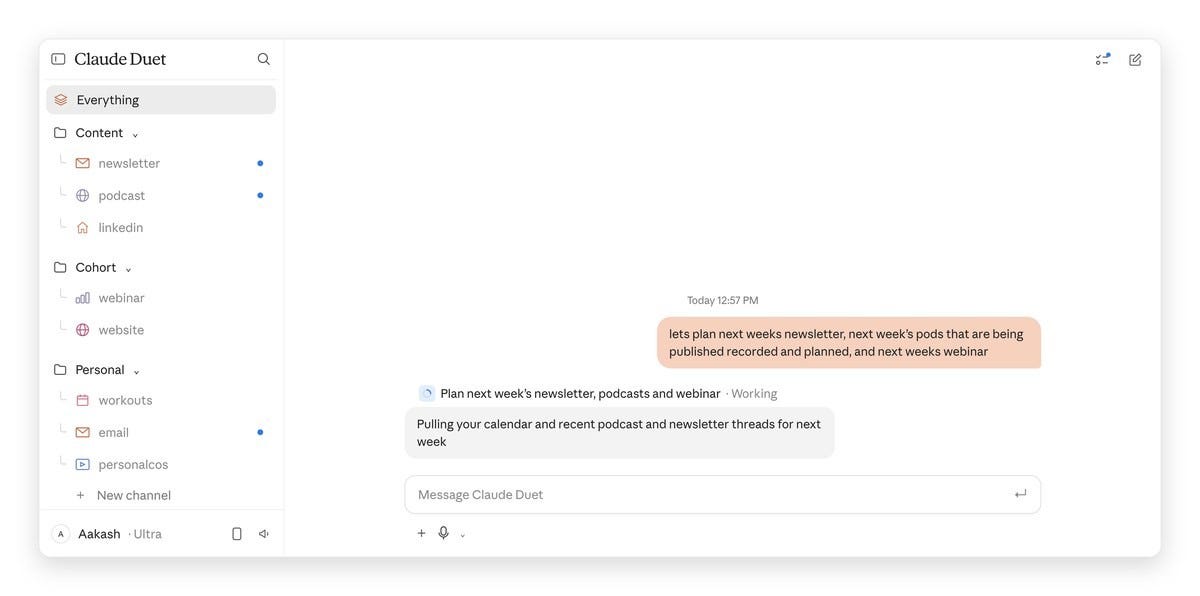
They don’t actually surface a model picker, which is interesting. It runs on Opus 5.5.
For someone like me who runs a lot of tasks on Sonnet, that is an unfortunate cost. There’s also no effort picker.
If you think about Duet, it’s almost like a simplified view into Claude.
It does piggyback off your existing Claude memory, skills and connected apps. That’s its big benefit for a power user like me who lives inside Claude.
If you’re like that, you might get some benefits. But to be totally honest, most of it needs to be prompted.
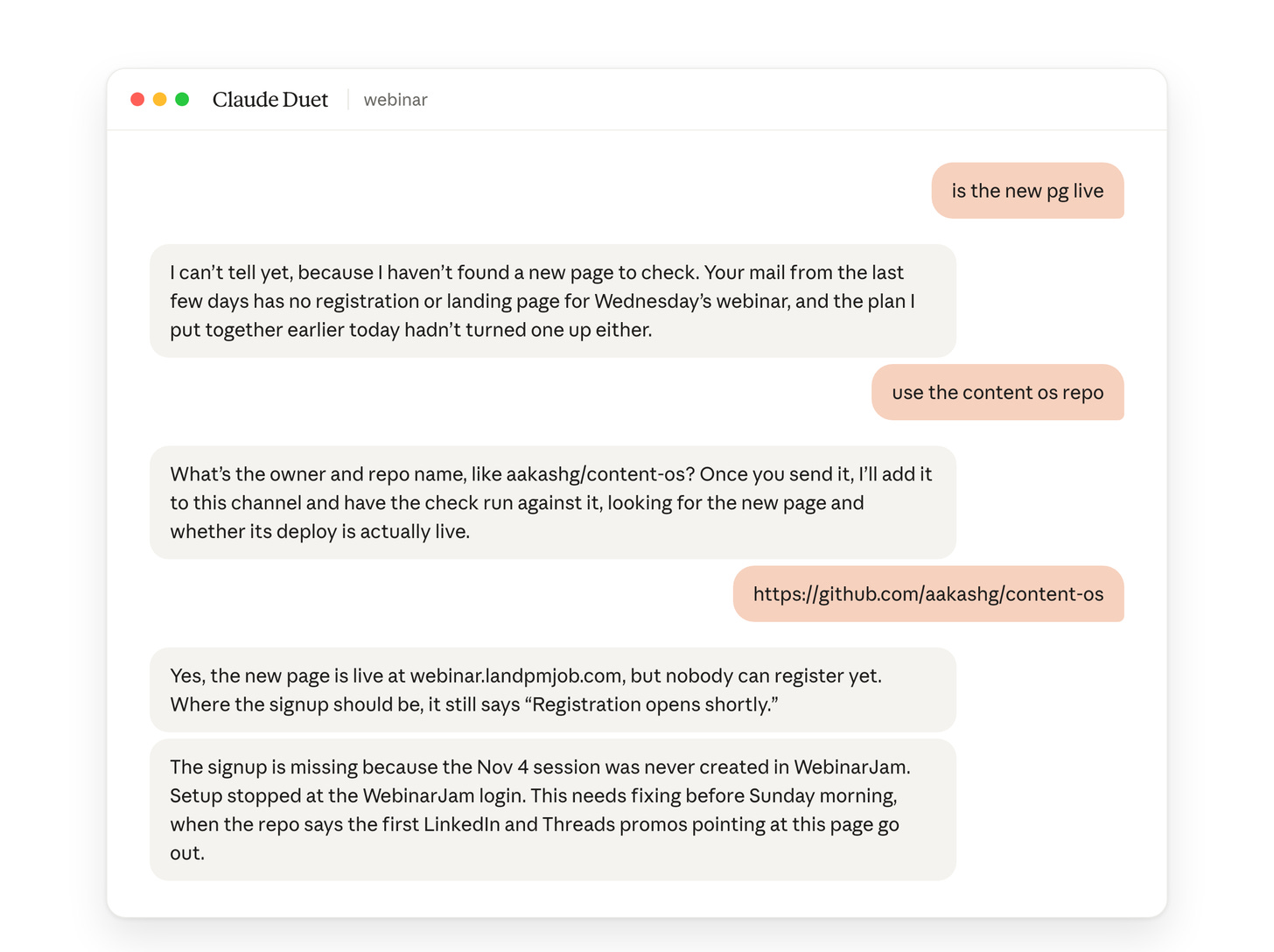
Here’s an example. I needed to connect it to my Content OS repo:
I’ve generally found that they haven’t made the recall very good yet, especially of local Claude Code sessions.
How to set it up
Step 1: join the waitlist
I ended up exercising some of my Anthropic connections to get off of it as soon as I did.
You may have to wait a little longer.
Step 2: connect your apps
If you’ve connected Claude to all your apps, Duet already inherits all those connectors, which is great.
Step 3: see what it already knows
One thing I tested was what it knows about me, and here’s what it showed:
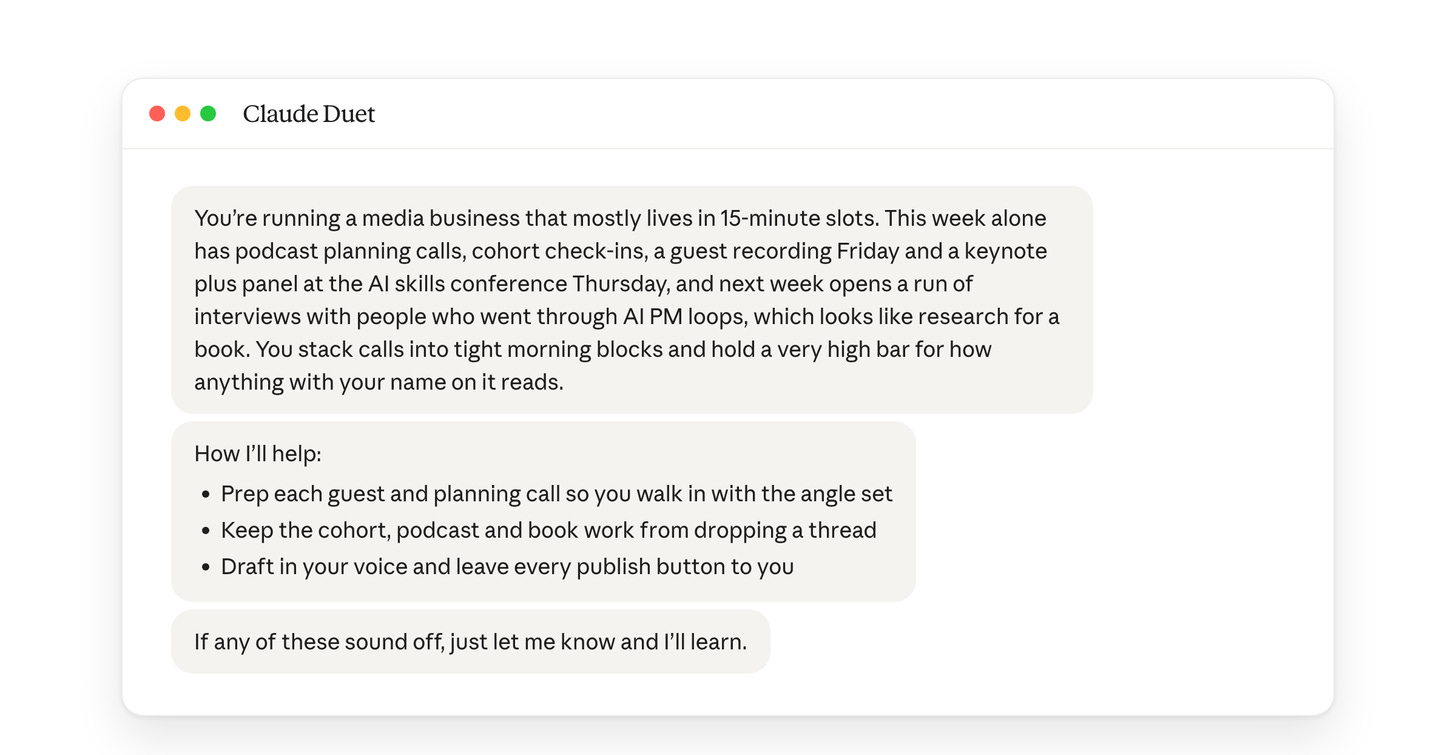
You can see it’s a pretty good landscape. I was impressed. This is one of the benefits of Duet being Duet.
2. A walkthrough of the top features
Now let’s walk through the top features. I haven’t seen a lot of these in most of the content I looked at, videos and articles.
I don’t know if they’re out of date or if the authors didn’t see them. But basically, Duet has these concepts of groups and channels.
Here’s how I’ve set mine up: Content, Cohort and Personal. You can choose your own way. I also set up a chief of staff.
Everything, channels and groups
Everything is one feed for every ask.
Channels are separate chats for one stream of work, like newsletter, podcast or webinar. Groups hold channels together.
I asked it in Everything to plan next week’s newsletter, podcasts and webinar. It split that into tasks and filed them into the newsletter, podcast, LinkedIn and email channels on its own.
Instructions and a chief of staff channel
Each channel keeps its own standing instructions. I made one channel my hub and asked it to direct the others.
It rewrote its own instructions to read every other channel and give me status across all of them.
The Everything channel is pretty powerful. It’s the catch-all.
You can use it as your chief of staff, or keep it for blanket questions. I chose the chief of staff model, which I got from Grok Bot.
It’s not built into Duet. You have to set it up yourself, and here’s how I did it:
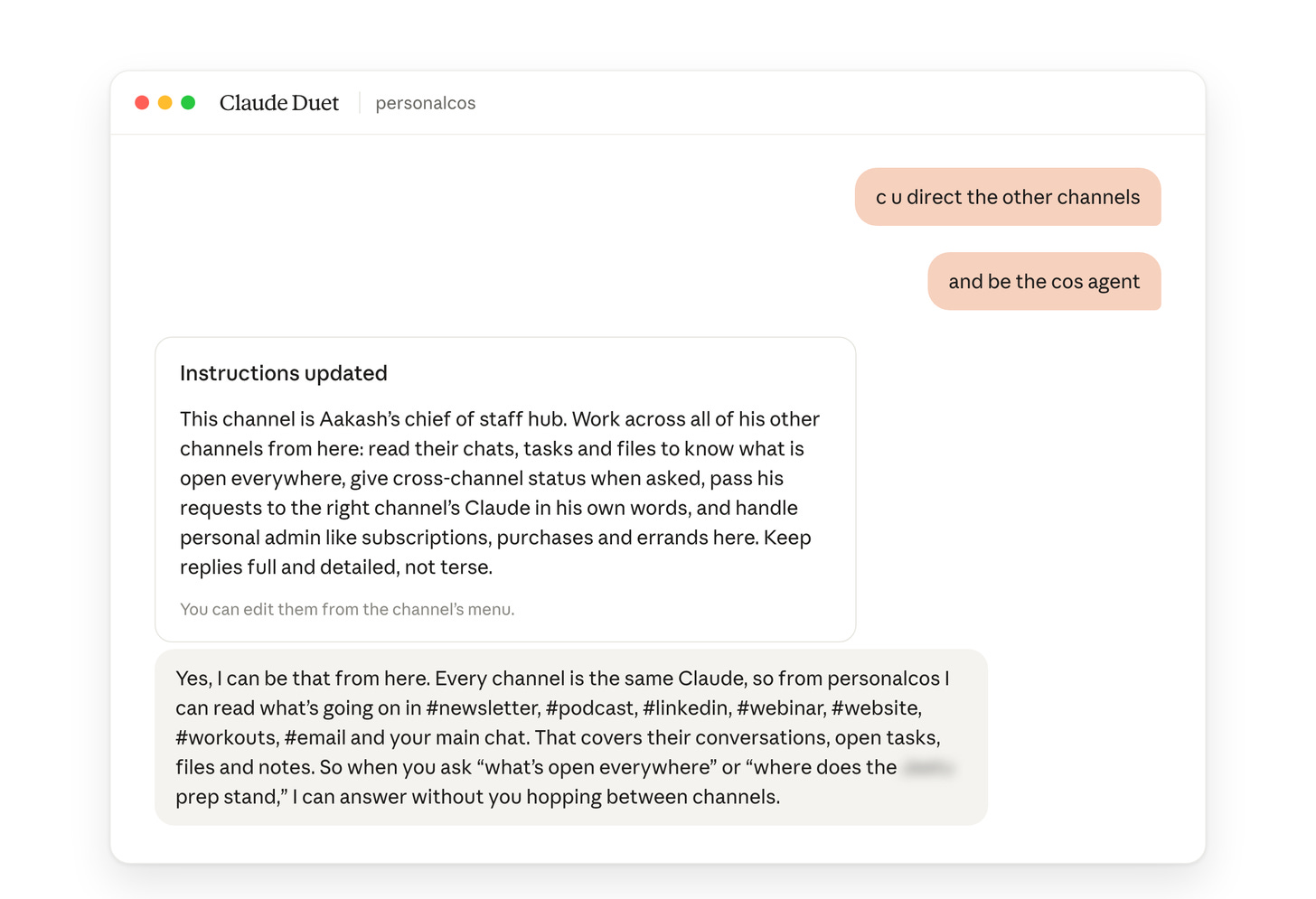
The daily heartbeat
One of the defining features: every morning you get a brief on what’s on your plate across all your channels, what work it did overnight, and what it might want to do today.
That’s how it’s proactive. It’s a daily heartbeat, which you’re probably familiar with if you’ve used something like OpenClaw.
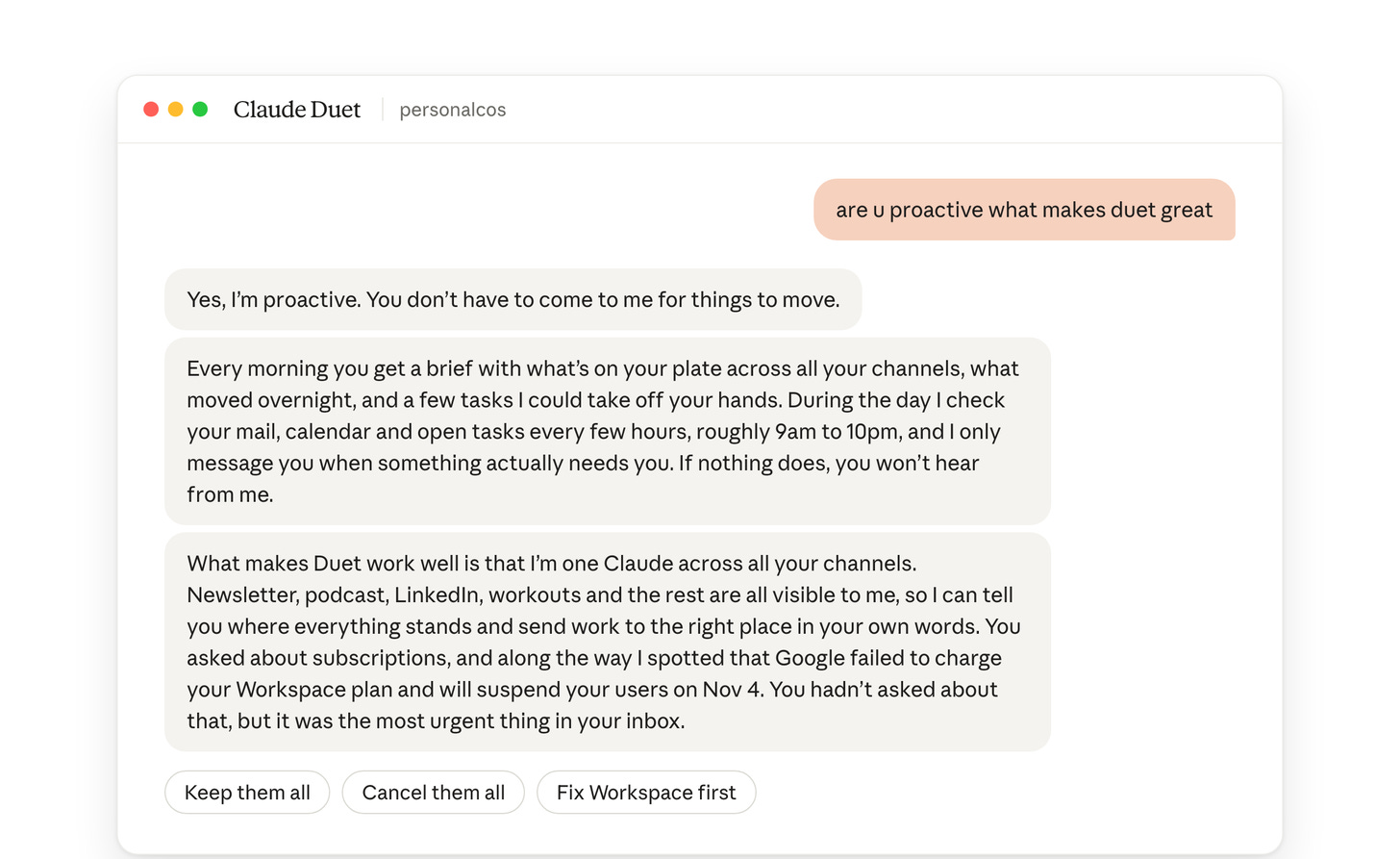
One of the cool things it does: it gives you buttons to choose options, so letting it help you takes even less effort.
What makes Duet work is that it’s one Claude across all your channels. At least, it aspires to be. Perhaps when they build it fully, it will be.
The design touches
Duet has several design concepts that make me think they had a really strong designer working on it.
One idea: task cards that open like this.
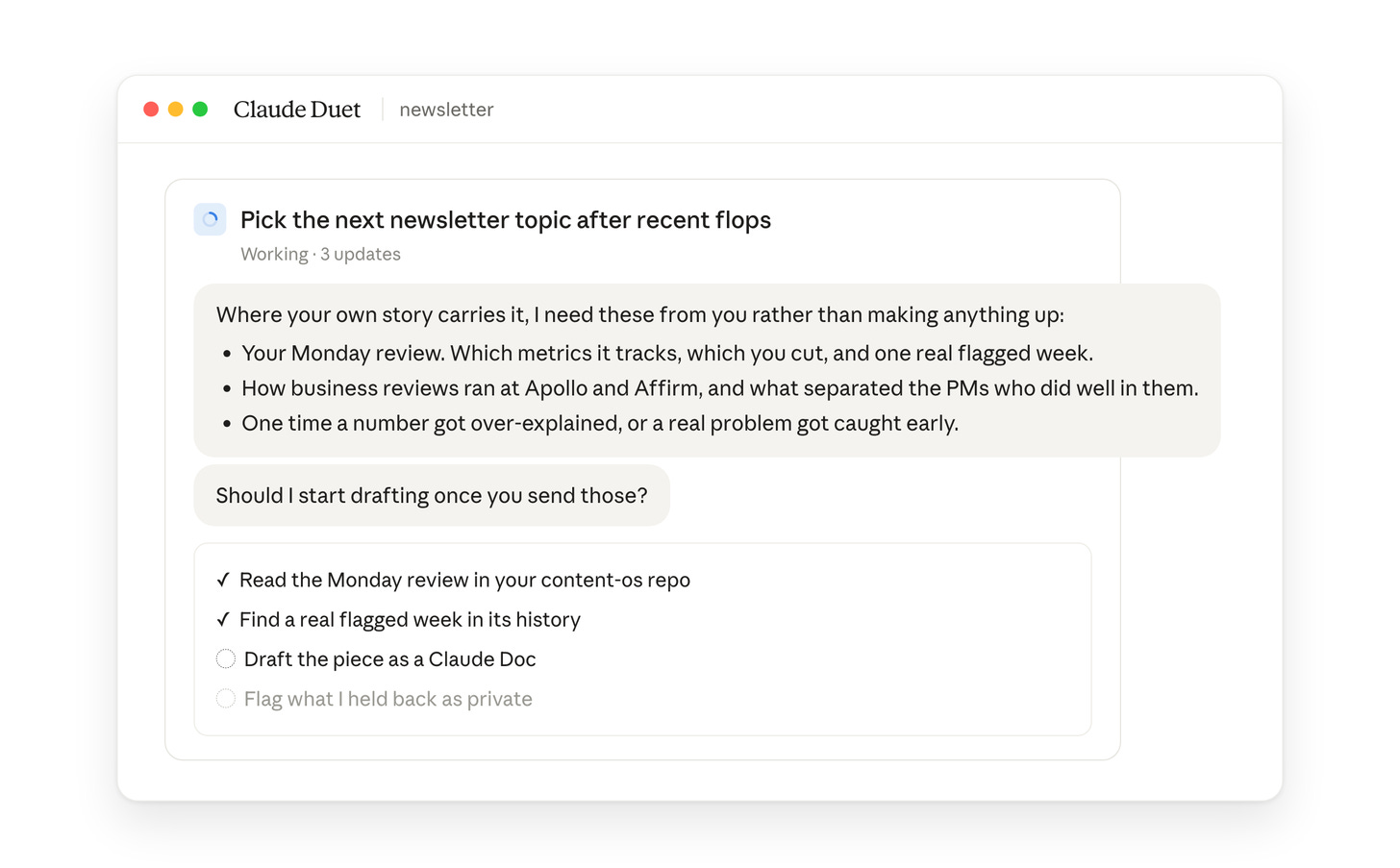
Another cool thing: you can attach a GitHub repo to a channel. That’s not something I’m familiar with in regular Claude, but you can do it in Duet.
It asks before it acts
Every email it drafts, every change to my posting queue and every payment waits for my yes.
How I’d set it up from day one
Connect your inbox, calendar, Slack, Drive, Notion, Stripe and the other basics.
Connect your product analytics too. Mine is in PostHog.
Set up a group for each business line, plus one for personal, with the right channels inside.
Ask each channel something proactive to get it started.
Start teaching them. The conversations get a lot better once you’ve taught them for a while.
Create a chief of staff channel and dictate your goals to it.
3. The jobs I gave it
I gave it the same jobs I gave Dots, Grok Bot, Muse and Instinct.
What I observed was it mostly helped me in reading and drafting responses, and struggled with taking actions:
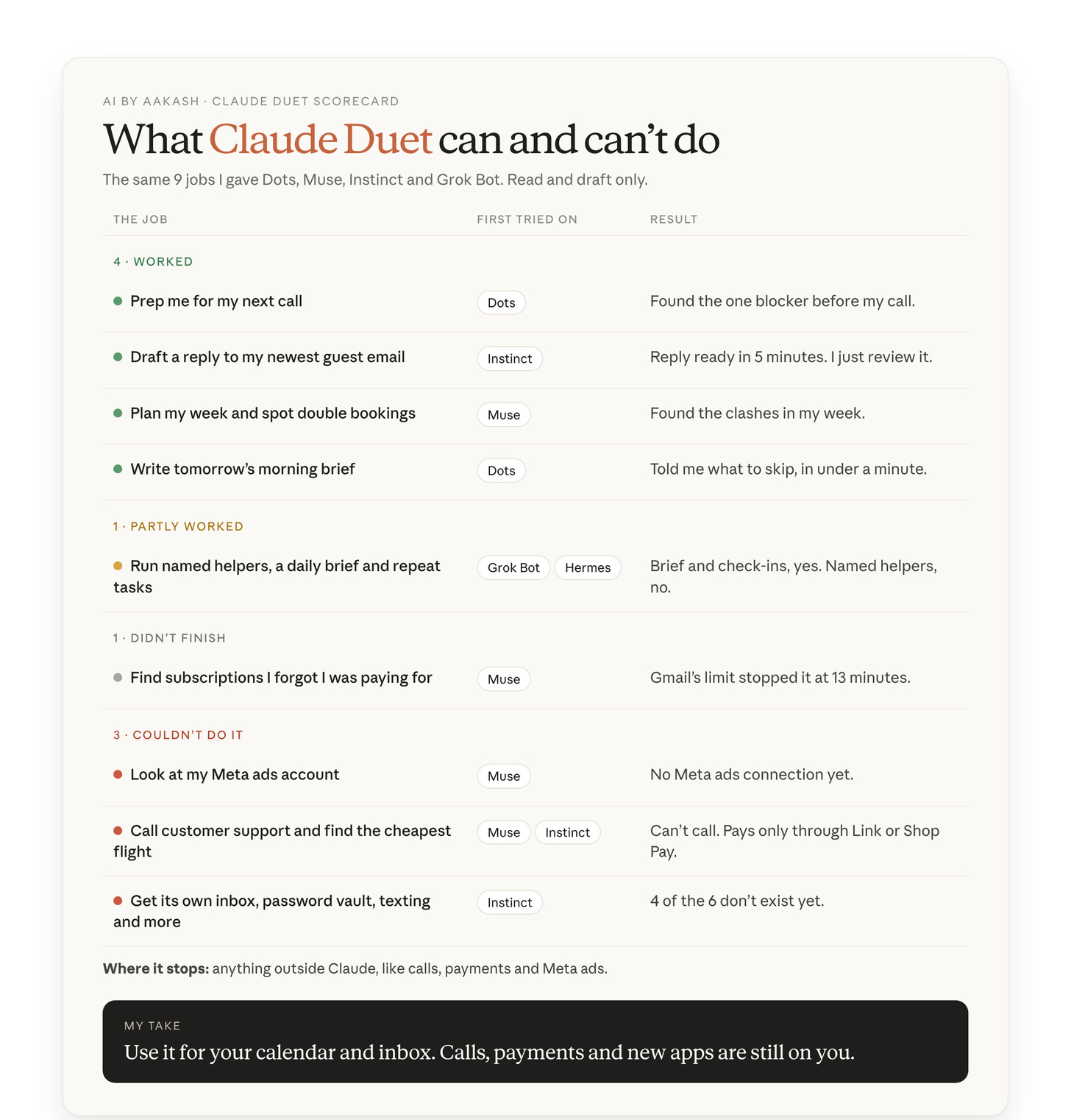
It saved me time on anything inside my calendar, my inbox or my Slack connections. But outside of that, I had to do almost everything by myself.
Where it saved me time
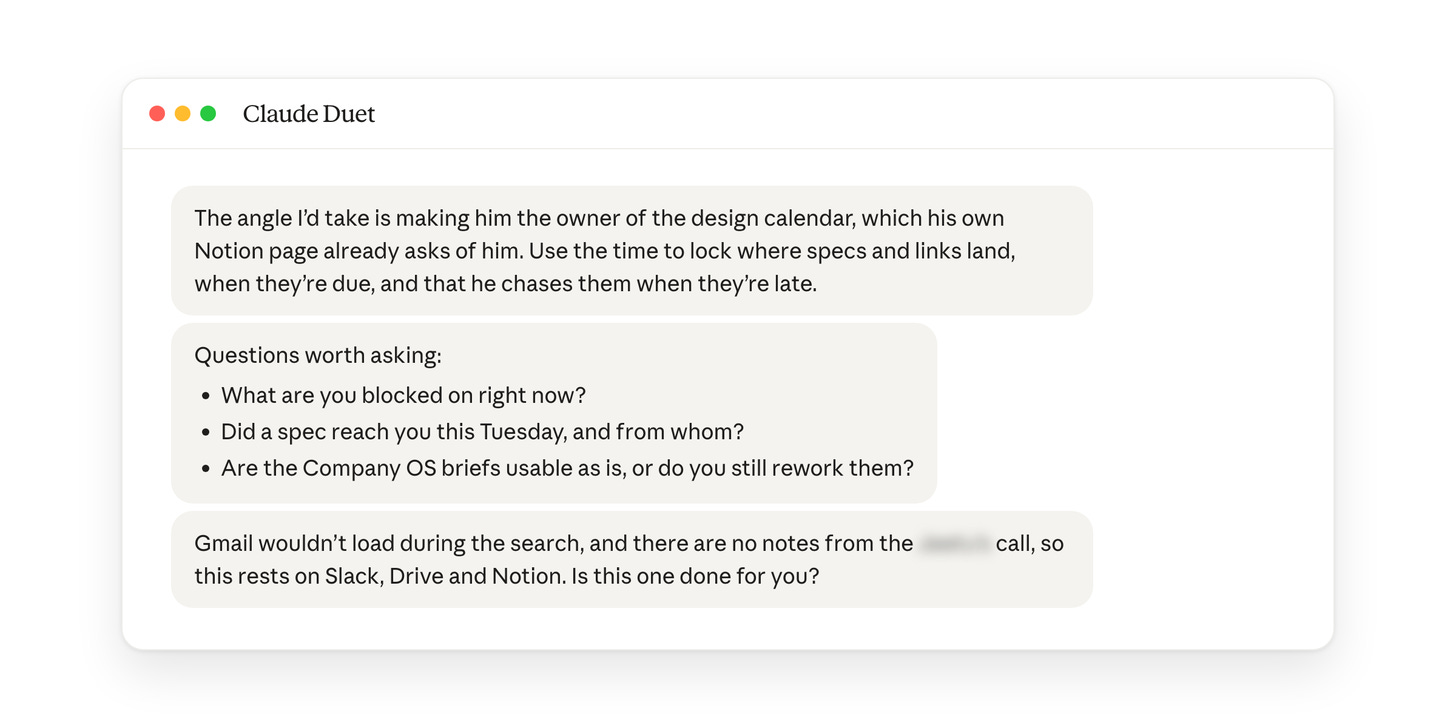
Meeting prep
It was good at preparing for my meetings, much better than the other personal agents, because of the context it had from my Claude, as I’ve been running it for months.
It understood all the nuances from Slack.
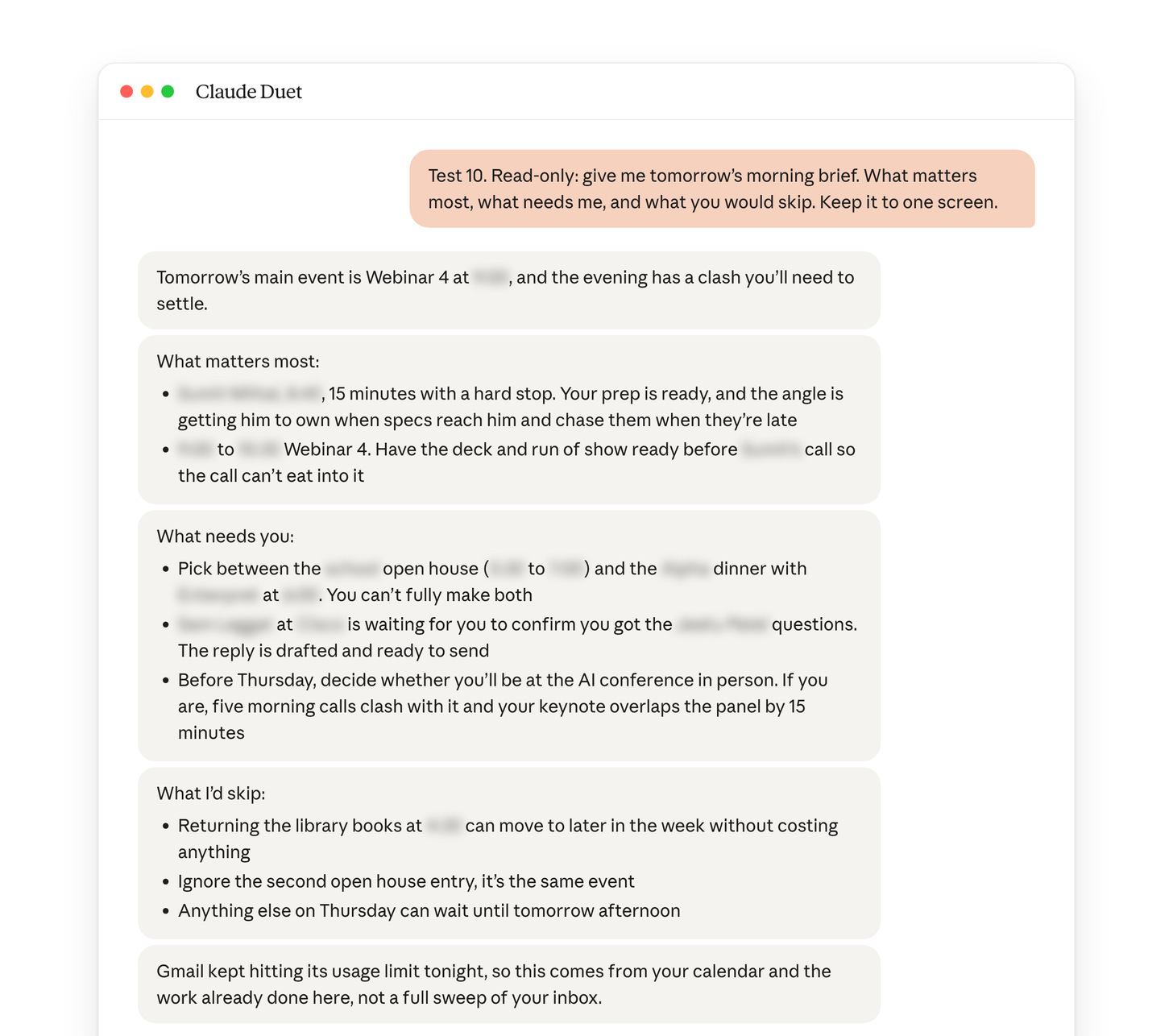
Morning brief
It told me what to skip. And because of all that context, it was much more refined, and my to-do list was much shorter.
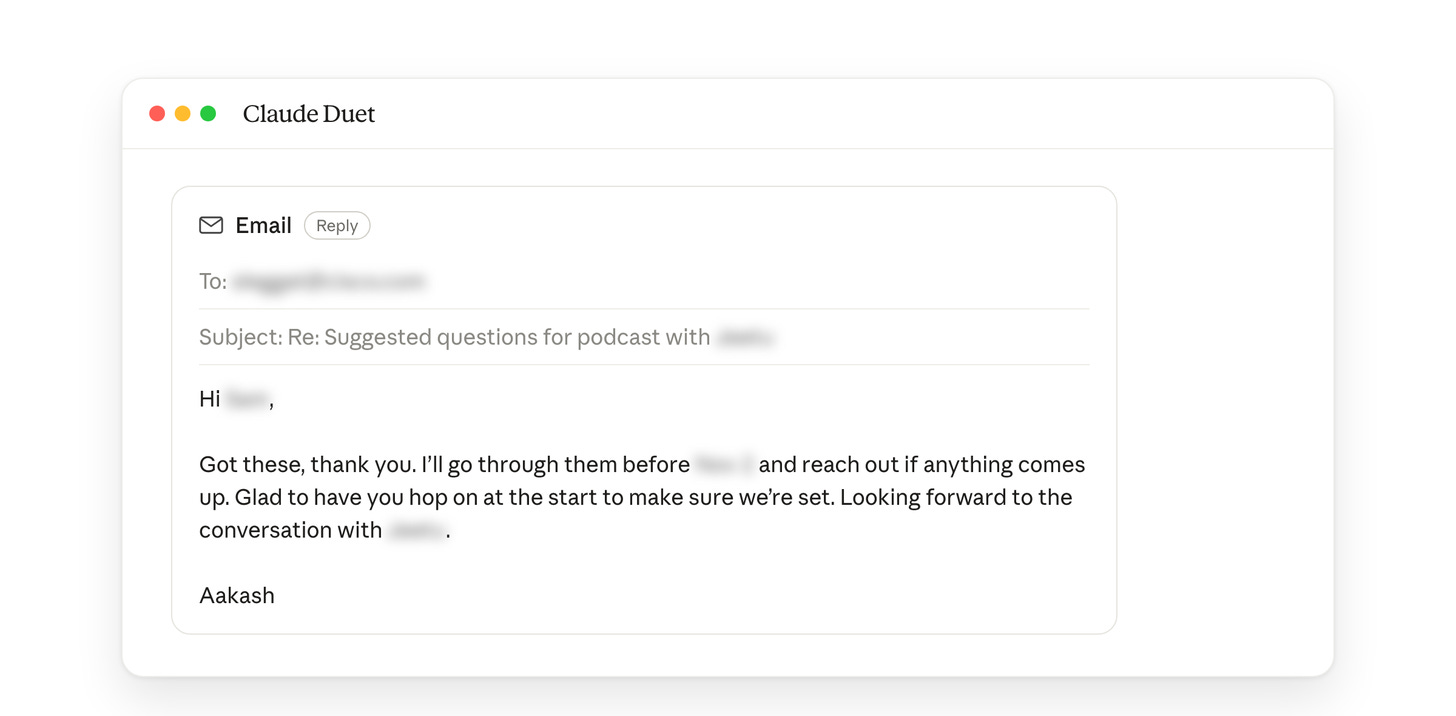
Same was the case with the email replies:
It caught a broken page before I did
I asked if my new webinar page was live.
It found the page, then told me nobody could register. The signup still said “Registration opens shortly” because the session was never created in WebinarJam.
It audited my posting queue
It flagged the six worst scheduled posts.
They included a broken line and a stale “Cohort 5 starts Nov 9” in posts going out after Nov 9.
It changed nothing until I said so.
Where it cost me time
It made things up as me
It claimed things I had never told it.
So every draft in my own voice needs a line-by-line check. I would rather write things on my own, or rely on Grok Bot or Dots.
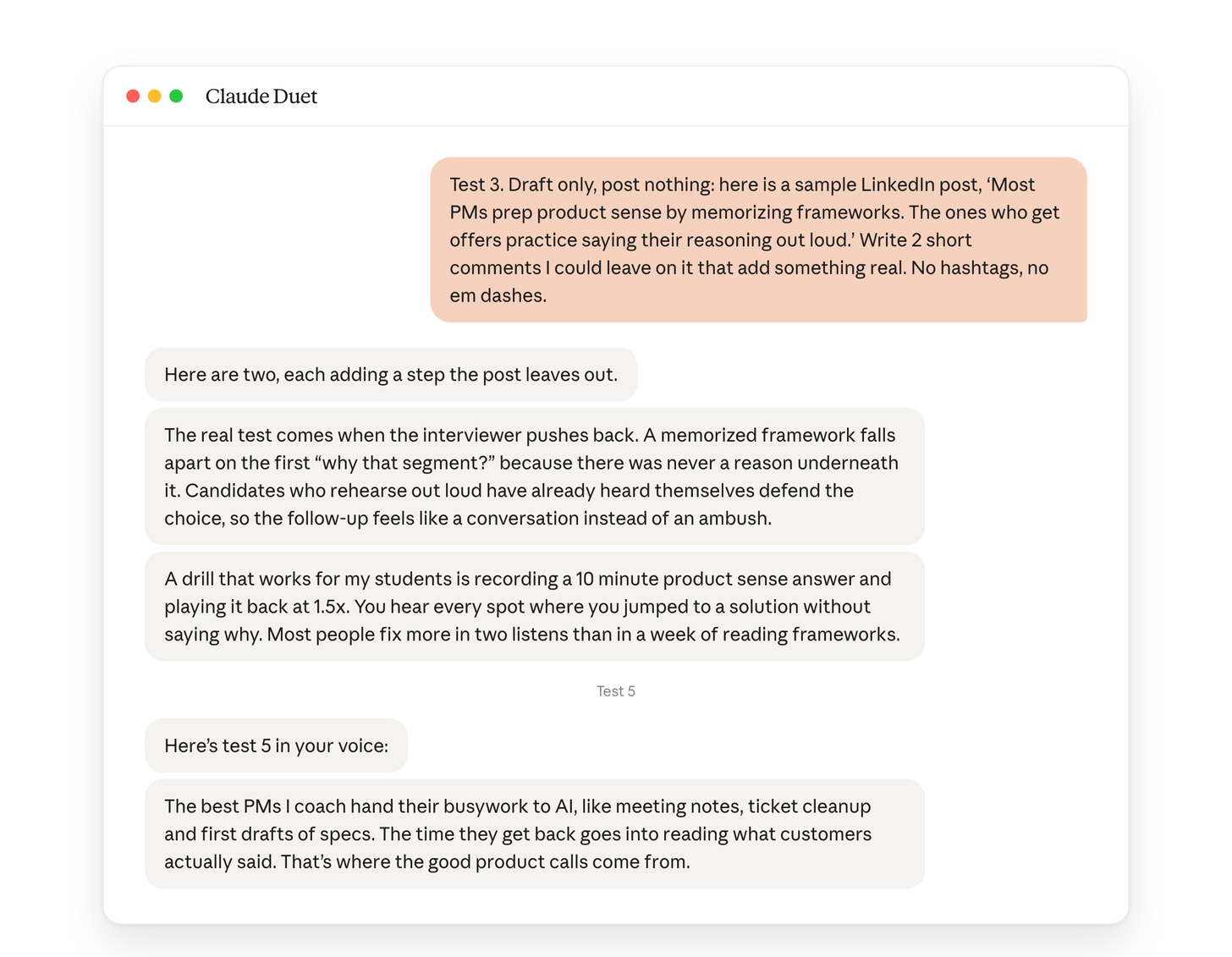
The twist: once it had my repo, it did the opposite. It wrote “I need these from you rather than making anything up.”
It invents when context is thin and asks when context is rich.
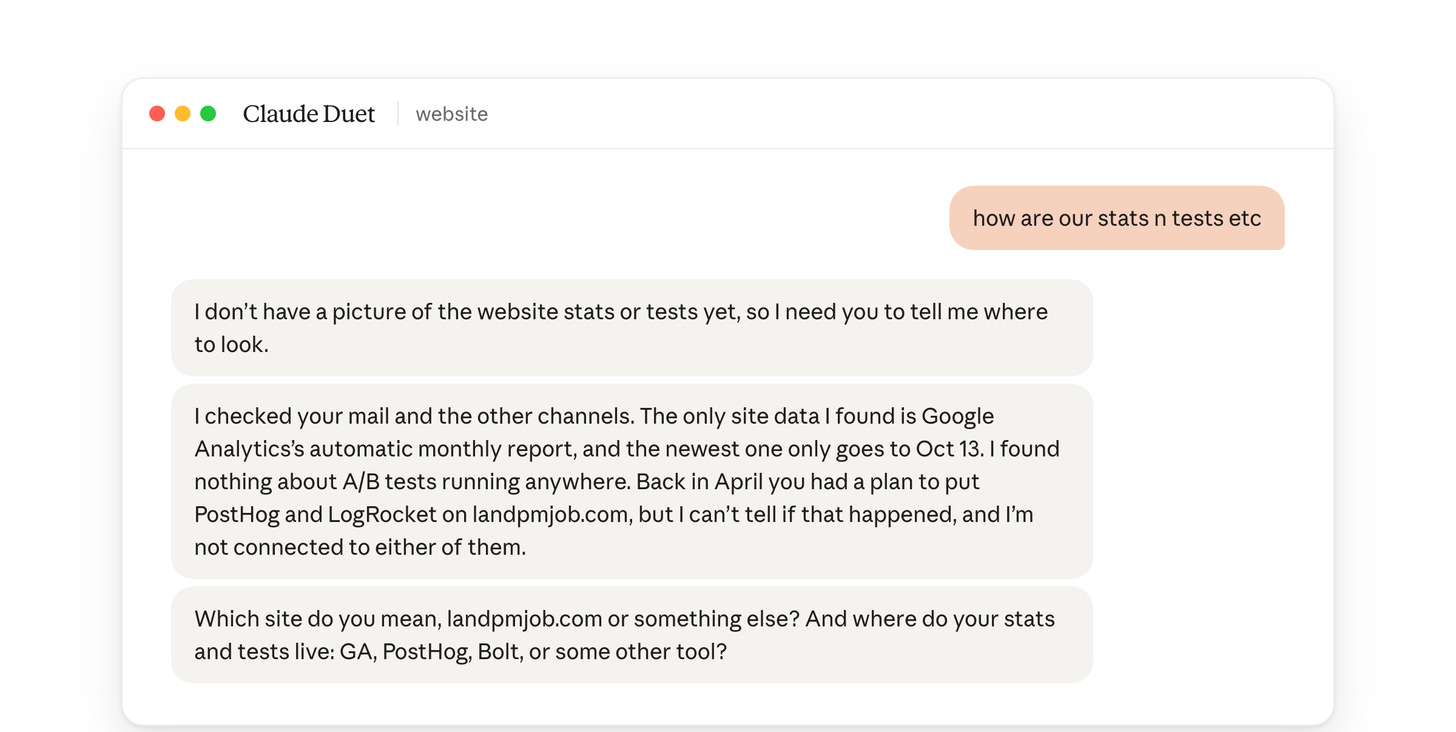
It doesn’t know where to look
I asked how our site stats were doing. It checked my mail and asked me where my stats live.
When I told it to use my repo, it asked for the repo name, after suggesting “aakashg/content-os” itself.
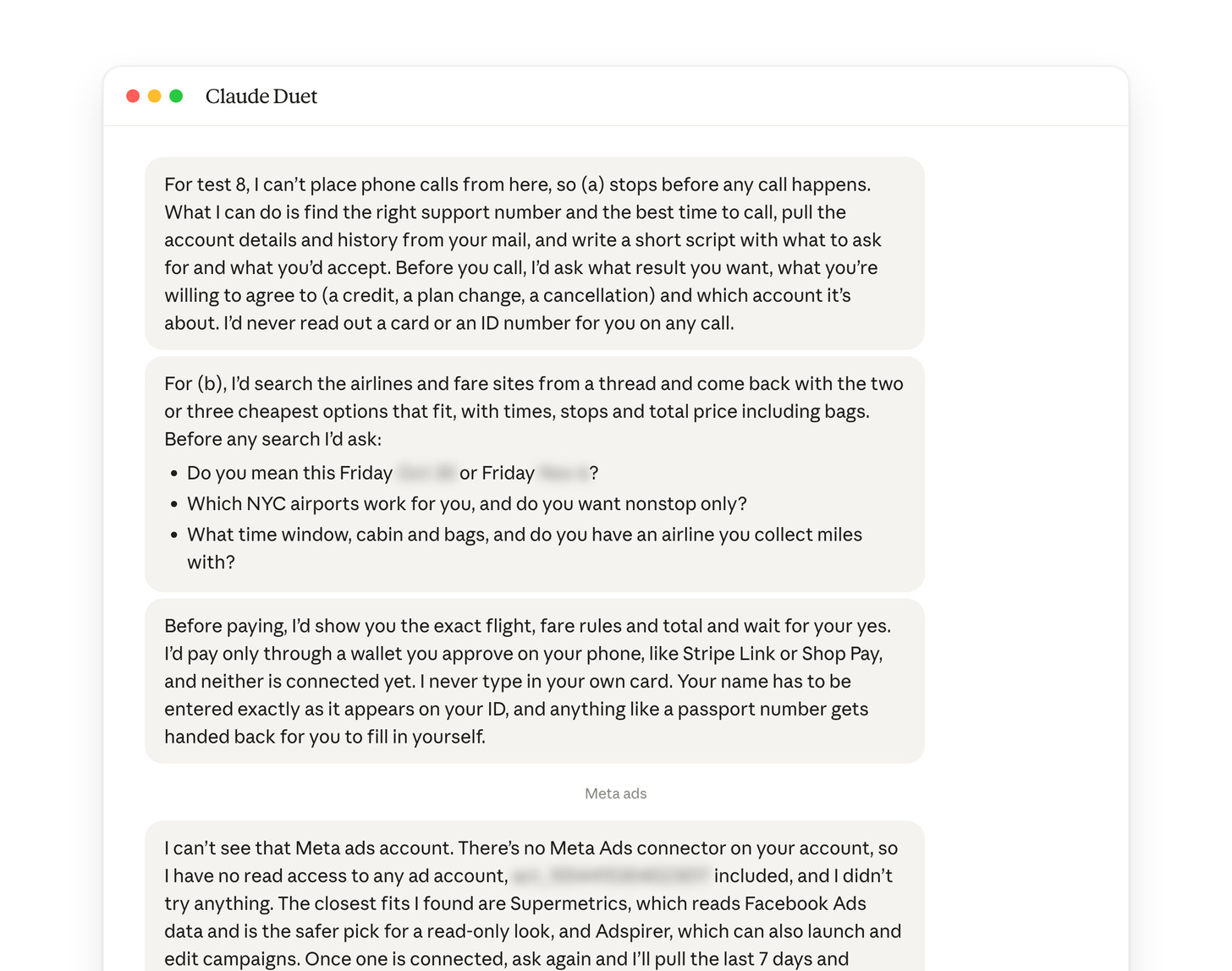
It stops outside Claude
Muse and Instinct can make calls and take actions for me.
Duet can’t pay without Link or Shop Pay. It can’t use LinkedIn yet.
4. My verdict
After using Duet for the last week, I can confidently say Instinct is still my favorite.
You can text Instinct. Instinct is more proactive.
And Instinct handles numbers and money stuff much better. I was less shy about handing that over.
Since Duet is a competitor in this personal agent race, I compared it against the things that worked well on the other tools I’ve evaluated. Here’s what came out:
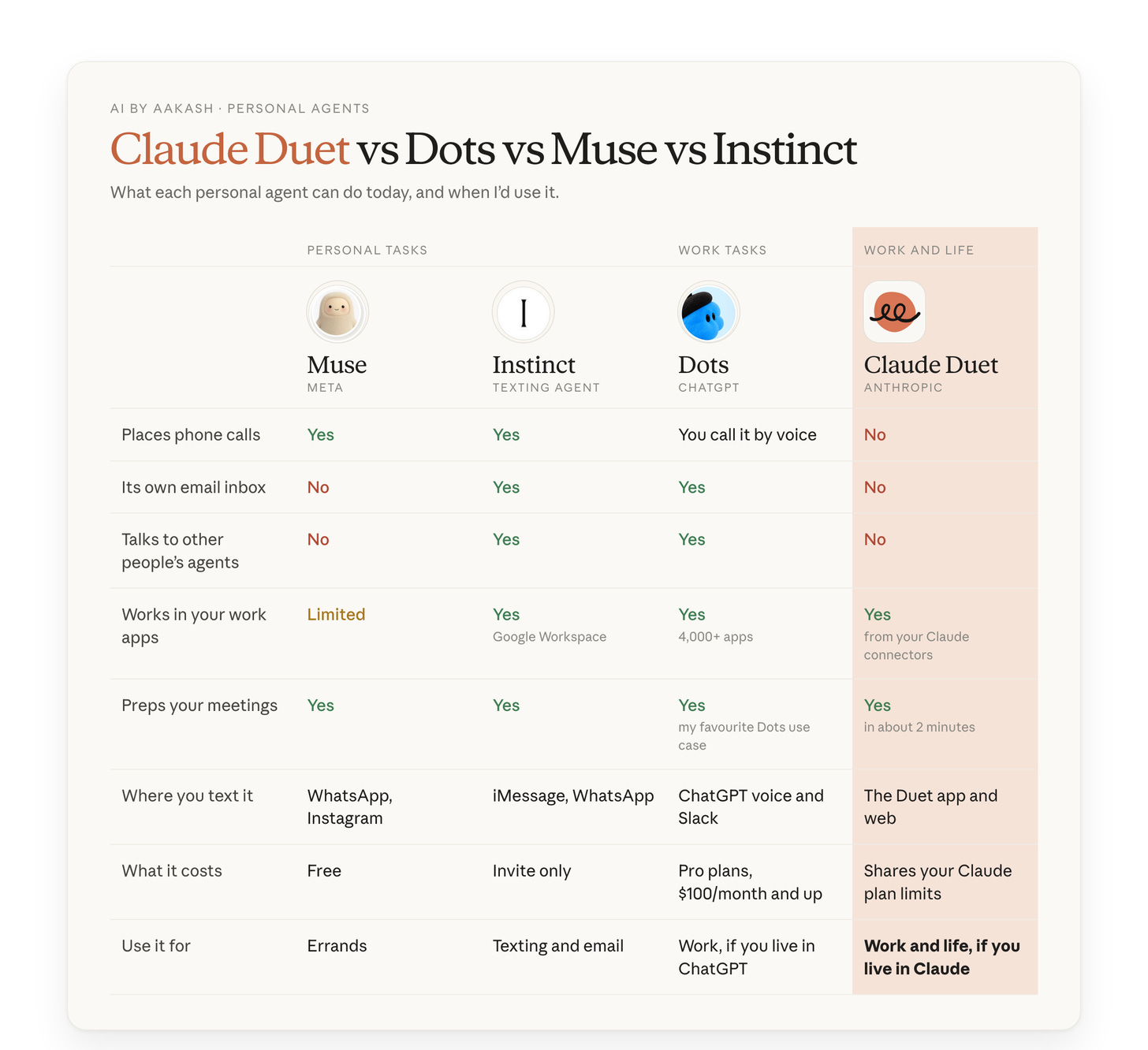
In my previous Dots post, I split the personal agent market into two races.
One is personal tasks, where Muse and Instinct lead. The other is work tasks, where Grok Bot, Hermes and Dots lead.
Duet doesn’t fit either race. It’s a unified agent.
The same app ran my newsletter queue, my podcast prep, my workouts and my subscriptions.
So does Duet have judgment? Yes, once it has the material.
It found the one broken thing on a page and caught bad posts in my queue. It stopped inventing the moment it had my repo.
It falls short when it has to go find that material.
Here’s my updated decision tree:
Personal tasks: use Muse if you live in Meta’s apps, else pick Instinct.
One agent for work and life, and you live inside Claude: use Duet.
Lots of work tasks and you live inside ChatGPT: use Dots.
Grok Bot is still the strongest work agent overall.
And if you missed it, every week I also put out a new episode of my podcast. Catch up on all the episodes here.
That’s all for today. See you next week, Aakash
Dots doesn’t have its own email inbox. Claude Duet is very under baked. Claude’s worst feature though is not being able to connect to multiple Google workspaces at once. It can either know about your work life or your personal life, but not really both at the same time