
Anthropic accidentally shipped Claude Code’s entire source code inside an npm package. I go through what’s inside in the news section.
And in today’s deep dive I cover the 120+ features Anthropic has shipped in the last 90 days.
I rank them into S, A, B, C, and D tiers. Then I give you the key details on the S tier.

Ariso: Your AI Chief of Staff
I am using an under-the-radar AI tool that talks to me in Slack - and it’s not OpenClaw. It’s Ariso:
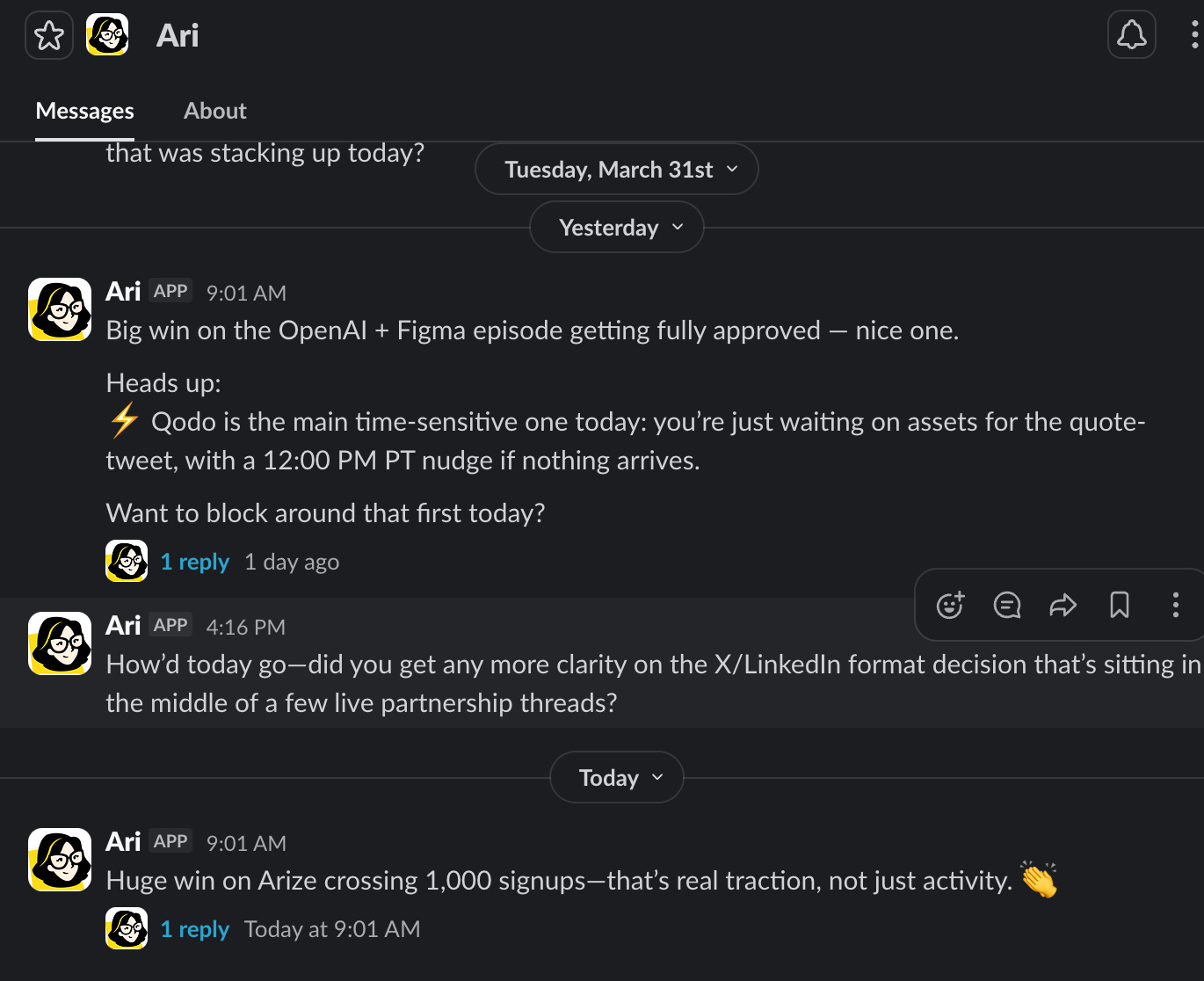
Ariso connects to my email, calendar, and docs, then handles meeting prep, follow-ups, and the rest. It remembers every conversation and gets smarter the more I use it.
Built by cybersecurity founders from Durham NC (where I used to live). I personally recommend it. Best of all? It’s free right now: ariso.ai/aakash

There’s a billion AI news articles every week. Here’s what actually mattered.
The Week’s Top News: Anthropic Leaked Claude Code’s Entire Source Code
The “safety-first AI lab” just had two major leaks this week: first, that its new Mythos model is so good it poses cybersecurity risks; and, second, ironically, the source code for Claude Code.
A source map file shipped inside the Claude Code npm package by accident. Chaofan Shou spotted it first and posted the download link on X.


Within hours, 512,000 lines of TypeScript were mirrored across GitHub, forked 41,500+ times, and picked apart by thousands of developers. Everyone is fixating on the embarrassment. But the real story is what’s inside the code.
I went through it, and there’s a lot. 44 feature flags for capabilities that are fully built but haven’t shipped yet. A persistent background agent called KAIROS that keeps working while you’re idle. An anti-distillation system that injects fake tool definitions to poison competitors trying to scrape Claude Code’s API traffic. And an “undercover mode” that strips all Anthropic references from commits when employees contribute to public repos.
Anthropic is preparing for an IPO, selling enterprise security, and positioning as the responsible AI company. Two leaks in one week make that pitch a lot harder.
The Other News That Mattered
News
Sam Altman’s non-binding DRAM deals may have caused the worst consumer hardware crisis in a decade. He locked up 40% of global memory supply with letters of intent that were never real. DDR5 prices jumped 171%. Micron killed its 29-year-old Crucial brand to chase AI demand. MU is now down 33% from its post-earnings high. The signature was worth exactly what the paper said: nothing binding.
Meta quietly released TRIBE v2, a model that predicts how your brain responds to anything you see, hear, or read. 70x higher resolution than v1. They open-sourced it, which tells you the research advantage is already captured. A company spending $135B in capex didn’t build this for academic citations.
Resources
Jack Dorsey published From Hierarchy to Intelligence. The thesis: corporate hierarchy exists to route information, and AI can now do that continuously at scale. Block cut 4,000 jobs and framed it as acceleration, not cost reduction. Fascinating read. Whether you agree with Dorsey or not, every leader should read this and decide what it means for their org.
New Tools
Google AI Quests is expanding to eight new languages. It’s a free, gamified AI literacy experience built with Stanford that teaches students aged 11-14 how AI actually works through real research scenarios like flood forecasting and disease detection. If you have kids or work in edtech, worth bookmarking.
Fundraising
OpenAI closed $122 billion at an $852B valuation, the largest private funding round in history. But look at who wrote the checks: Amazon ($50B), Nvidia ($30B), SoftBank ($30B). All three are also OpenAI’s biggest vendors. The capital isn’t just flowing in, it’s circulating. $35B of Amazon’s piece is contingent on an IPO or AGI by 2028.
WHOOP raised $575M at a $10.1B valuation. A screenless rubber band with SaaS metrics: 2.5M members, $1.1B bookings run rate, 103% YoY growth, cash flow positive. Qatar Investment Authority, Mubadala, Abbott, and Mayo Clinic all wrote checks. Sovereign wealth funds and healthcare institutions don’t invest $575M because recovery scores are cool. They’re buying a distribution channel for continuous patient monitoring outside the clinic.

I Ranked Every Feature Anthropic Shipped This Quarter

Anthropic shipped 120+ features in 90 days.
Most people saw a few headlines and moved on. Agent Teams, Opus 4.6, maybe Dispatch. But they’re missing the bigger picture. These features aren’t isolated launches. They build on each other in ways that aren’t obvious if you’re only watching one product line.
I researched every Anthropic release so far this year. Blog posts, changelogs, tweets from the engineers who built each feature, official docs, community reports. And I tested them.
Honestly, most of it is incremental. But about 30 features are worth your time.
Here’s what you need to know:
The Full Picture
I mapped every release to a calendar. Here’s what Q1 looked like for Claude:
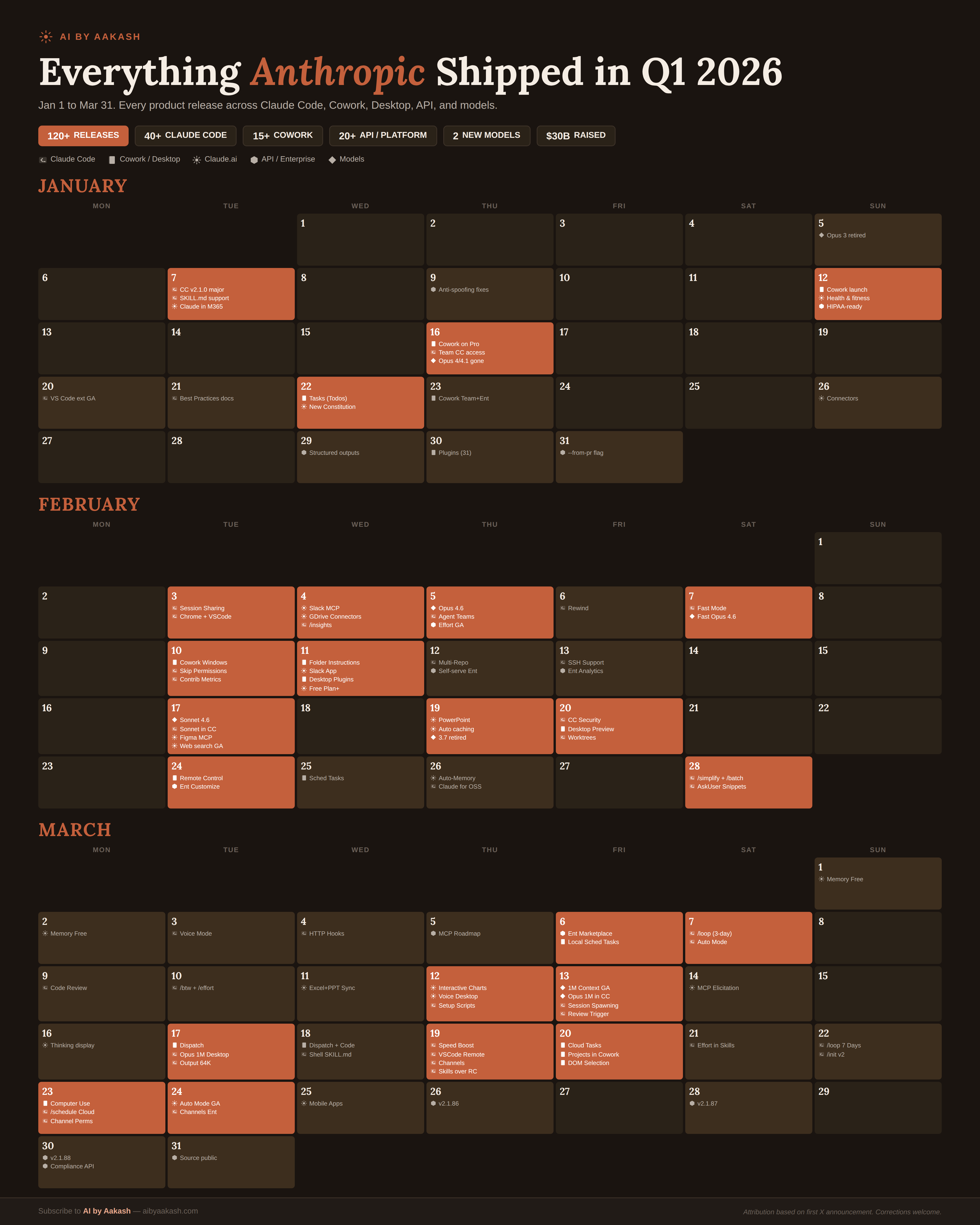
That’s 40+ Claude Code releases, 15+ Cowork updates, 20+ API changes, and two new models in 90 days.
The thing that stands out when you see it on a calendar is the overlap. Agent Teams and Opus 4.6 shipped the same week. Code Review landed on a Monday, and by Friday they’d added 1M context GA and four more Claude Code features. No product line was waiting for another.
That matters because these features build on each other. /loop is more useful when the model can stay on task for 14 hours. Dispatch gets more powerful when it can launch Claude Code sessions. Worktrees work better when 1M context means each agent can hold the full repo. The product lines connect in ways that aren’t obvious if you’re only watching one.
I went through all of it. Here’s the tier list:
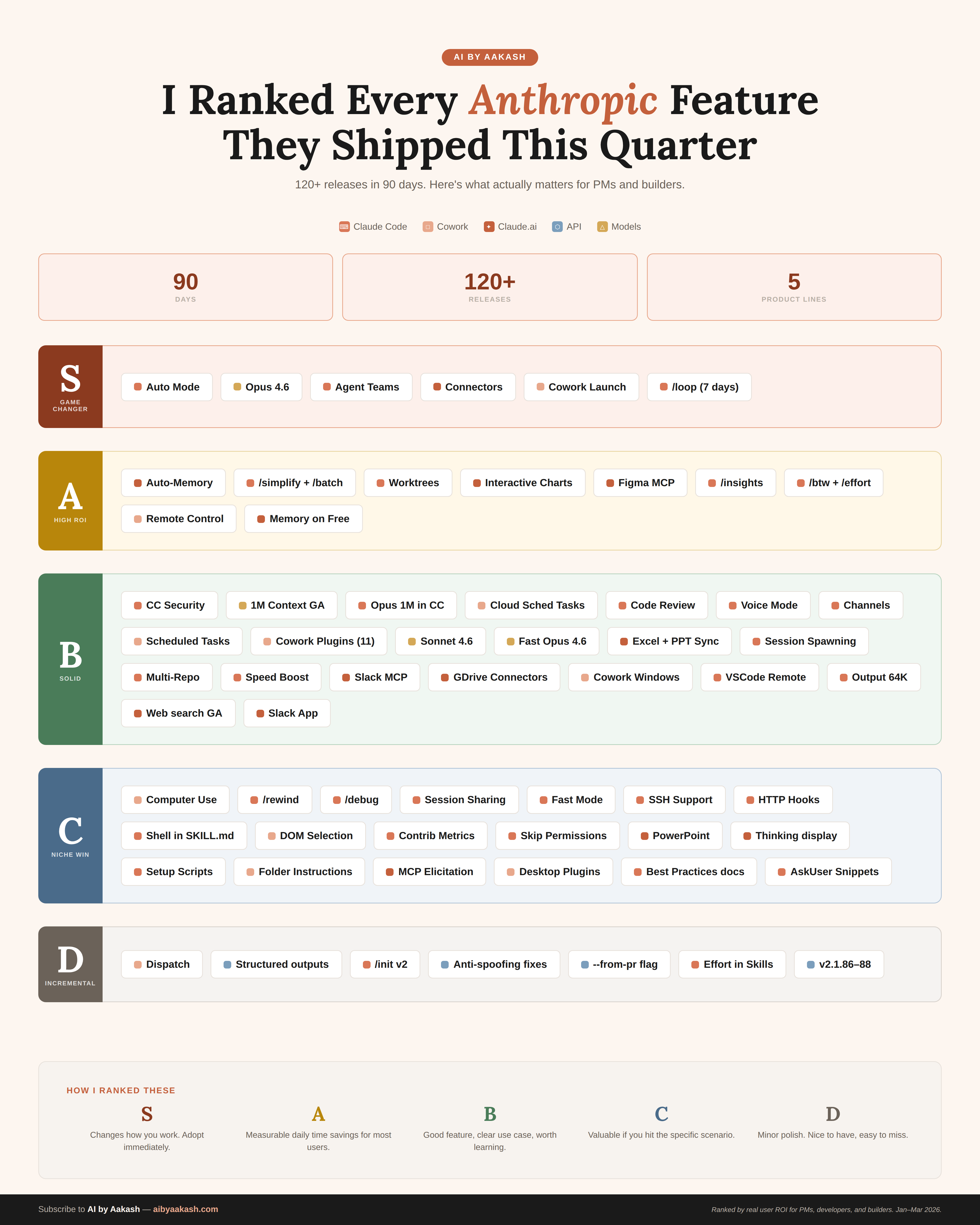
Now let’s cover everything in S tier.
S Tier: Claude Code
Auto Mode
Auto Mode lets Claude make permission decisions on your behalf. It runs two safety checks before every action.
I enabled it and gave Claude a refactor task: dependency injection across a user service, update all tests, make sure CI passes. Claude edited 14 files, ran tests 3 times, fixed two test failures, and committed. Zero permission prompts. 8 minutes total. Before Auto Mode, I would have clicked “Allow” roughly 40 times during the same task.
claude --enable-auto-modeNot the same as --dangerously-skip-permissions. Auto Mode still won’t delete your database. It just stops asking permission to edit a CSS file.
Opus 4.6
Opus 4.6 launched in February and the world hasn’t remained the same ever since.
Everyone focused on the benchmarks. The part that matters is the task horizon. Opus 4.6 can stay on a single task for over 14 hours without losing track. That’s what makes /loop, Agent Teams, and Dispatch viable on real projects.
Without this model, half the features on this list break on anything complex.
Agent Teams
Agent Teams lets a lead agent delegate to up to 10 parallel teammates that coordinate through a shared task list.

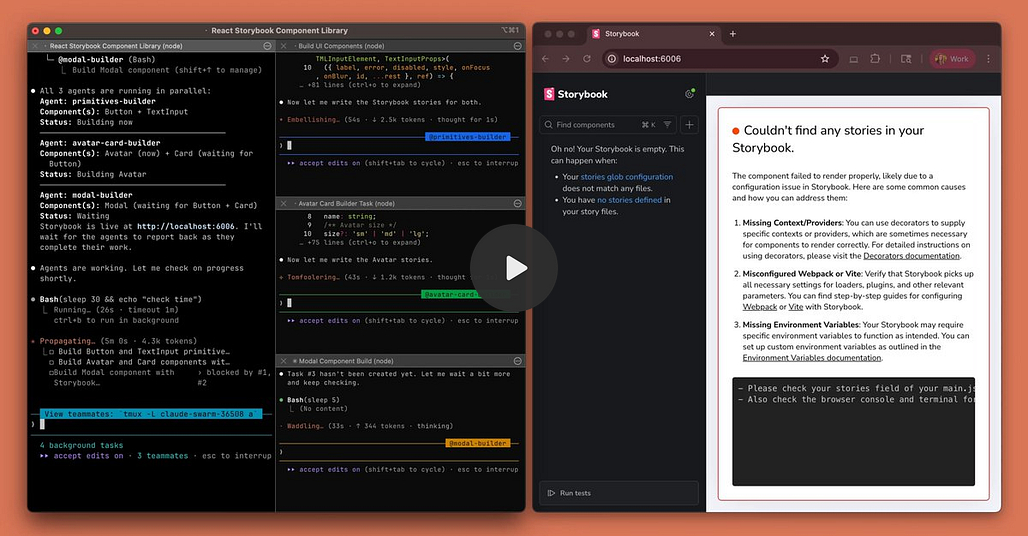
I tested this on a side project with three open issues: an auth flow, a dashboard layout, and a broken CSV export. Described all three to the lead agent and let it delegate. All three had PRs open within 40 minutes. Two passed tests immediately. The third needed one manual fix on a type mismatch.
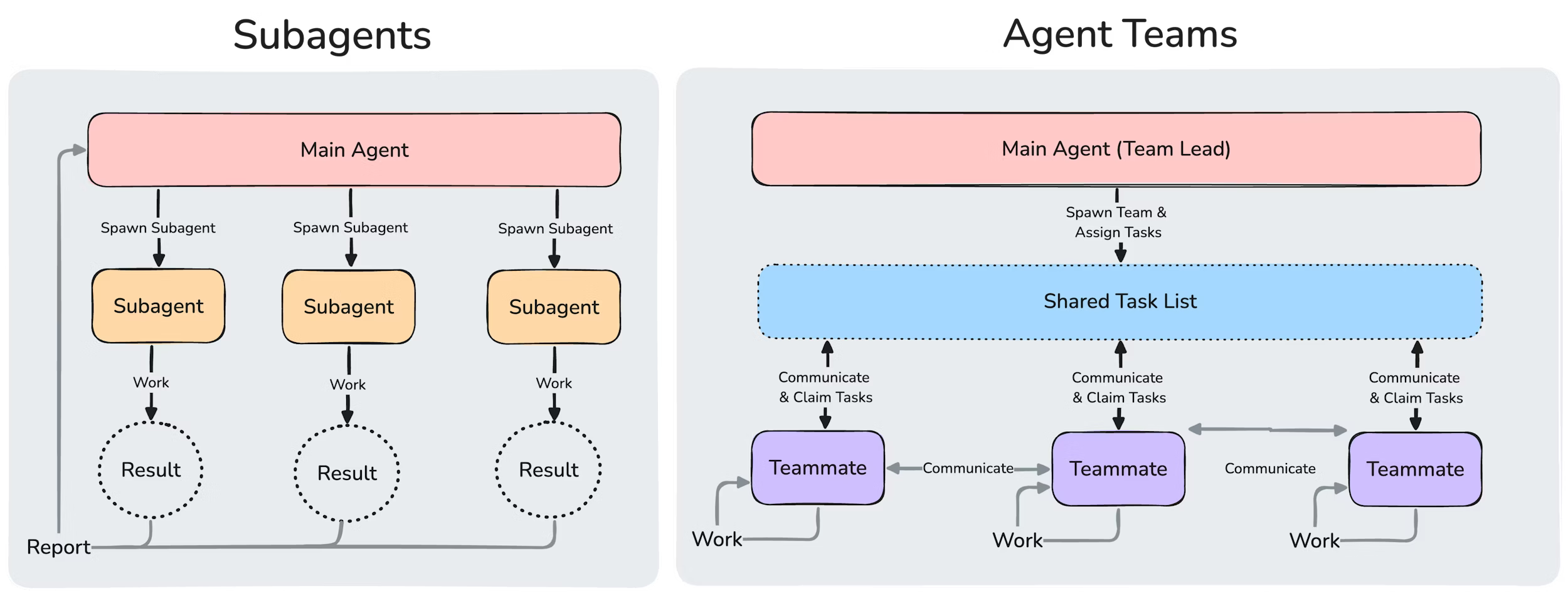
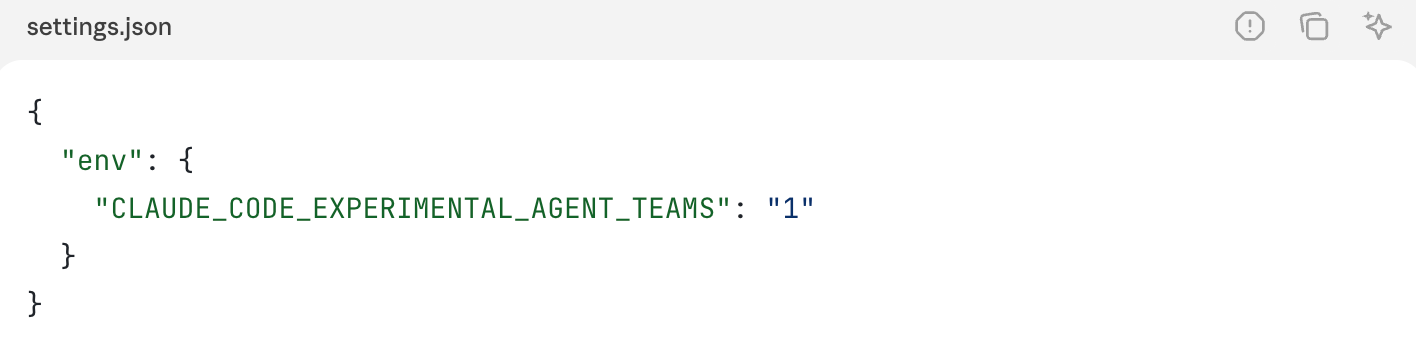
Add CLAUDE_CODE_EXPERIMENTAL_AGENT_TEAMS=1 to your environment and describe multiple tasks in a single prompt. Requires Opus 4.6. Research preview.
Cowork Launch
Cowork is Claude running persistently on your computer with access to your apps, files, and screen. You message it, walk away, and come back to finished work. It’s a great skin on Claude Code:
Before a 2-hour meeting, I told Cowork: “Catch up on my Slack DMs and summarize anything I need to respond to. Then find the Q1 metrics deck in my Drive and update the revenue chart with this month’s numbers.”
When I got back, Cowork had summarized 12 Slack DMs into three priority buckets, flagged two that needed immediate replies, and updated the chart. The Slack summary saved me 30 minutes of scrolling.
Connectors
Connectors let you plug Claude into your work tools with one click. Gmail, Slack, Notion, Figma, Asana, Google Drive, and 50+ others as of February 2026. Built on MCP, but you don’t need to know that. You just toggle it on.
I connected the Figma connector and pointed Claude Code at a mockup for a settings page. It read the frame, extracted the layout and tokens, and generated a React component that matched the design. When I asked it to adjust spacing, it updated both the code and pushed the changes back to the Figma file. Design-to-code and code-to-design in one loop.
Connectors work across Claude.ai, Cowork, and mobile. Any MCP server anyone builds becomes a connector you can add. Refer docs here.
/loop
/loop runs a task on a repeating interval inside your session. These are the patterns I’ve been using:
/loop 5m /babysit
/loop 30m /slack-feedback
/loop 1h /pr-pruner
The first auto-addresses code review comments and pushes PRs to production every 5 minutes. The second puts up PRs for Slack feedback every 30 minutes. The third closes stale PRs hourly. These patterns come from the Claude Code team’s own workflow.

Loops run for up to 7 days and support up to 50 tasks per session. /loop can invoke other slash commands, so you can chain it to a skill and the whole workflow runs without you touching the terminal. I covered the origin of this pattern in Ship Features While You Sleep.
Final Words
Start with three things today. Turn on Auto Mode so you stop clicking “Allow” forty times per session. Set up Cowork so Claude works while you’re in meetings. And run /loop 5m /babysit on your next PR.
I’m shipping faster and I’m not working more hours. Not every feature here will matter for your workflow, but the S tier ones changed mine.
That’s it for today’s deep dive.
I wrote an extended version for paid Product Growth Subscribers covering A, B, C, and D Tier features. Read it on Product Growth →

Beyond AI, here’s what I found interesting this week:


1/ Zuckerberg’s yacht once sailed 9,600 nautical miles to the South Pacific and waited two months for him to show up, but he never boarded and the vessel turned around empty. It burns 1,165 gallons of diesel per hour and in nine months produced what 400 American households emit in an entire year. Meta pledges net zero across their value chain by 2030. Net zero is a line item in someone else’s budget.
2/ The S&P 500 had its worst quarter since 2022. Forward P/E fell to 19.7x, below the 5-year average. But every time it’s dropped below 20x since 2020, forward returns have been positive. Miss just the 10 best trading days and your returns get cut in half. The worst time to look at your portfolio is the best time to add to it.
3/ GTA 6 isn’t delayed because $3B is hard to spend. GTA 5 still generates $700 million a year thirteen years after launch, and day one of GTA 6 is also the last day of GTA Online’s current economy. Every delay is Rockstar protecting the most profitable entertainment product ever made while making sure its successor can match that run rate on arrival.
That’s all for today. See you next week,
Aakash
P.S. Want my AI tool stack? Join my bundle. Want my job searching coaching? Apply to my cohort.