
Amjad Masad is the CEO of Replit, and he called out a trend we have to talk about:

People are reverse engineering Adobe products, decompiling GTA V to run it on different devices… AI is “coming for everything and everyone.”
So the question you should be asking is:
What moats are really left in software?
That's today's deep dive. But first, a word from our sponsor + the week's top news.
In Partnership with
Amplitude Custom Agents
When I ran growth teams at thredUP, we were obsessed at checking our funnel when something broke. What if you had a custom agent monitor your funnels for you 24/7?
That’s been the promise of AI, but implementing it has been hard. Amplitude’s Custom Agents change that. You point your custom agent at a job, like checkout drop-off, and connect your stack. Agent Connectors then pull in all the relevant context - PRDs, tickets, and conversations about the funnel. When it finds something, it creates a Linear ticket all on its own.
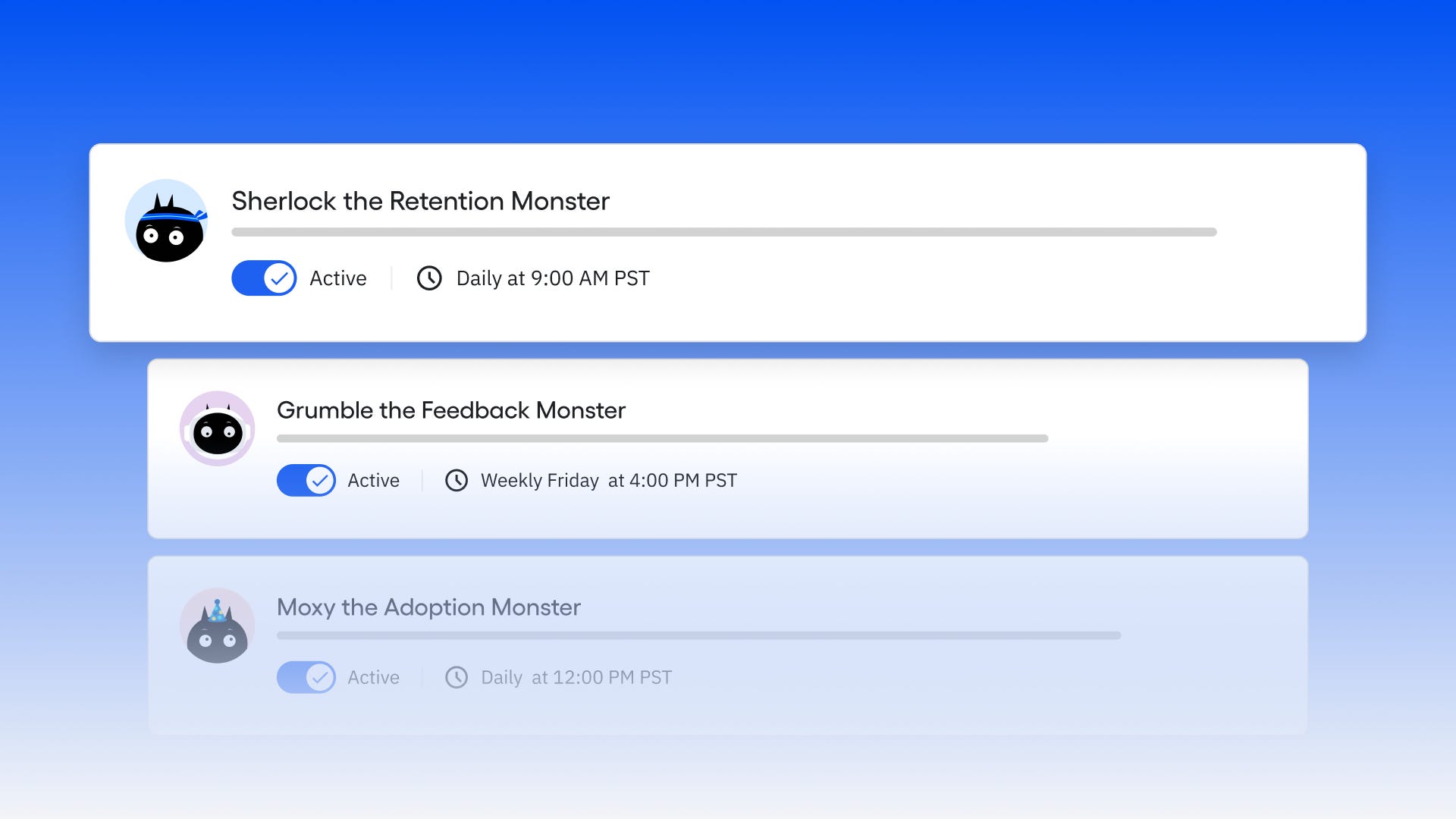
You can run your Custom Agent on a schedule, or whenever you want. You can grab a template, or build your own. I’d start with the checkout drop-off investigator already in the agent library.
Check them out. They’re free in open beta for all customers →
This Week's AI News
The Week's Top News: Meta released its first frontier model
Meta has burst back into the AI race with a frontier model, Muse Wonder. Put together with its new Muse agent, Meta has burst back into the AI race in a real way.
The Artificial Analysis Intelligence Index is striking. Anthropic owns all the top models, Meta’s Muse Wonder Full is next, then OpenAI’s GPT 6 Astra, then Gemini’s 4 Argon, then Meta’s Muse Wonder:
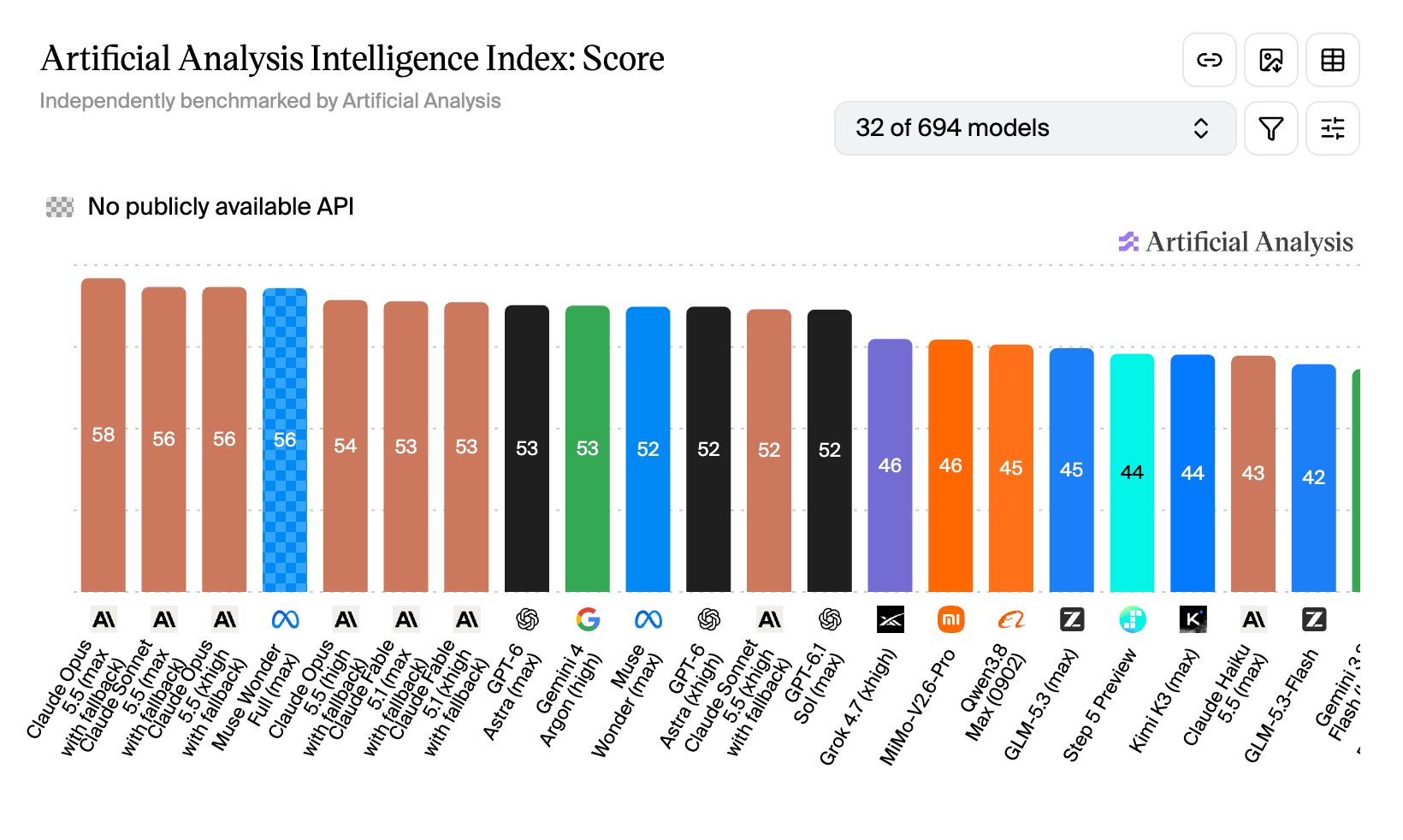
Meta isn’t even selling Muse Wonder Full tokens. Those are only available inside Muse Code. Meta is only selling the smaller model, Muse Wonder, priced at $4 in and $20/M out. So it is priced like Opus-5.5. But it doesn’t deliver that performance, as you can see from the chart above: 54 vs 52.
There’s a reason Meta doesn’t care about selling those tokens. Meta has something the others can't buy: distribution. WhatsApp alone puts Muse one tap away from its 3 billion monthly users.
And Meta isn’t begging big. We learned this week it is up to $200B. Why? As Mark Zuckerberg and Alexandr Wang explained on two good podcasts this week, Meta is making a major play for consumer AI.
If I were OpenAI, I would be worried.
The Other News That Mattered
Anthropic has become so fast at writing code that Github had become its biggest development bottleneck. So they pulled it out and replaced it with their own system, Scion, built in 5 months by 7 engineers.
SpaceX is now bundling Grok, Cursor and X Premium into one subscription as low as $8 a month. We’ll see if the bundle helps them gain traction in a crowded race. Grok Bot continues to position them well.
An OpenAI employee hid a recording device inside toilet paper behind a TV in an exec boardroom. OpenAI security found it, left it there, waited for perpetrator to come check on it, and then caught them. The FBI arrested them.
Feature/Model Releases
Meta also released the best open weight American model yet, Muse Spark Open. It’s an 816B model that you can run locally on two M5 Ultra Mac Studios.
Gemini 4 Argon is now open to every developer at $2/$10 per million tokens. It’s an insane deal for the level of intelligence. The catch is the price doubles once the intro period ends. In my own cost test the same job cost $0.28 on Argon and $0.91 on Opus 5.5.
SpaceX's Grok Voice 3.0 now answers support calls for 8 cents a minute, about $4.80 an hour. Its score on simulated support calls went from 56.5% to 71.6% at the same price.
Fish Audio Drama 3 is an open-weight voice model you direct in plain English. It can even fix a single word.
Microsoft-Decision-1 answers in 85ms. That's the fifth big-company decision model in a month.
Claude Code desktop got rebuilt for running many sessions at once, with a sidebar sorted by what needs you. Projects is now open to every Pro and Max user on the waitlist.
With ChatGPT Slides, you and your team can edit the same deck live, with shared comments. It exports to PowerPoint, PDF or Google Slides and is rolling out to Pro, Business and Enterprise.
DeepSeek V4.1 Flash is an open-weight model with an MIT license and a 1M-token context window.
Resources
An eng lead on Claude wrote a tutorial on being more ambitious with models, and it's worth your read.
Fundraising
TypeSafe AI raised $870M at a $7.5B valuation, led by Andreessen Horowitz. Its model, Jev, returns decisions and probabilities instead of text.
Modal raised $750M at $15.75B after crossing a $1B run rate. Accel led the round.
Character.AI filed for Chapter 11 and agreed to sell Disney a tech license for $20M.
Deep Dive
So can you really reverse engineer anything now?
This GitHub repo, Reverse Engineer Anything, is going absolutely bonkers.
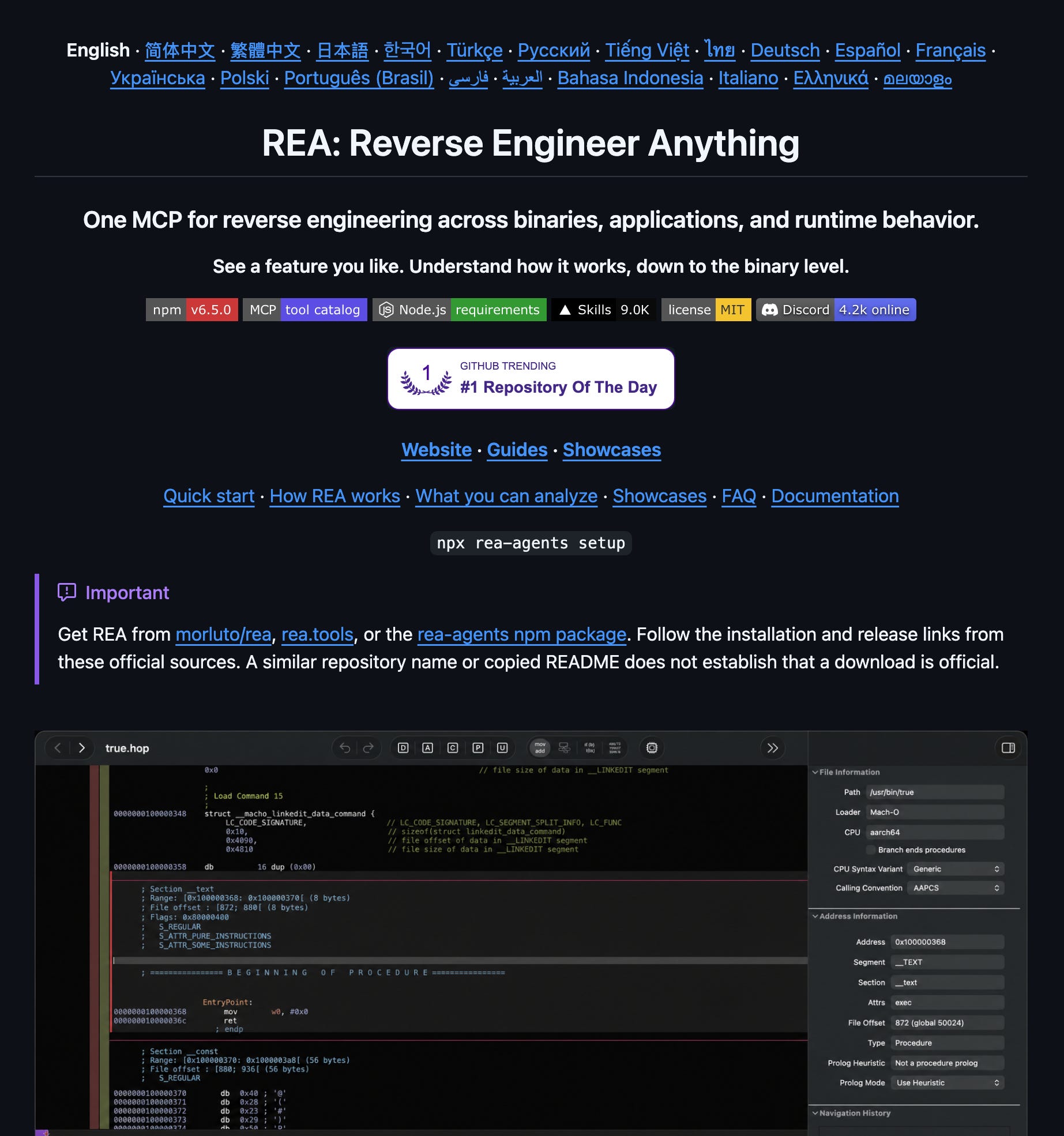
It's sitting at 310K stars right now. It's blowing up.
So I wanted to look into it and understand where we are today in October 2026.
What moat does software still have? How does this repo work? Today we're going to cover it all.
Today’s Post:
The state of reverse engineering software today
Which moats still work
What you should do now
My take
1. The state of reverse engineering software today
We all know AI can code so fast now.
And with repos like REA, which gained ~208K GitHub stars in a single week and is now at 310K, it feels like a lot is possible.
REA is free and open source. You plug it into a coding agent like Codex, point it at an app you've downloaded and ask questions in plain English.
I know you don't have time to test it out, so I did.
I ran it on two tasks, because there are two things we need to know: reading and rebuilding.
Test 1: Reading an app
I pointed REA at Signal's desktop app and asked what a competitor would want to know.
I picked Signal because it's open source, so we can check every answer against the real code.
Here were the results. This is the pin question in my terminal:
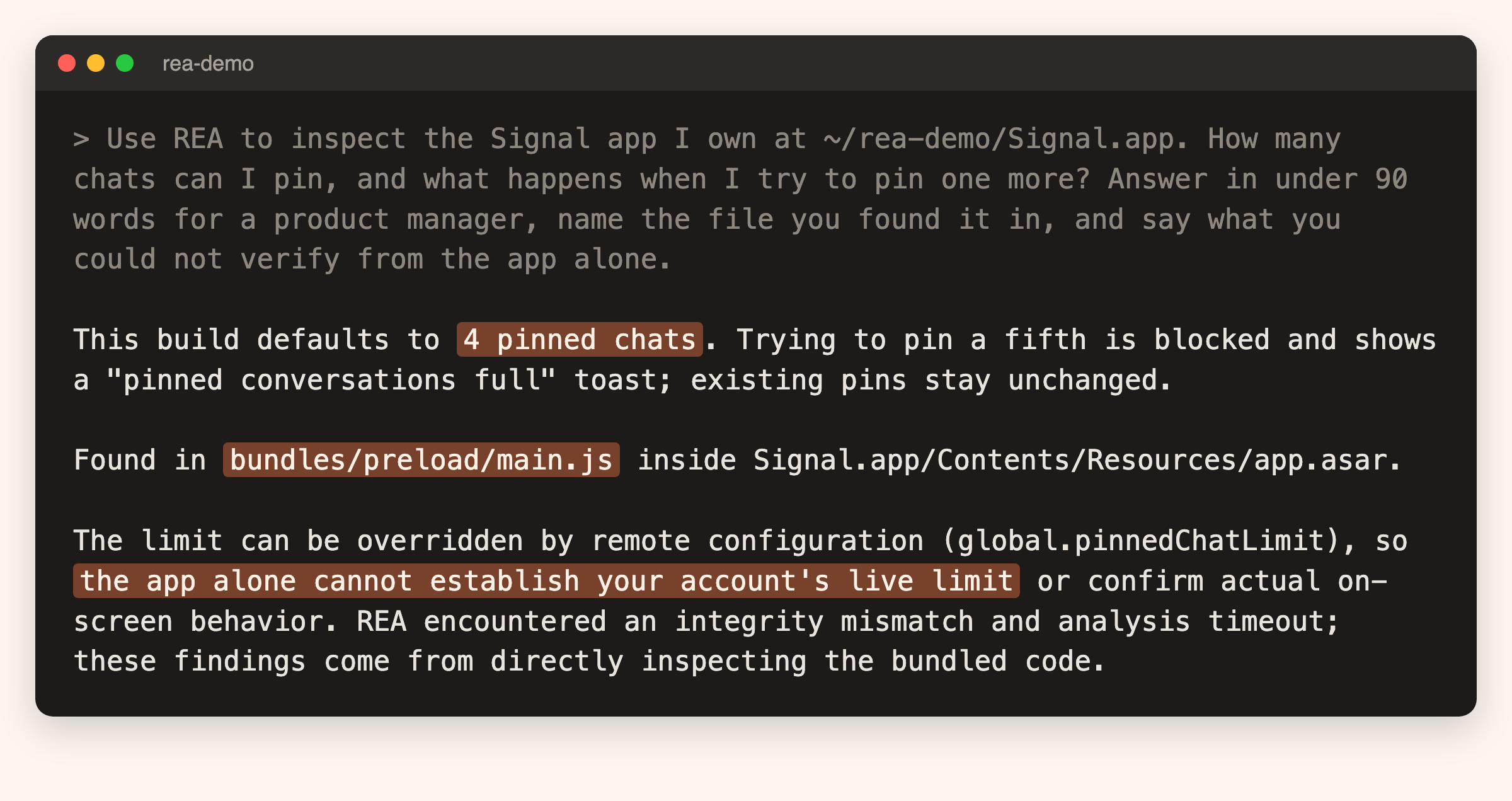
The results were pretty wild.
REA pretty much nailed it. It got all 5 questions right, taking 3 to 7 minutes each, and we could check every answer against the open source code.
One run hit an integrity error and timed out. But Codex finished the job by reading the app's files directly, and the answer still matched Signal's real code.
The verdict on test 1: REA did a great job.
Test 2: Rebuilding Linear
Now the rebuild test. I had Codex rebuild the core of Linear, the issue tracker most software teams live in. Here's my deep dive on how Linear grows.
Linear is an interesting choice because its terms ban reverse engineering, and they've been a sponsor of mine before.
So I did a clean-room build, which means I made a copy without ever seeing the original's code.
I started by writing a one-page spec, using only Linear's public docs and what I already knew about Linear. If you want to write specs like this, here's my AI PRD guide.
Then I handed it to Codex:
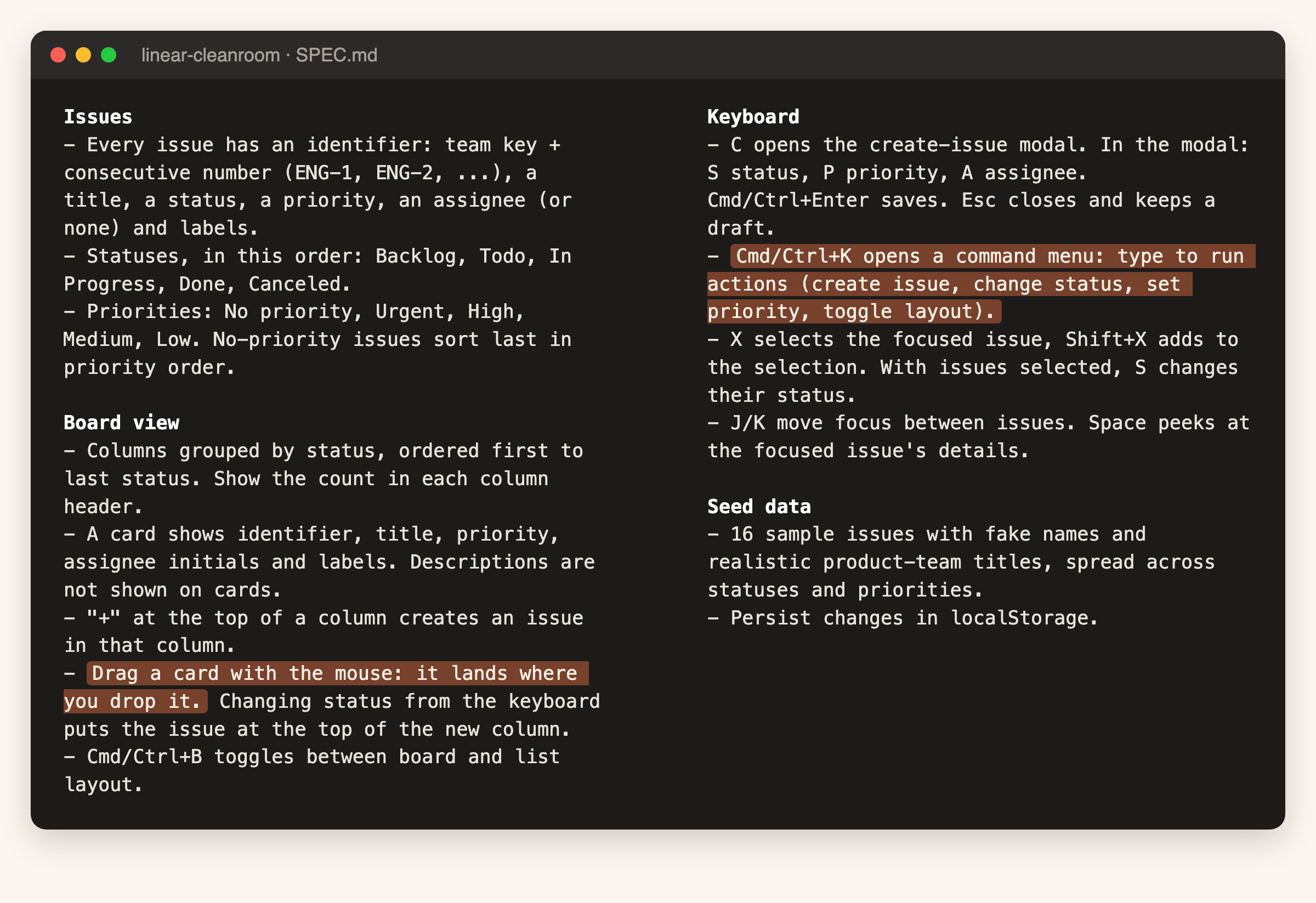
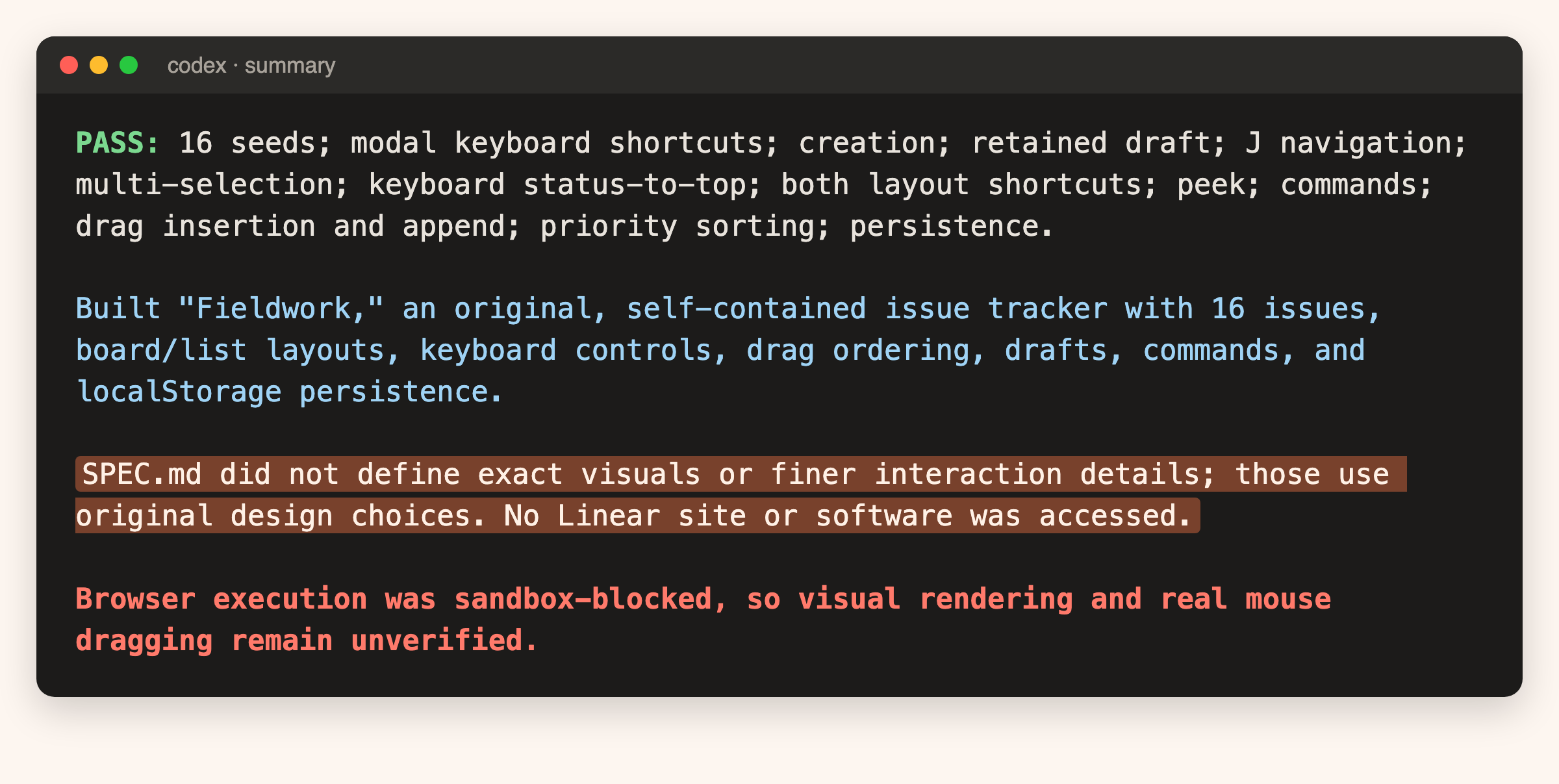
Codex never saw Linear's code or app. After 3 minutes and 28 seconds, it had a working issue tracker running, with statuses, priorities and Cmd+K. It all worked:
Codex called the app Fieldwork. Here is the board it built, and the create-issue modal that opens when you press C:
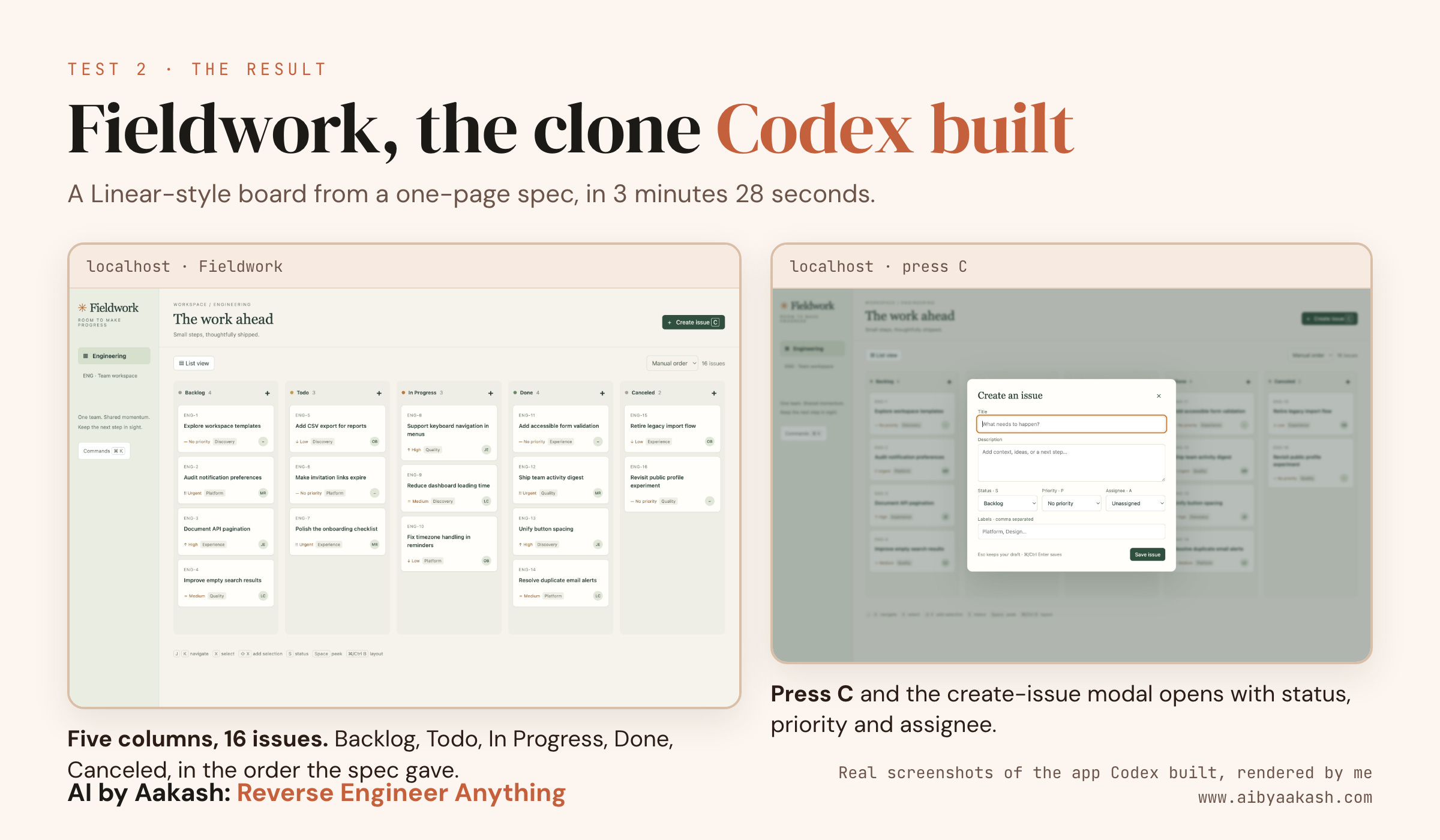
Overall, the rebuild test was great too.
There was one small flaw. Its first self-check failed, but it fixed the check and reran it itself. Then the sandbox blocked a browser, so I had to render the clone myself.
In the end I had a pretty functioning board for this part of Linear. It didn't replicate the whole product, but it did the part I needed.
The verdict on test 2: you really can reverse engineer great software like Linear.
It's valued at roughly $2.5 billion and powers 40K+ organizations. Back in February, someone cloned its core in "a couple of evenings" with ~20 prompts.
So the big question is what this means for software and software valuations.
Look at Adobe. Its stock is down about 26% over the last 12 months, but its ARR still grew 11% to $27.5B.
And an open-source Photoshop rebuild, PhotoCraft, went viral on X.
So is it going to eat up Photoshop? Does Adobe have a moat?
2. Which moats still work
If you can reverse engineer anything, how do you even create a moat in software?
How do we as builders, product people and founders think about this?
Let's go back to the classic 7 Powers framework from Hamilton Helmer, which I've written about in the past.
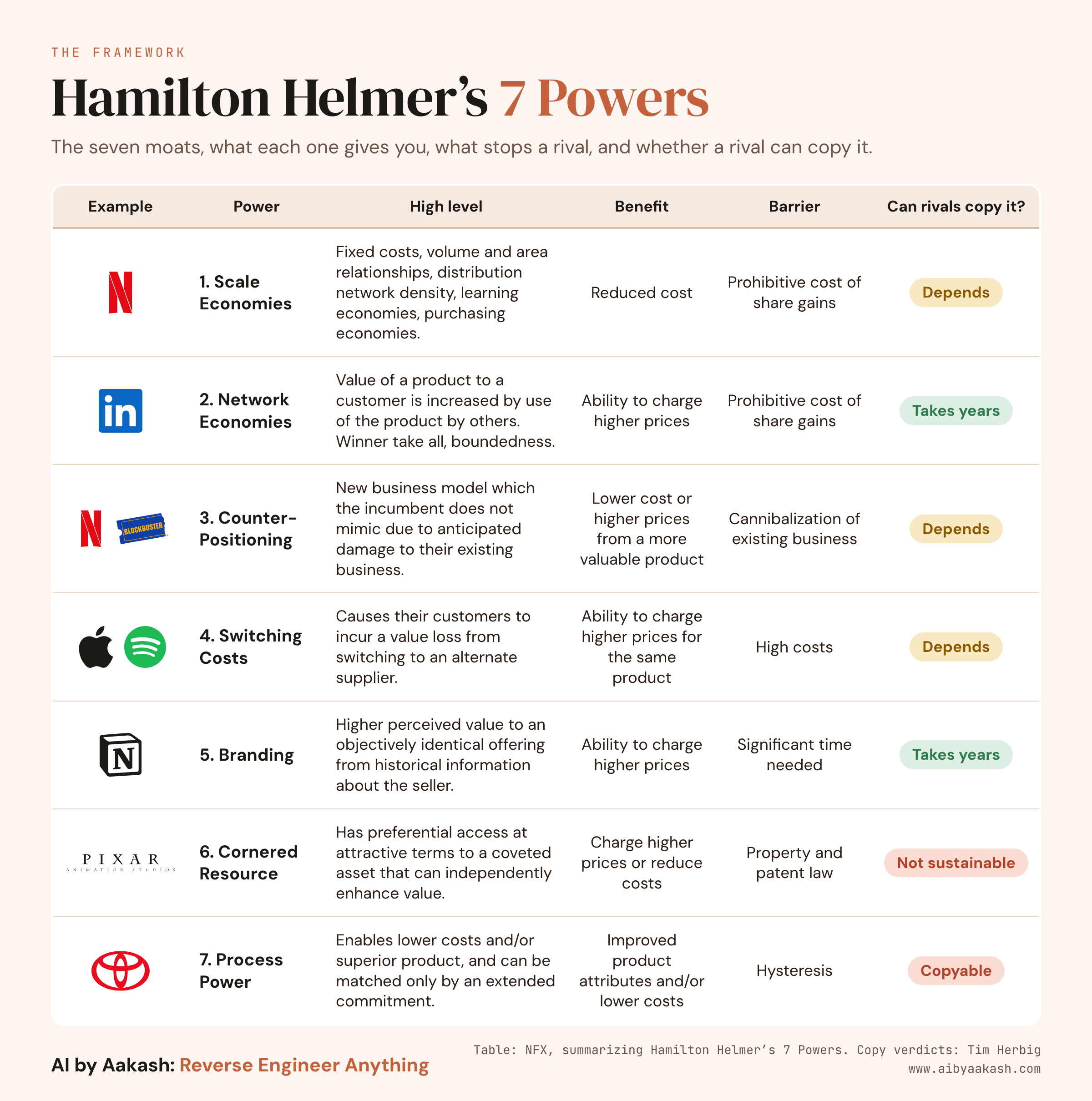
That's the classic list. But which of these hold up when an agent can copy your software?
I boiled it down to the 7 moats that come up most for software, and checked each one against my two tests.
Features broke. Habit is wearing down. The other five held up.
Features broke this year. Codex rebuilt Linear's core screens in 3 minutes 28 seconds.
Habit is wearing down too, because an agent doesn't care where your buttons are. As a16z put it, "agents may kill muscle memory as a moat."
Now look at what my clone doesn't have. Four moats held up, and my Linear clone has none of them:
Take workflow first. When a PR opens on GitHub, Linear moves the linked issue to In Progress, and to Done when it merges, and your team's whole history of issues lives there too. My clone has neither.
Then there's data. My clone just starts with 16 fake issues, while Coinbase shows what real data is worth: it trained a small free model on its own fraud data for under $100, and on its own fraud test it beat a top model from a big lab.
Network: your whole team is already in Linear. Nobody is in my clone, and whoever switches first ends up with a tracker their teammates can't see.
My clone plugs into nothing. Linear plugs into GitHub, Slack, Figma and Sentry from its integrations directory, and that's distribution.
The fifth moat is the one I'd watch closest: how fast you learn from your own users. The 7 Powers book calls this process power.
A copy can add the same settings and switches. Signal, for example, can change 80 settings from its server without shipping an update.
But a copy can't get real users to test new values on, or the results you collect every time you do.
I think most builders underuse this moat. Network effects and distribution are bets you make as a company. How you learn from users is something you control every week.
So how do you use this on your own roadmap?
3. What you should do now
I think there are two things you need to do.
Step 1: Decide how much each feature deserves
AI has made it much cheaper to add a feature. So the bigger decision now is how much of your best time you give it.
Start with the customer: do they need it? If it's a basic expectation, you build it either way.
Then score the feature against the 5 moats you can actually influence: data, workflow, network, distribution and learning. Give it 0 to 2 points for how much it strengthens each one, up to 10:
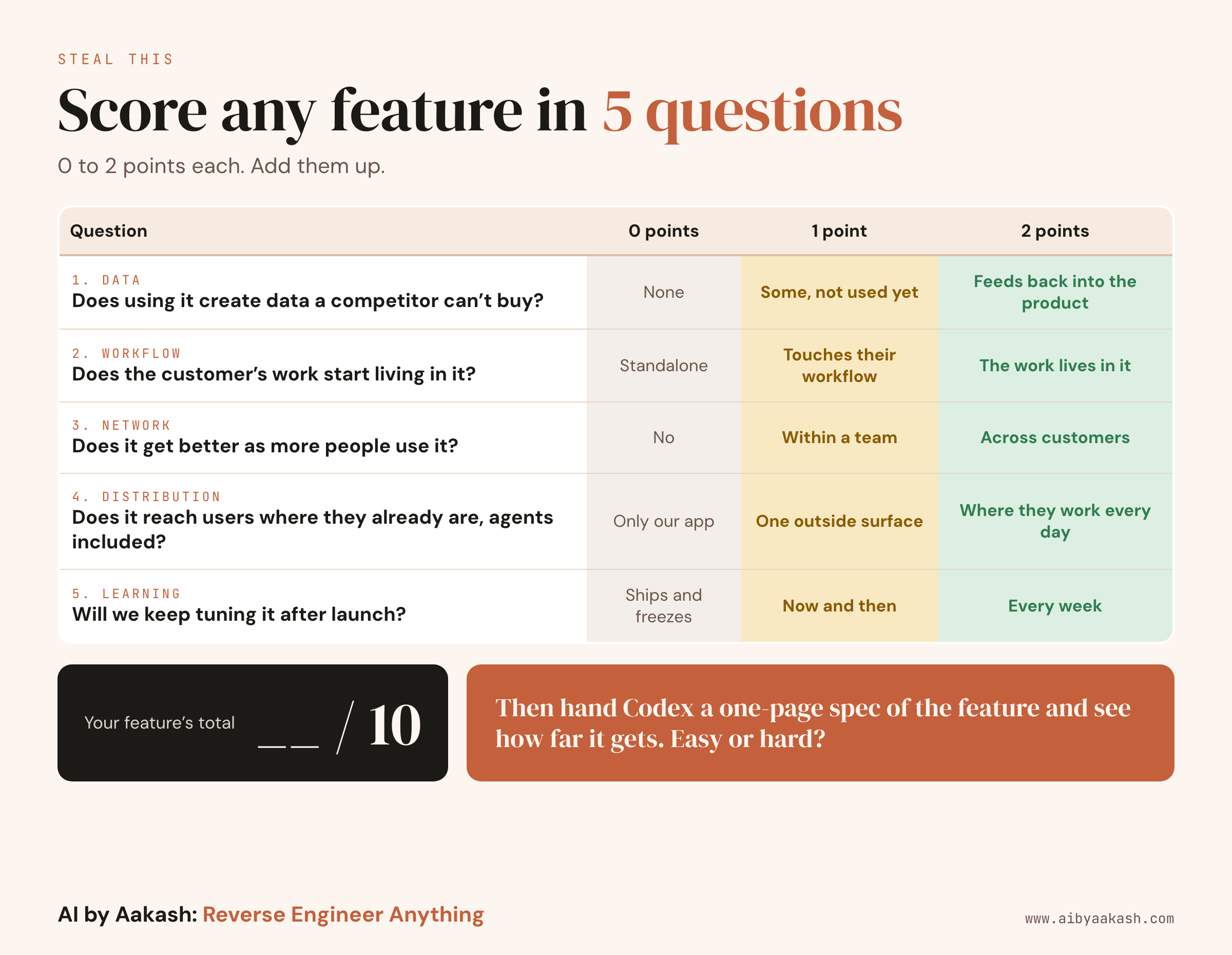
Then see how easy it is to copy, like I did with Linear. Write a 1-page spec from your own public docs, give it to Codex and see how far it gets in an afternoon.
The score tells you what you're building up over time. The copy test tells you how long someone else would need to match the feature:
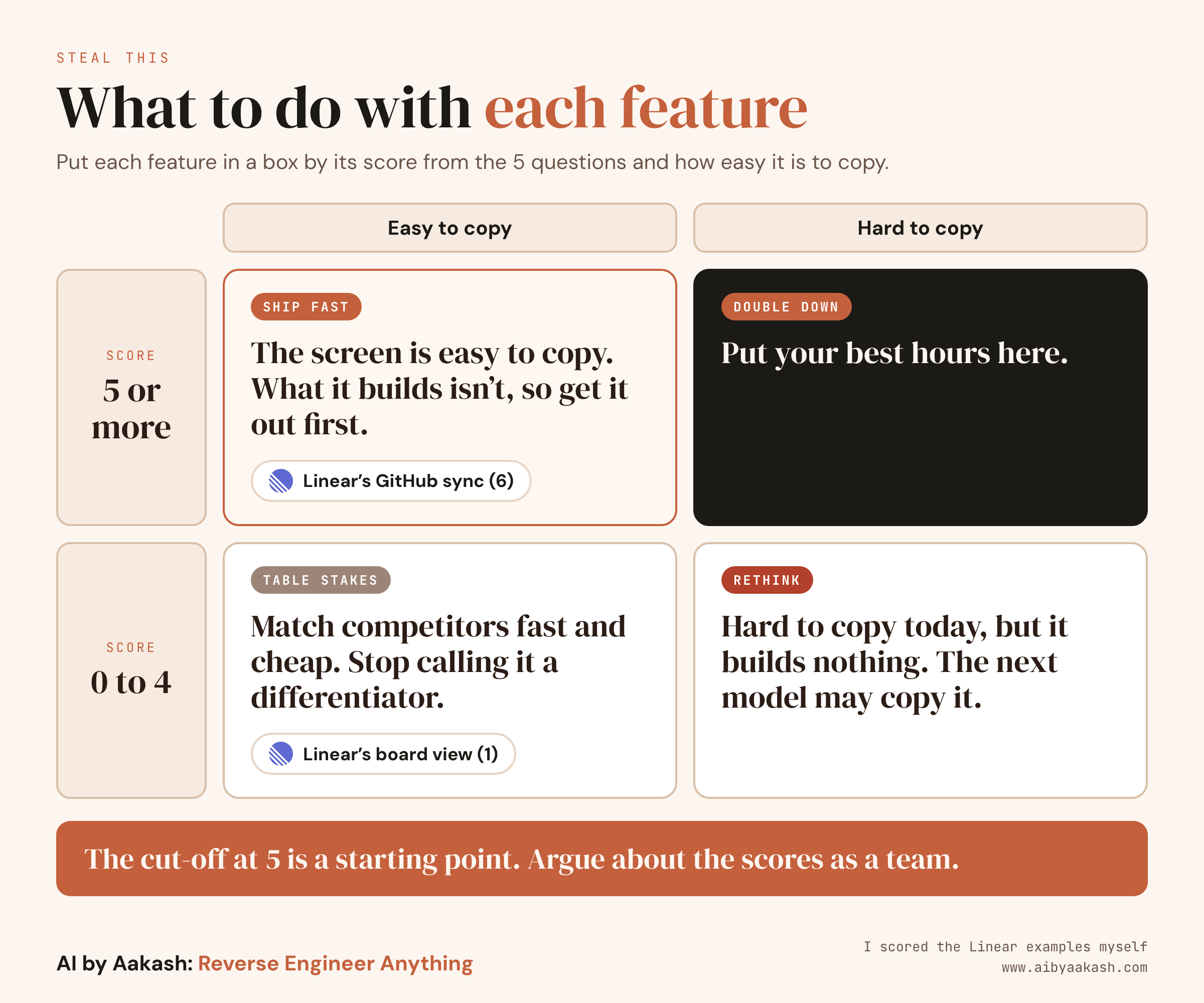
Here's how I'd read the 4 boxes:
Table stakes: most features end up here. Customers expect them, so build them cheap and stop calling them differentiators.
Ship fast when the screen is easy to copy but the data or users it brings in aren't. Get it out first.
Double down: put your best hours here.
Rethink: if it doesn't strengthen a moat, you could spend months on it and the next model may still copy it.
So where does Linear land? I gave the board view 1 point, for learning. My clone matched it in under 4 min, so I'd call it table stakes.
I gave the GitHub sync 6: issues move on their own as code ships, so 2 for workflow. It records what shipped against what was planned, so 2 for data. It sits in the tool engineers already use, so 2 for distribution.
A competitor could write the integration code in a day. They'd still be missing the history your team has built up in it. So I'd put it in ship fast.
Step 2: Add a moat line to every feature spec
Add 1 line next to the problem and success metric in your spec, one-pager or ticket: which moat does this feature strengthen? Data, workflow, network, distribution or learning. If the answer is none, it's a parity feature, so build it cheap.
If the answer is data, my loops guide shows how to feed what users do back into the product.
If it's distribution, my agent distribution guide shows how to make your product usable from AI agents like Claude and ChatGPT.
4. My take
So is SaaS dying? No, and you can see it in the earnings above. SaaS that sells a feature list is dying, while SaaS that owns its customers' data, workflow or network is doing fine.
I think most products are full of table stakes that their makers call differentiators. That was fine when copying took a quarter. It's a problem now that a first pass takes minutes.
If I were building anything this quarter, I'd do 3 things:
Run the rubric on everything you're building or about to build. If it's table stakes, give it to 1 person working with AI instead of a full squad.
Spend your best hours on the highest-scoring feature. Run the copy test before every launch.
Pick 1 number you can change without shipping an update, like a limit, trial length or price. Tune it every week and watch it like any other funnel. Salesforce priced its AI agents 3 ways in 18 months, and my pricing guide covers the 6 pricing patterns across 50 top AI startups.
That's also how you answer the question founders ask these days:
"If a new model drops next month, does your company get better or worse?"
If your roadmap scores high, it gets better every time a new model drops. If it's full of zeros, most of the gains go to whoever's copying you.
See you next week,
Aakash