
Welcome to another AI by Aakash. I follow the AI news so you don't have to.
The way Spotify uses Claude Code is wild. Their co-CEO, on an earnings call, shared that most of their senior engineers
"haven't written a single line of code since December."
The way engineering looks at Spotify these days is an engineer calls Claude to fix a bug from Slack on their morning commute, and they push the fix live before they even get to the office. At a company with 7,300 employees, that results in a huge Claude bill for the company.
So it's pretty crazy that they managed to reduce it by up to 90% with a PM's help. In today's deep dive, I investigate whether you could get similar savings.
Before that, a quick word from our sponsor and the week's AI news.
In partnership with Optimizely
How to put AI into your experimentation program
Optimizely is one of the leaders in experimentation, and they just released their AI Experimentation Mapping Template, completely free.
If you're one of the many teams who want to bring AI into your experimentation program but don't know where to start, this is perfect for you.
It'll help you find your top AI use cases across the AI experimentation lifecycle, from ideation to iteration. It's been used by teams at Salesforce and Kingfisher.

Here's what I recommend:
Map where your workflow is breaking down.
Identify your biggest pain points.
Map that against where AI agents make the most impact.
Score and prioritize your build list.
The template helps you develop a clear plan.
This Week's AI News
This Week's Top News: Fable 5.2.
For 12 days, Google held the top spot in the Artificial Analysis Intelligence Index. Today, Anthropic reclaimed the throne with a 65 for Fable 5.2.
The question for you is, should you pay up for Fable 5.2? It's 20% cheaper than Fable 5.1, but still twice the cost of Opus 5.5.
I ran my own set of model evals. I took 8 product management tasks and ran them on Fable 5.2 and Opus 5.5, at medium and max effort, plus OpenAI's and Google's best, on tasks like analyzing an A/B test, prioritizing a roadmap and critiquing a PRD, each scored out of 10 by a blind judge:
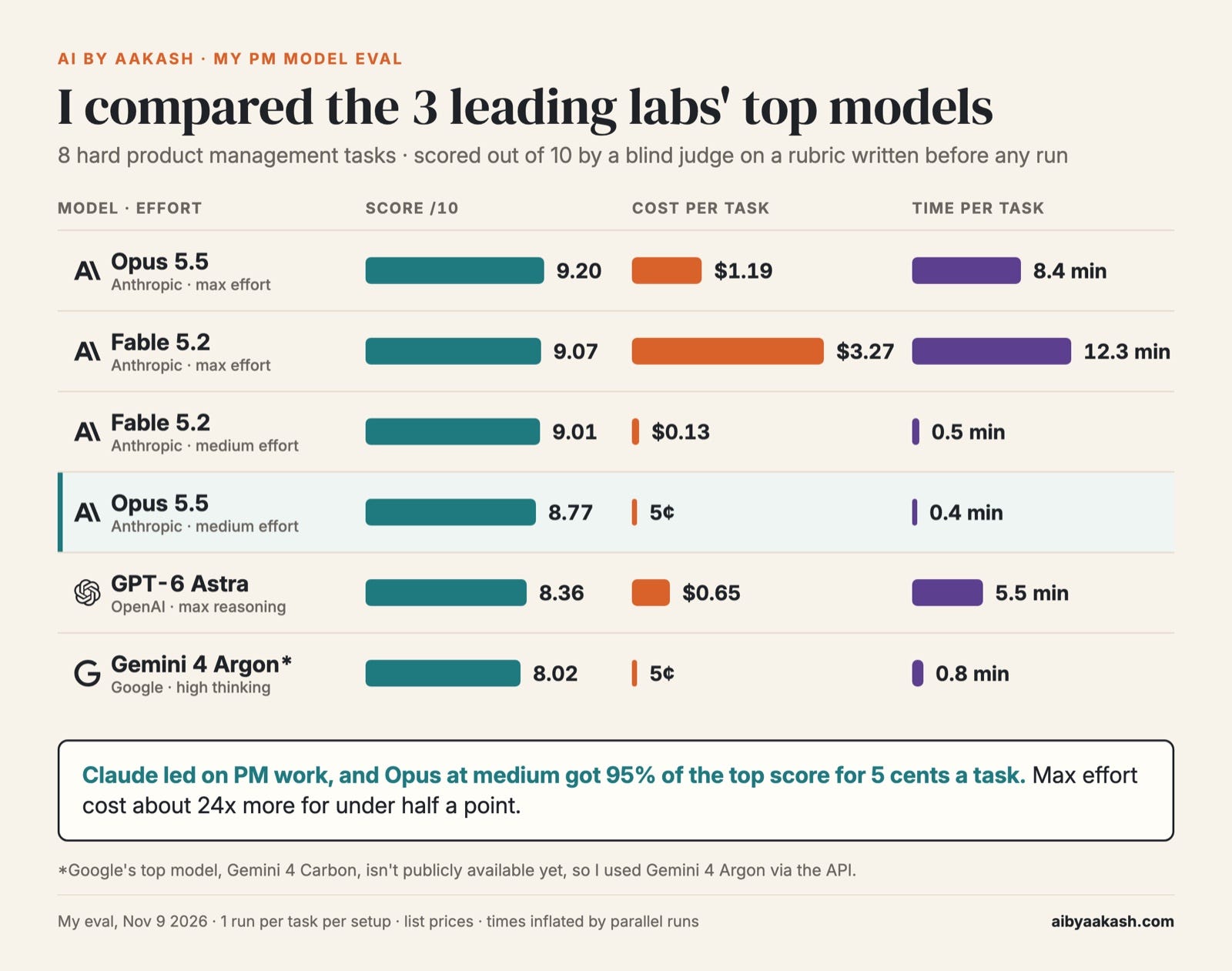
Anthropic led. Opus 5.5 at max scored 9.2. OpenAI's GPT-6 Astra scored 8.4, and Google's Gemini 4 Argon 8.0.
Every setup scored between an 8.0 and 9.2. For PM work, the gap between today's frontier models is small. You can check the judge yourself: one task, every model's answer and every score.
The vibes differed more than the scores. Fable at max was terse and decisive and caught buried facts. Opus double-checked its own math. GPT-6 Astra was precise but hedged, and Gemini 4 Argon ran long but made the plain call.
Surprisingly, on max effort, Opus scored better than Fable. That goes to show why it has the 5.5 numbering versus Fable 5.2. Fable 5.5 is likely to be the dominant model, but right now Opus is a really excellent model to use.
Max effort cost about 24x more for under half a point.
My recommendation is use Opus 5.5 at medium effort. It's the best balance of quality, cost and speed. After that, use Fable 5.2 if cost is not as much of an issue, because you do get a bump in quality that's worth it.
The Other News That Mattered
It's so hard to keep up with the AI news. Here's what mattered:
METR published a fascinating new study on how Claude is now in the early phase of recursive self-improvement (RSI), and it is improving the rate of Claude's development about 2x.
ChatGPT released Images 2.6, continuing its dominance on image generation. Its new Sunburst model is #1 on Artificial Analysis's image leaderboard, and OpenAI holds the top 4 spots. OpenAI added the capability to create GIFs, like this one.
AI still struggles at real professional work. On SemiAnalysis's new GDPx test, which gives models real tasks in 11 fields like chip design, law and finance, the best model, Opus 5.5, scored just 12%.
The frontier model companies keep finding flaws in major software. This time OpenAI found 948 working exploits in Linux. To help patch such issues, they released GPT-6 Cyber.
Kimi K3.1 Pro is the best open-weights model on the Artificial Analysis Intelligence Index. At launch it scored within 3 points of Opus 5.5, at half the price.
Gemini released Omni 1.2 Flash. It now makes 15-second videos at $0.07 a second, about a sixth of what Veo 3.1 costs.
Feature Releases
Claude rebranded its $200 plan from Max 20x to Ultra. And it also dropped the 5-hour limit on it for verified accounts.
Claude released Personal Finance as it takes aim at giants like Credit Karma.
Tools
Andrej Karpathy built HackerTube in about two hours with Claude Code: a free YouTube alternative of 6,454 videos Hacker News kept recommending.
Fundraising
OpenAI raised $11B at a $1.25T valuation, short of the $1.4T it wanted.
fal raised $1.3B at $16B, with Nvidia in the round. That's about 20x its reported $800M+ in annual revenue, and image and video demand ran so hot it had to rate-limit customers this summer.
Deep Dive
Claude Code at Spotify
A Spotify PM's post on cutting Claude Code token use by 90% is all over LinkedIn right now. My post on it got 3,757 likes.
So I tested it on real code to find out what you can actually save. Today's deep dive comes in 4 parts:
How Spotify got a 90% cost cut
How AI is charged
What savings you can expect
How to get the savings yourself
1. How Spotify got a 90% cost cut
Spotify built its own coding agent called Honk. It's pretty cool. Engineers can just tag Honk in Slack:
Honk reads the codebase and writes the change.
Spotify's tests run on it.
A person reviews it before it ships.
Honk now merges an insane 1,000 code changes every 10 days. That pace used to take 3 months at Spotify.
But all that reading runs up a pretty high token bill. So a Spotify PM built Shunt.
It's a plugin that blocks Claude from reading any file over 350 lines in full. Instead, a cheaper model (they use Gemini Flash) reads it.
In their tests, they saw an 82% to 94% reduction in tokens on big files.
On a 162K-line Java monorepo, they saw a 90% cut on average.
Remarkably, they open-sourced the plugin. It's on GitHub in a repo with 3,186 stars.
That's just their experience, though. And you might imagine Anthropic has incorporated some of the learnings, right?
So I set out to test it myself, too: where does your Claude Code bill actually go?
2. How AI is charged
But first, a quick recap on how you're racking up those huge AI bills (if you are like me).
There are 4 elements to your bill: input, cache write, cache read and output. Each is priced pretty differently. For Opus 5.5, for instance:
Input: $4 per million tokens
Cache write: $5 to $8 per million
Cache read: 20 cents per million
Output: $20 per million
What that means for coding is really interesting. I had Opus answer 4 questions on a big open-source Java codebase, and here's where the money went:
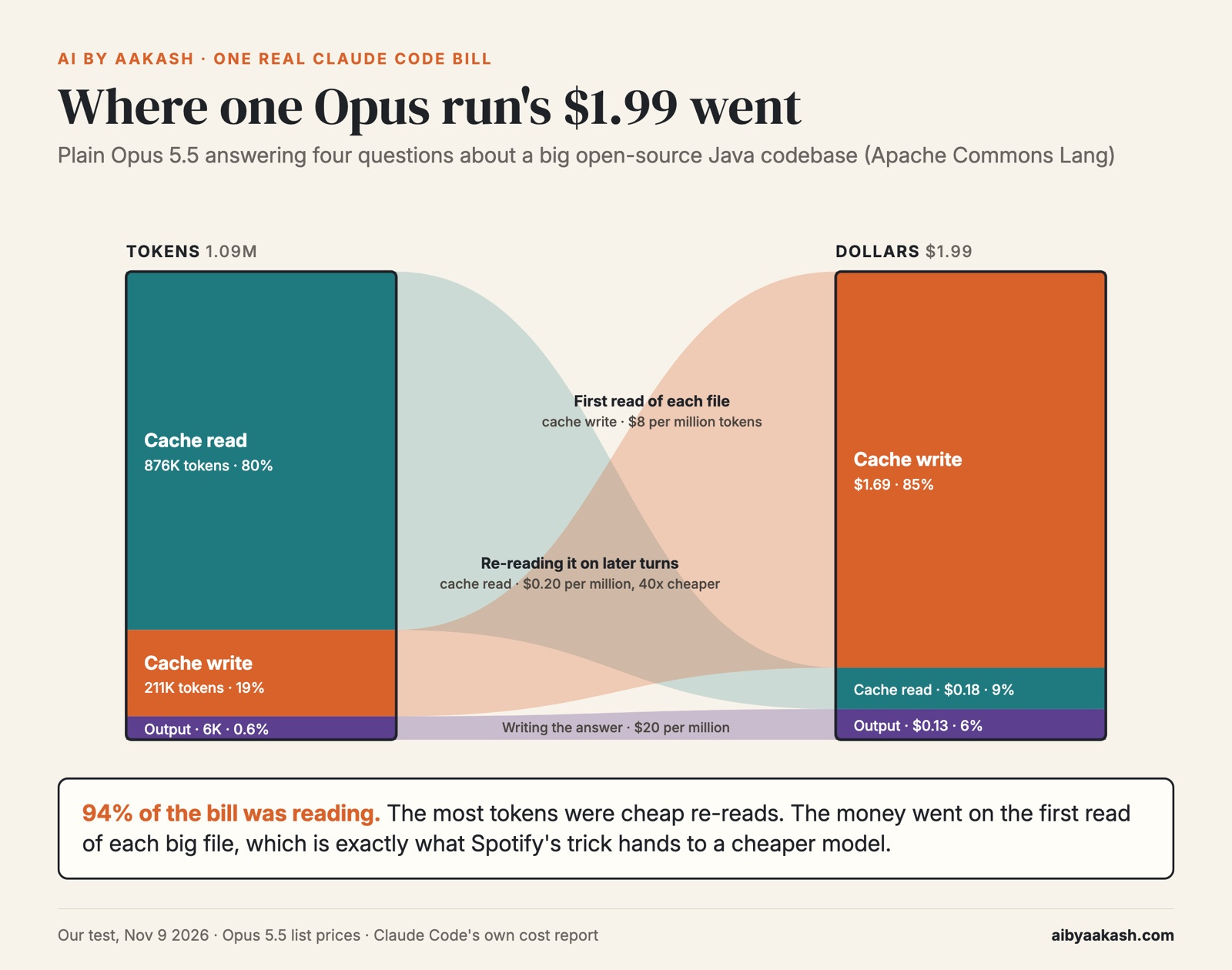
94% of the bill was reading. Can you believe that?
85% went to cache write and 9% went to cache read. The output, even though it's priced so high, was only 6% of the bill.
That first read of every big file is exactly what Spotify's trick hands to a cheaper model.
3. What savings you can expect
I ran the test across 2 codebases: my Land a PM Job repos (78K lines) and Apache Commons Lang, whose biggest files run 9,800 lines. I asked the models to answer questions that forced reads across files. One example was to trace a payment link through an admin tool, through Stripe code, to a site.
And I tested this 2 ways. First, with a simple prompt that encouraged use of a cheaper model, which looked like this:

The second way was to use Spotify's hook, ported to Claude Code. I also ran everything twice: once in normal Claude Code, which can search your files, and once with search turned off, so Claude had to read whole files. Here are the results:
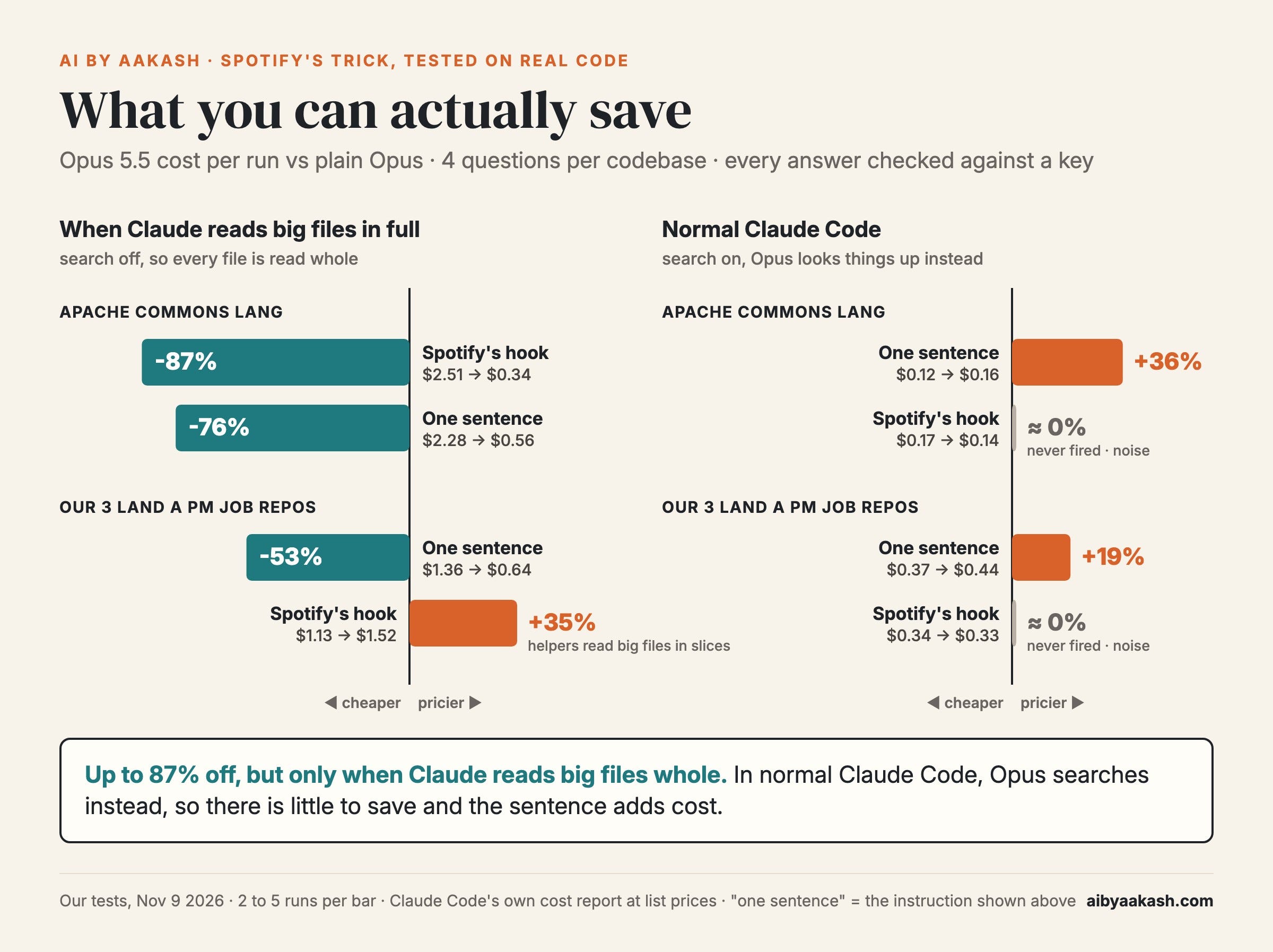
The tricks paid off. On Commons Lang, we saw the cost go down 76%, and 87% with Spotify's hook.
But on my own repos, the Spotify hook actually cost more. The sentence did help, cutting costs 53%, which is the most important takeaway.
In Claude Code, there's very little to save. If you're in the Claude Code harness, it's already going to do searches. It looks up the few lines it needs instead of reading whole files, so the sentence just added cost, 19% to 36% more. But if you hit the models without the harness, this hook really matters. That means any agent you build on the API without a search tool, or any job where Claude has to read whole files, like code reviews and migrations.
From a quality point of view, all these models did fine. So you can achieve the cost savings in the codebase without any decrease in quality, which is crazy.
So if your team has Claude read whole files, you can expect big savings. But if you mainly ask Claude to find and fix things, Claude Code is already doing the cheap thing.
4. How to get the savings yourself
Look at how your team uses Claude first. If it's mostly search and edit, skip the trick. It added cost in every one of those runs.
If Claude reads big files whole, start with the sentence. It saved money on both codebases. Spotify's hook saved the most on Commons Lang but backfired on our repos, so test it on yours for a week first.
Roll it out to the whole team by committing it to your repo: the sentence in CLAUDE.md, the hook in .claude/settings.json. That way every engineer gets it.
Open every cheap answer before you trust the saving. In one of our early runs, a 91% "saving" was Claude refusing to do the job.
To size it, multiply what each read-heavy run saves by how many of those runs your team does in a month. On our repos, that's $0.72 × 3 runs a day × 20 engineers × 21 workdays, or about $900 a month. It's an estimate, so measure a week before and after.
Spotify's 90% is real for teams whose Claude reads whole files. Figure out which kind of team you are first, then copy the part that fits.
Want to land a PM job in 2026? My Land a PM Job cohort starts Nov 23. Apply here.
Me around the web
I joined Vida Patil on the Ctrl Alt Podcast at Dreamforce to talk about the future of product managers.
That's all for today. See you next week,
Aakash
The 91% "saving" that turned out to be Claude refusing the job is the line every cost dashboard should have printed on it. A cheaper run only counts if the answer is still there. I also didn't expect the hook to cost more on your 78K-line repos, though it makes sense once the harness is already searching instead of reading whole files.