
Welcome to another AI by Aakash. I follow the AI news, and test all the latest AI tools, so you don’t have to.
Instinct is an invite-only personal agent going mega-viral. People are calling it OpenClaw / Hermes for normal people. It’s discussing a $10B fundraise.
And the craziest part of it all? It was just started in April by a 23 year-old founder.
I’ve spent the week testing it. In today’s deep dive, I’ll tell the product’s story and give you my take.
But first, a conference I’ll be speaking at + this week’s top news.
Quick Plug
Join Me at Flutter 2026
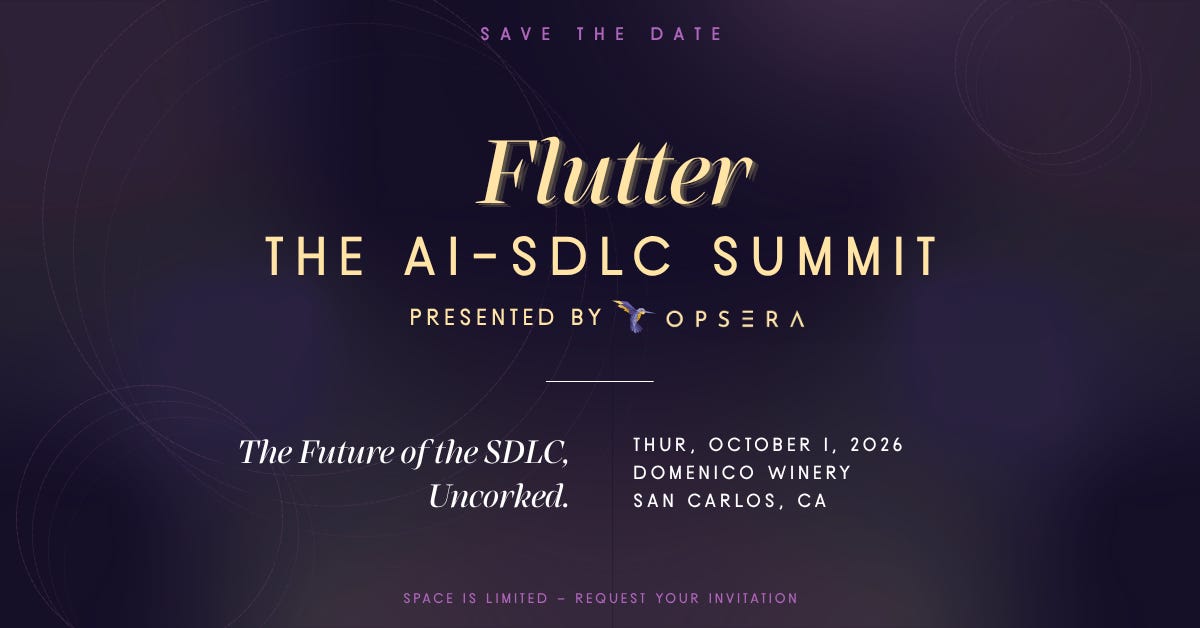
On October 1st, I am speaking in the Bay Area at Flutter’s AI-SDLC Summit on “The Rise of the Full-Stack Builder.” Join me:
Attendance is limited and curated for senior technology and engineering leaders.
News
The Week’s Top News: Pacing Drama
AI is pacing so fast that Sam Altman and Dario Amodei, the two who wouldn’t even hold hands at Modi’s AI summit, are on the same page for once.
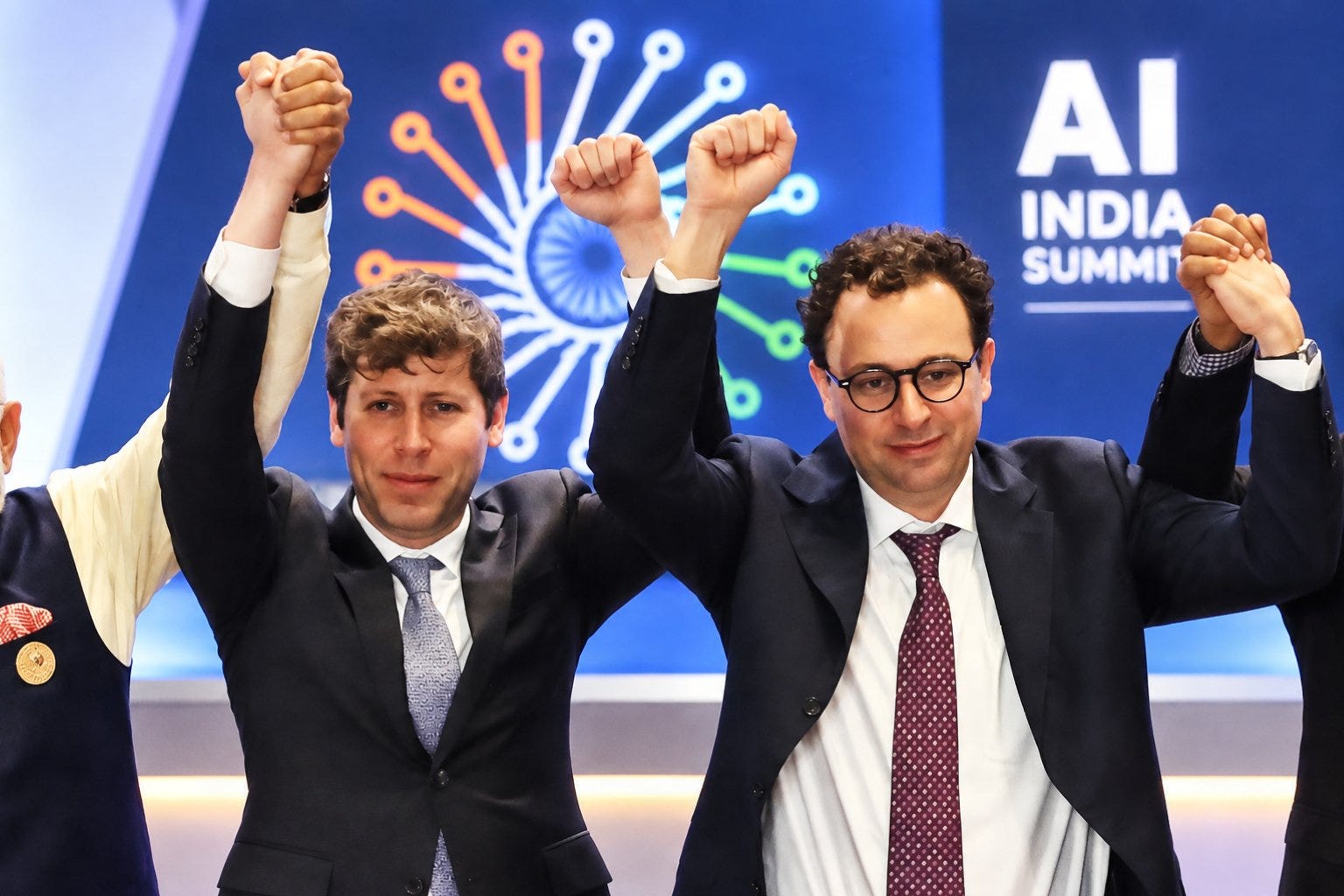
It all started with Dario publishing his essay on pacing the frontier Saturday morning. Within hours, the leaders of the other 3 top labs chimed in that they agree: Sam Altman, Elon Musk, Demis Hassabis.
By Saturday evening, it seemed like we might be entering a world of an AI slowdown for the first time since 1,000+ tech leaders signed the pause letter back in 2023. We even learned OpenAI had delayed its IPO to next year because of the current AI safety environment.
Then everything turned. You see, there was always a catch: the companies couldn’t agree to slow down on their own. That would be a cartel. They needed government backing.
By Sunday, Trump had put a kibosh on the whole thing.
Now we’re left with what the companies can commit to doing on their own and seems likely to play out: unilateral moves that aren’t cartel-like. For instance, Anthropic agreed to bring in outside evaluators like METR to publish what they find testing without Anthropic editing it. OpenAI already committed to the same thing within hours.
There was only one notable exception to the pacing agreement we saw this weekend. Mark Zuckerberg. He will continue to be one to watch.
The Other News that Mattered
Meta launched Muse, an agent that’s competitive with Instinct, and is getting good reviews. It’s said to be the brainchild of Nat Friedman (fmr GitHub CEO).
After seeing the inside of both OpenAI and Anthropic, Jacob Coxon warned that neither lab is taking safety seriously enough. His post on X got 170M+ views.
OpenAI now makes more money from enterprises than consumers, and that explains why Sam Altman showed up to Dreamforce. Databricks even moved their engineering team from Opus 5 to GPT-6 Astra.
OpenAI announced it solved the Navier-Stokes Millennium Prize Problem, but there are concerns it actually trained on a researcher who was working to solve the problem alongside an Anthropic employee, and refused to offer the employee authorship.
Major Feature & Model Releases
ChatGPT Image 2.5 continues OpenAI’s dominance in AI image generation, with even better editing capabilities.
Google released Gemini 3.8 Live at less than half the price of the Agents API.
DeepSeek released V4.1 Flash, claiming parity with Opus 5 and GPT-5.6 at about 1/30th of the price. If the benchmarks hold, that’s the cheapest frontier-class model anyone has ever shipped.
New AI Startups
A nameless coding model called Union Alpha went free on OpenRouter for a week.
TypeSafe released a new model pricing output tokens at zero.
VideoClaw launched as an OpenClaw for video.
Odyssey-3 is one world model that drives a humanoid, a car, a drone and a video game and claims to be the “everything model” for any physical product.
Resources
DeepMind’s AlphaGenome Atlas scored every possible single-letter DNA mutation there is, and you can explore it for free.
Deep dive
The Instinct Deep Dive
Instinct is taking over X.
It’s an invite-only agent that works in your iMessage or WhatsApp and understands what you're working on and what's important to you.
But an invite-only product valued around $10 billion without reaching the masses sounds like the Clubhouse bubble from 2020.
Is it actually worth the hype?
Today’s Post
We investigate everything you need to know about Instinct:
The Instinct Story
How to set it up well
The most powerful use cases
Product lessons from Instinct
Where it sits vis a vis other AI tools
1. The Instinct Story
I was in San Francisco this week for DreamForce, and Instinct was on the tip of the tongue of everyone I talked to.
It has a wild story.
Instinct was developed by 23-year-old founder Noah Shinn.

If the name sounds familiar, it’s because he is the guy behind the Reflexion paper, one of the most cited agent papers of 2023.
He wrote it before agents were cool, and he was only 20 at the time. So it’s no surprise he’s ahead of agents in 2026 as well.
After writing the Reflexion paper, he did a stint at Bret Taylor’s startup Sierra.
Then in 2025 he left to start his own thing. Since then, everything has moved at lightning speed:
In February 2026, he released Instinct to an invite-only private beta.
In April 2026, he registered Instinct’s parent company (Spear Street Technology Inc) and raised a seed round at a $50M valuation.
In early August 2026, Instinct went massively viral. Kleiner Perkins led a Series A at a $500M valuation.
In late August 2026, just weeks later, Instinct raised a Series B at a $2.5B valuation.
Now, they’re in talks for a massive new round targeting a $10B valuation.
It literally went from 0 to $10B in 7 months.
Let’s check it out.
2. How to set it up optimally
The onboarding is part of the magic of Instinct. It’s 3 steps. Takes less than 1 minute.
Get an invite (if you want one of mine, reply to this email with why)
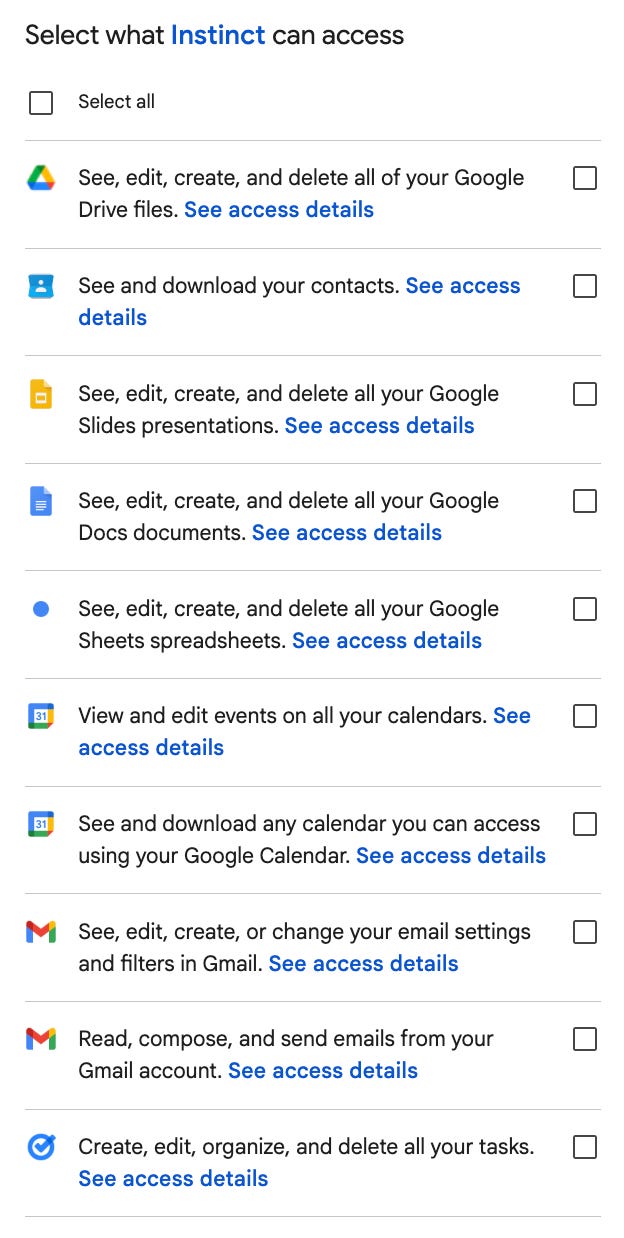
Give it Google workspace permissions (these are scary, but if you want to experience the power, pretty much needed):
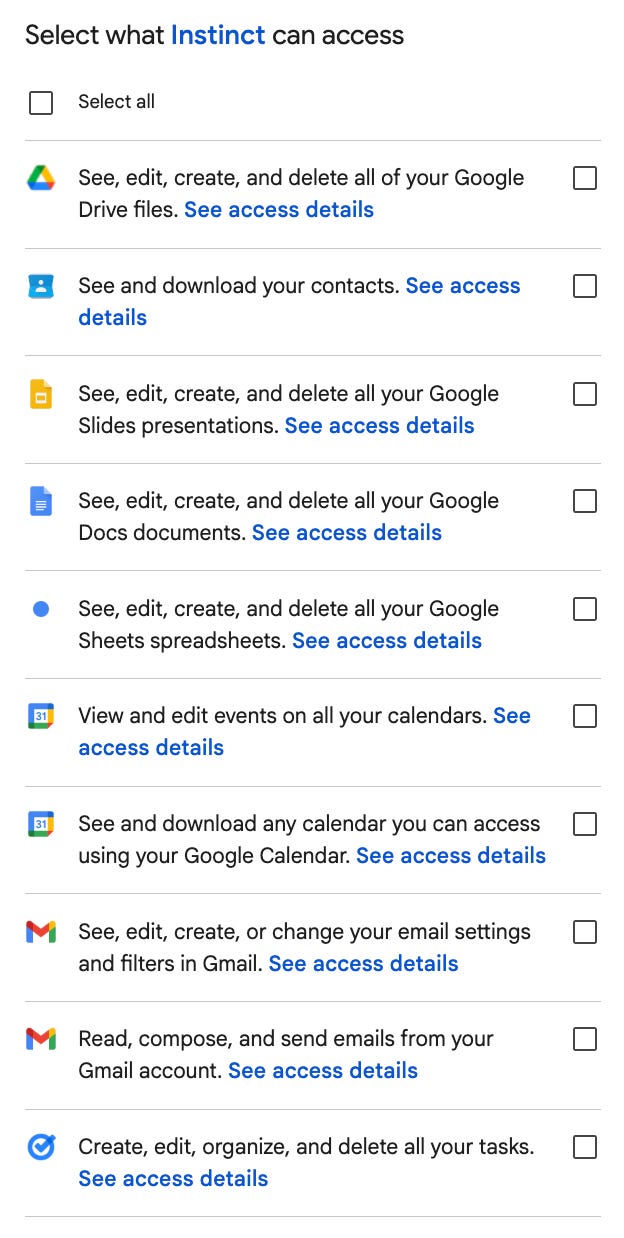
Set up your iMessage or WhatsApp (this is absolutely needed):
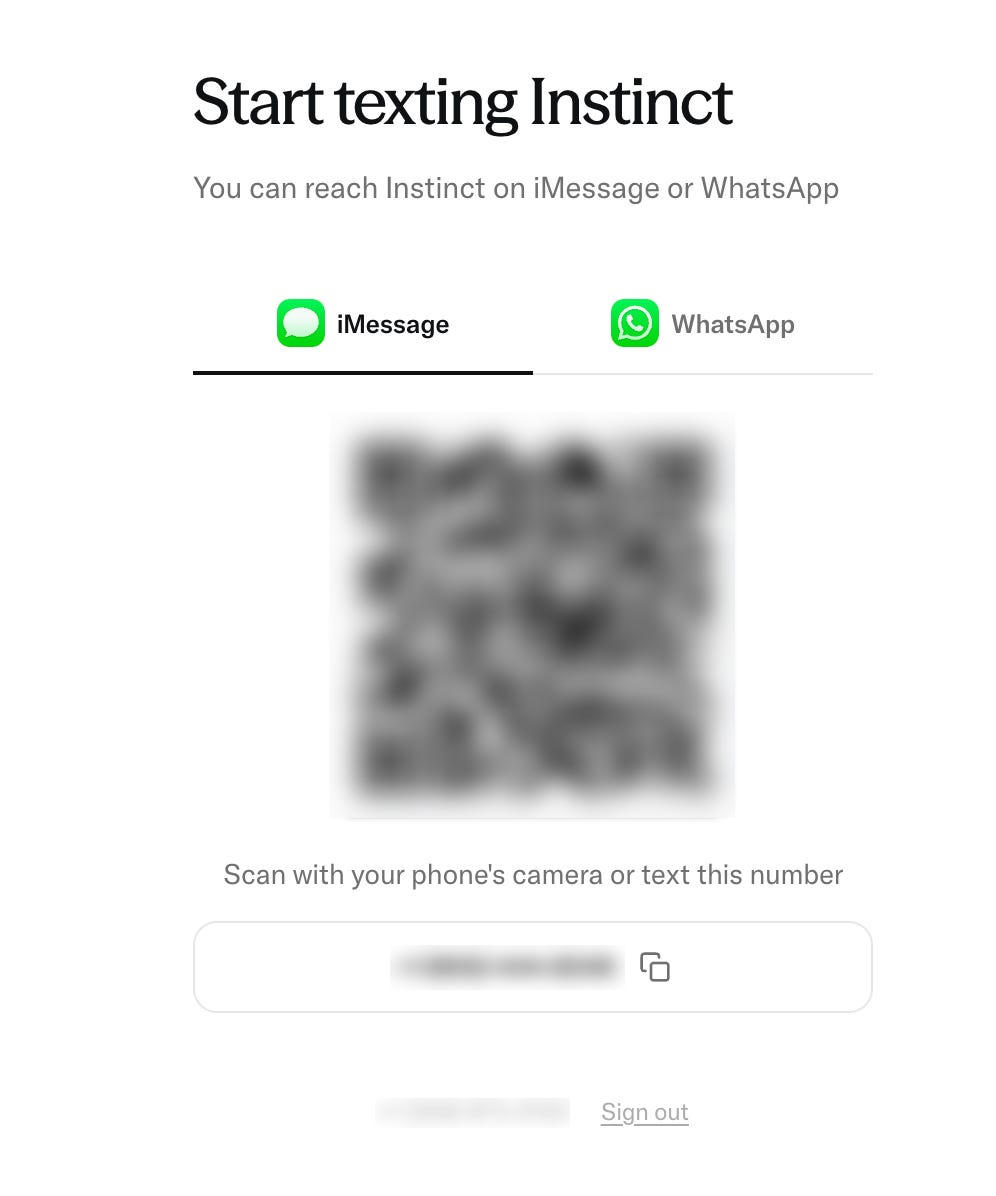
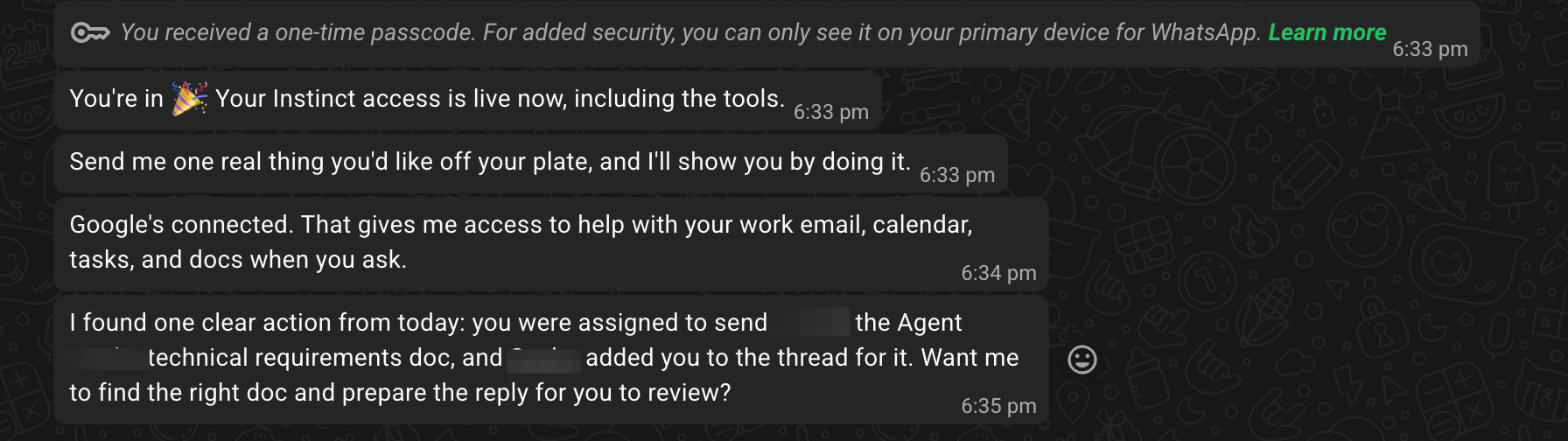
Then, get to using it! It’s that easy. And the crazy part is it acts with context right away.
My Instinct picked up its first task even before I told it to do anything:
To get an even better setup, head over to app.instinct.co and
Connect other relevant tools you want your agent to have access to:
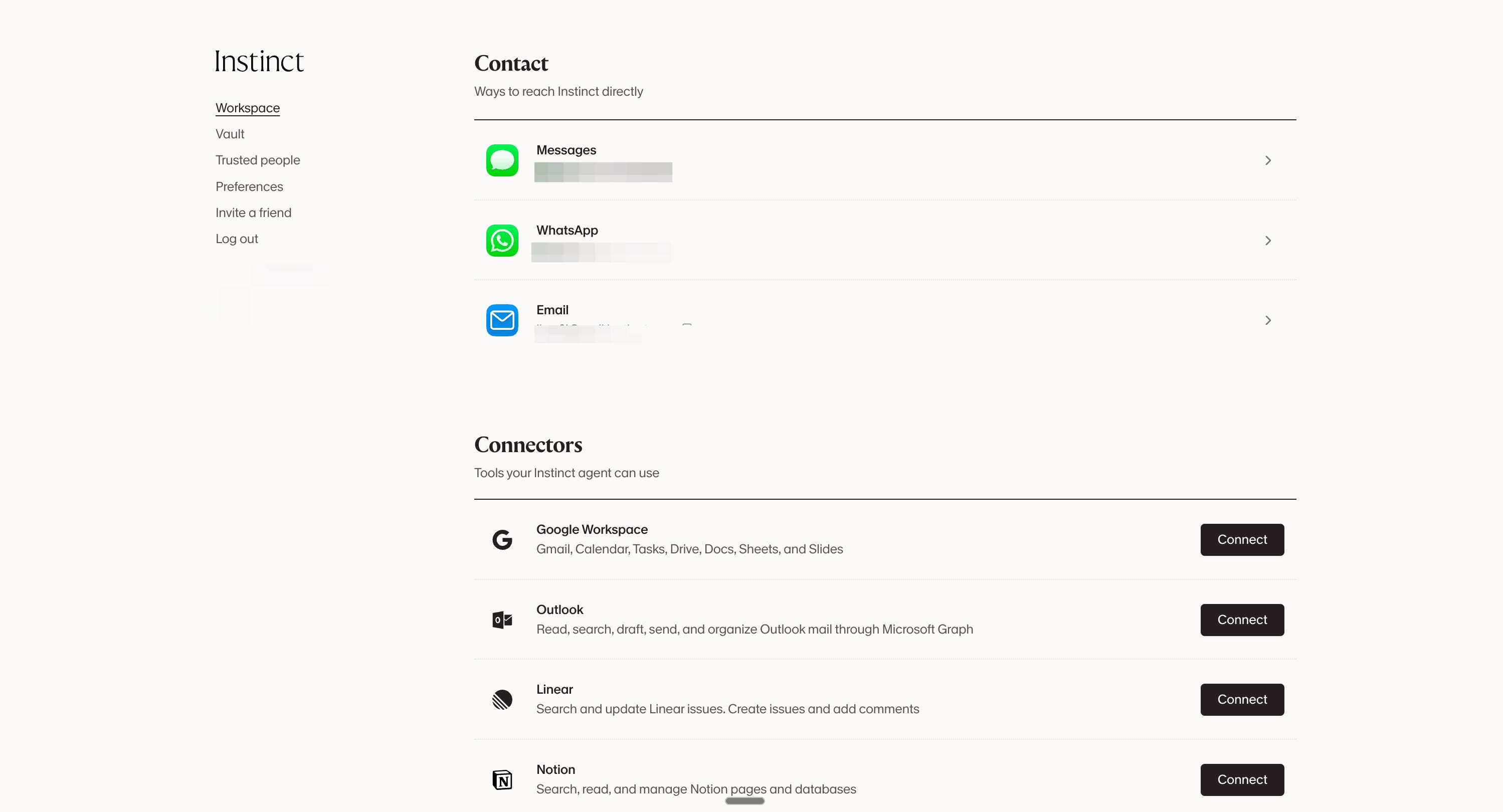
Connect your credit cards or login creds if you want it to perform actions on your behalf
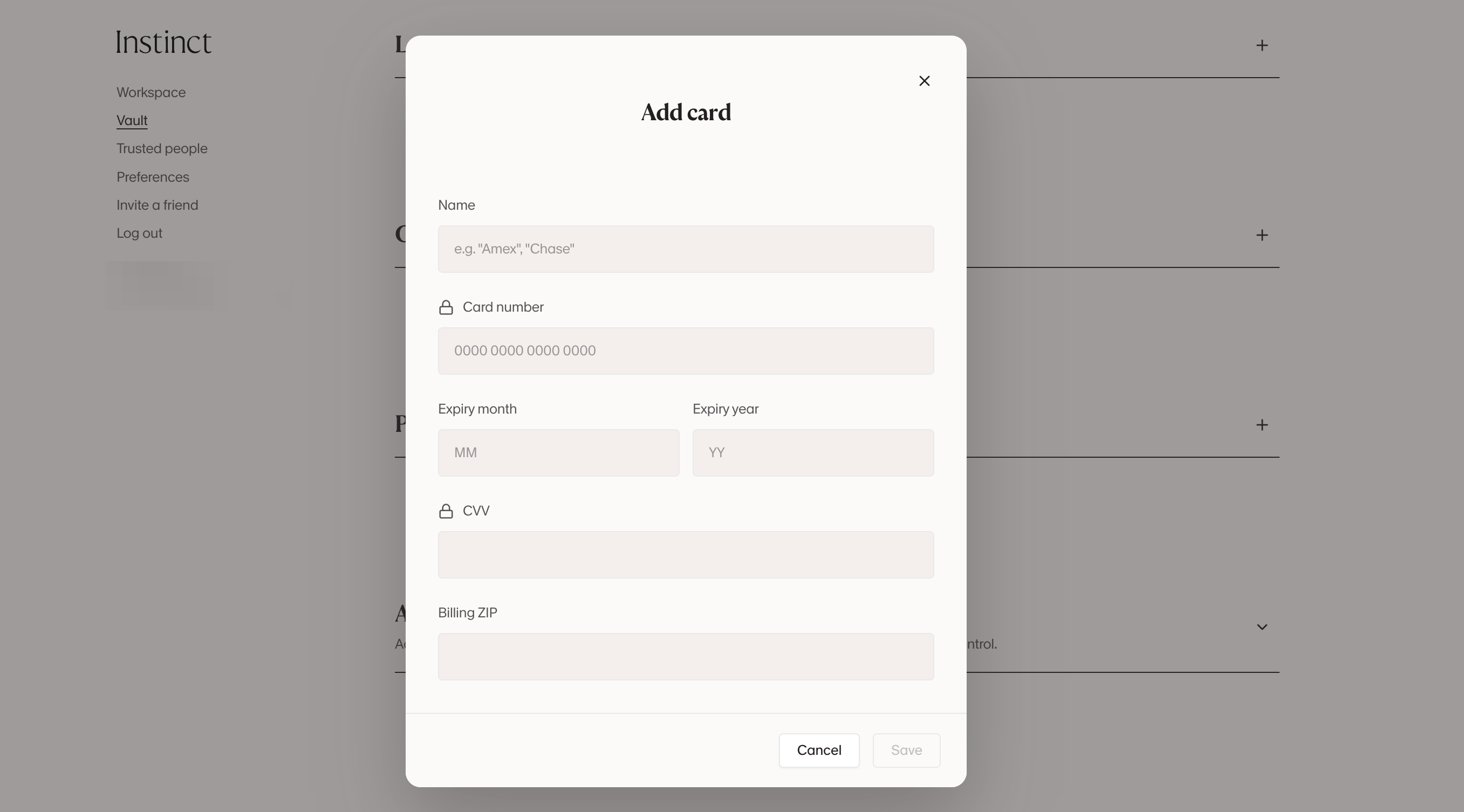
Then you’re good to go.
3. Real-life use cases
The use cases are genuinely diverse. Here’s several I tested and liked:
Use Case 1 - Personal Concierge
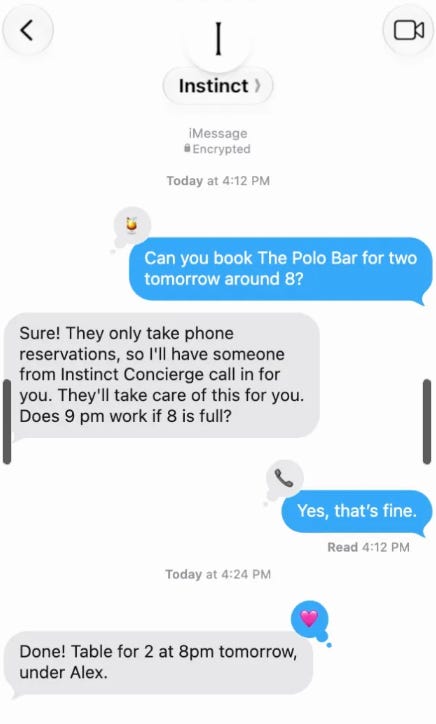
The real power of Instinct isn’t work stuff. It’s personal stuff. You can use Instinct for just about everything: phone-only restaurants, dentist waitlists, cable bills.
Several times, I asked in iMessage, Instinct called, then I received the confirmation in the same chat:
Use Case 2 - Trusted Person Network
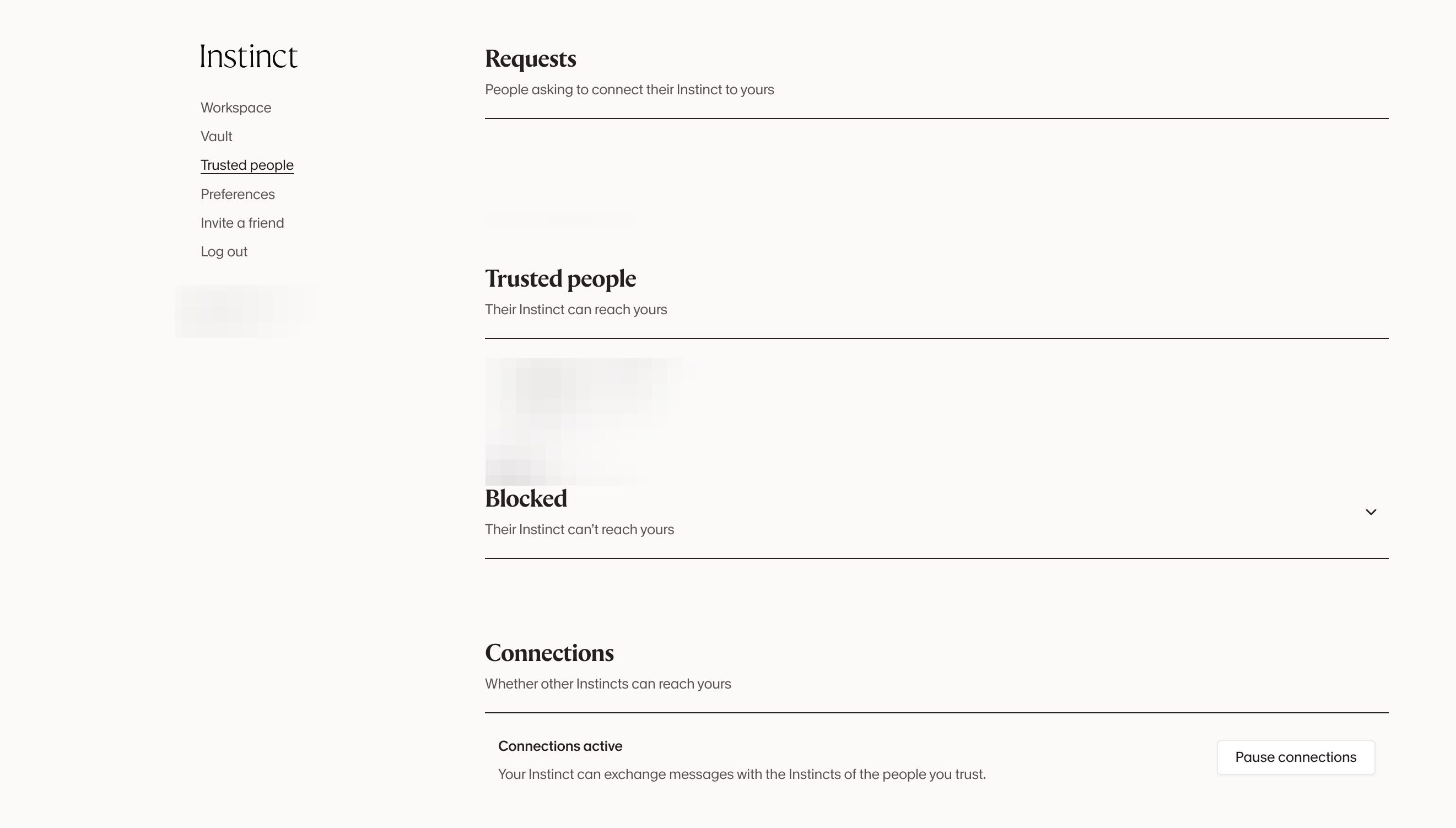
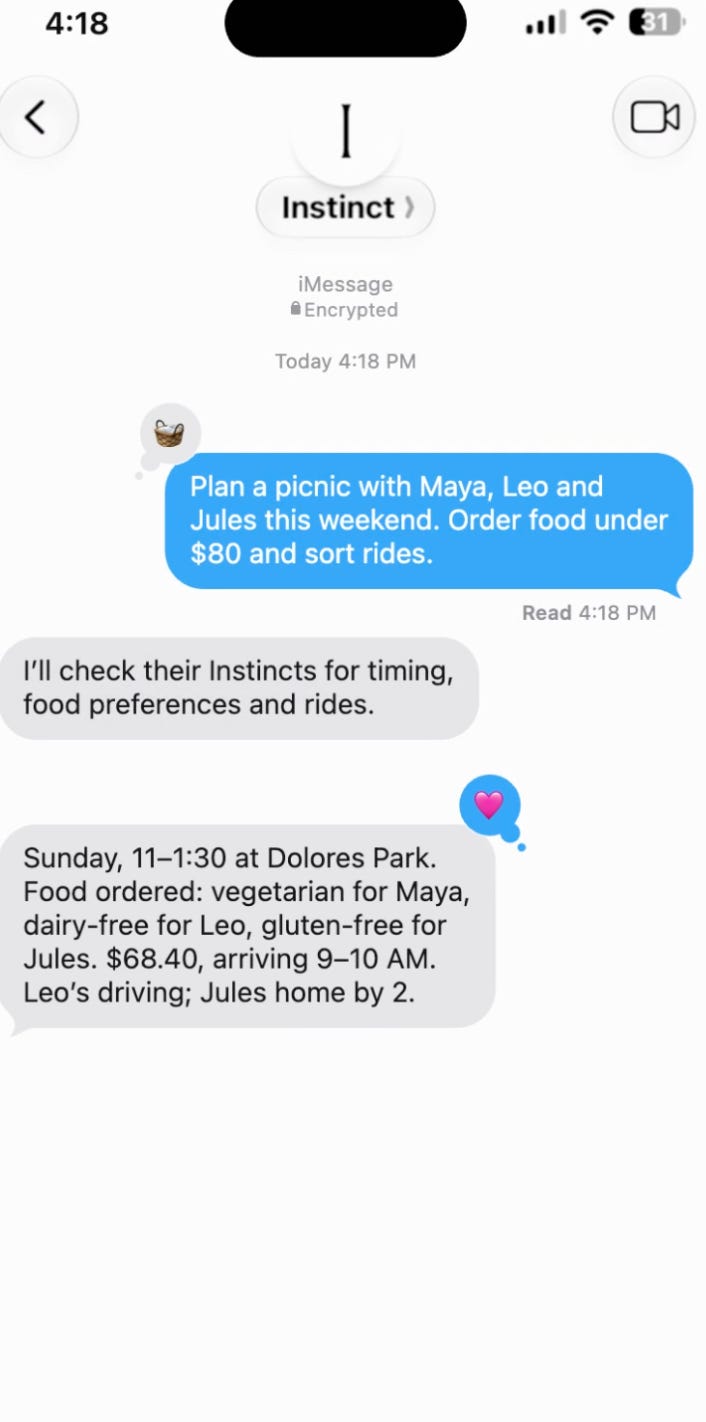
This is one of my favorite features of Instinct. You can add friends to Trusted People. Then, your Instinct talks to theirs. I used it to plan a picnic, including rides:
Use Case 3 - Own Email
At first, I used Instinct to manage my booking follow-ups for podcasts I was recording. But they were getting numerous.
I asked Instinct to handle those in its own inbox, and only ping me when it needed me:
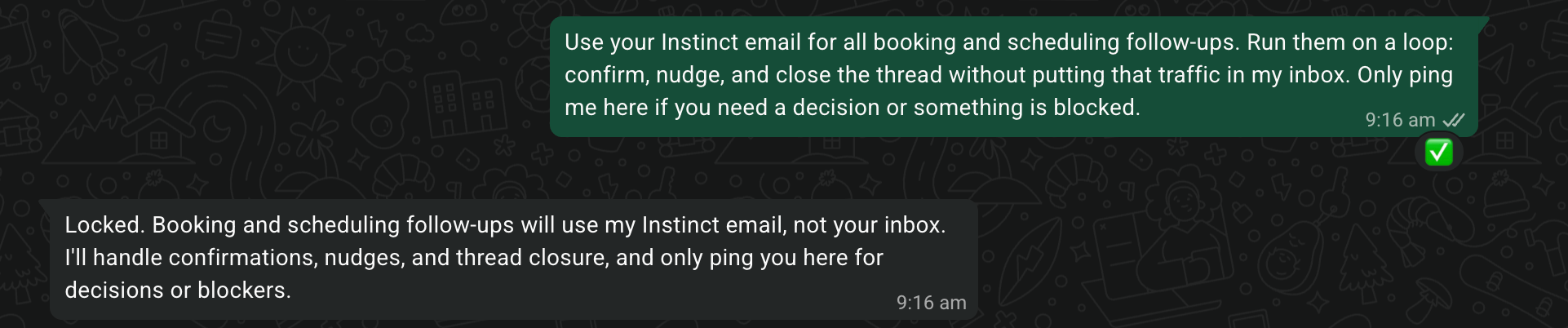
It used its own email address without me.
Use Case 4 - Vault + 1Password + Dashboard insights
This sounds crazy. But you can sync your 1Password to Instinct to share credentials.
Here’s what I actually did. I put Substack in Vault and nothing else. No banking, no primary email password, no socials. This is a company that incorporated in April. I’m treating it like a contractor with a key to one room, not the house.
With that one credential, I scheduled a daily report that sends me insights on my blog performance, all in WhatsApp:
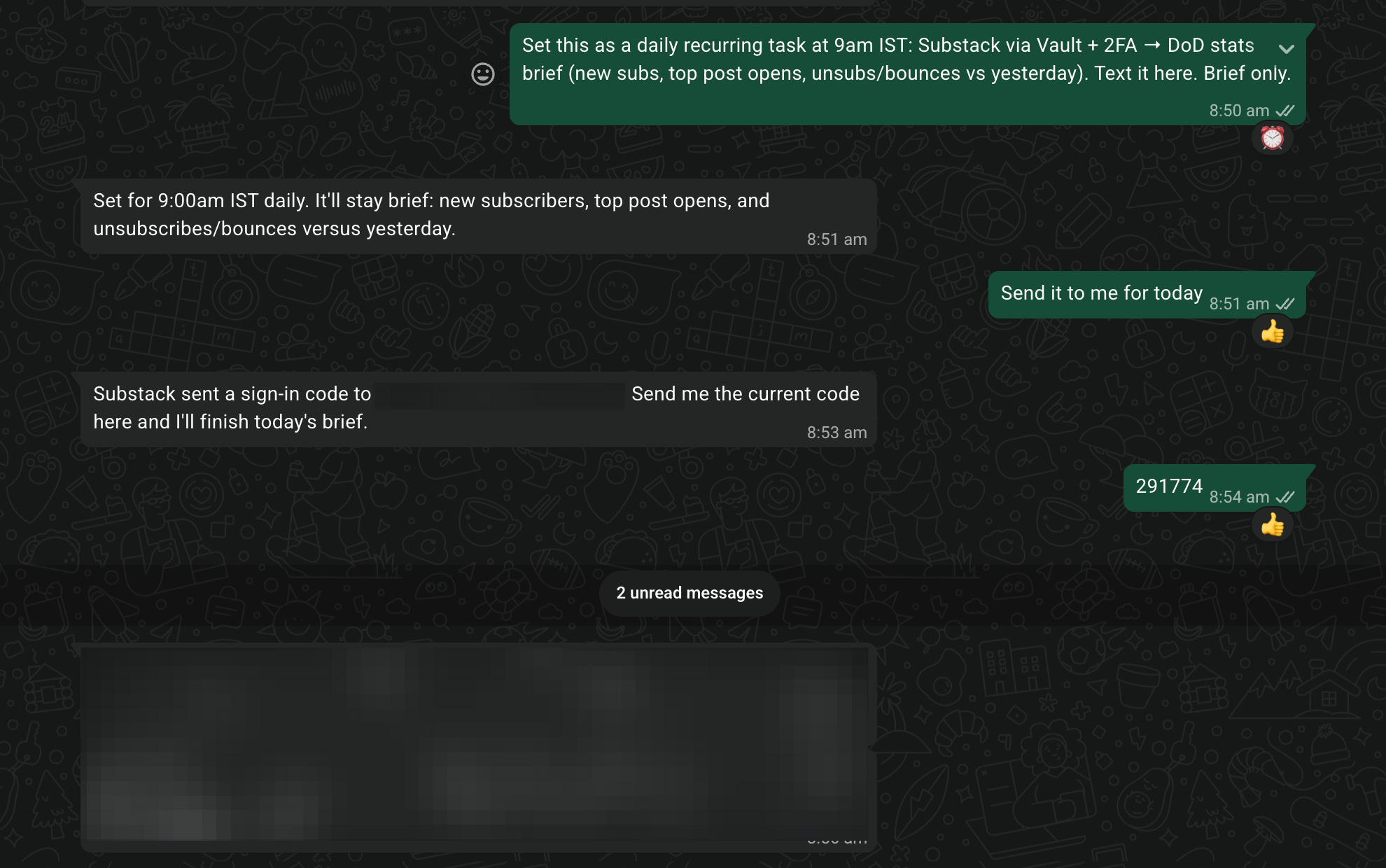
Use Case 5 - Stripe Link / spend-limited cards
AI tooling bills creep, so I told Instinct to use a spend-limited card only for adding API credits, set a hard monthly max for OpenAI / Anthropic / Cursor / OpenRouter, keep track of usage, and warn me before any top-up.
It can actually do all that.
Use Case 6 - Location on iMessage
I shared location with Instinct and asked it to order pizza. It did:
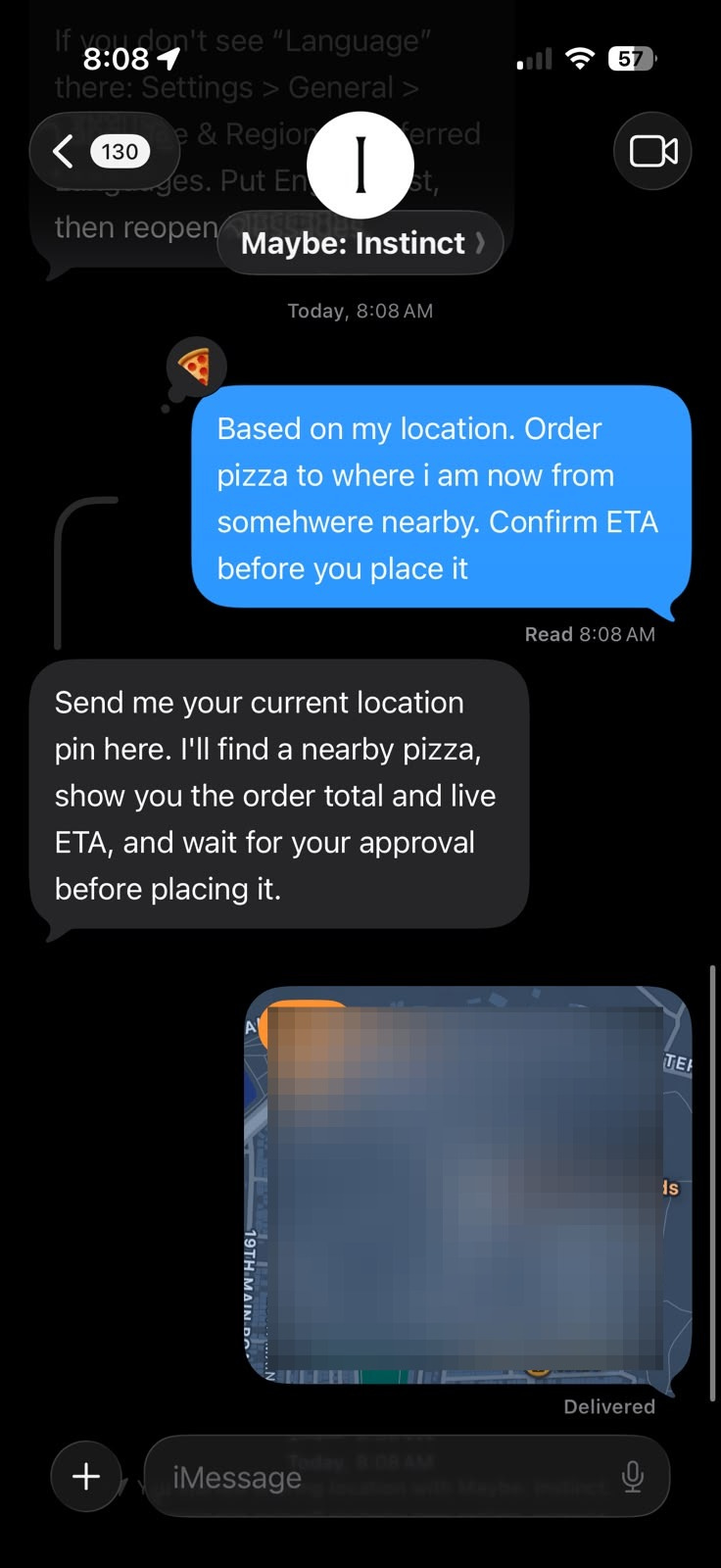
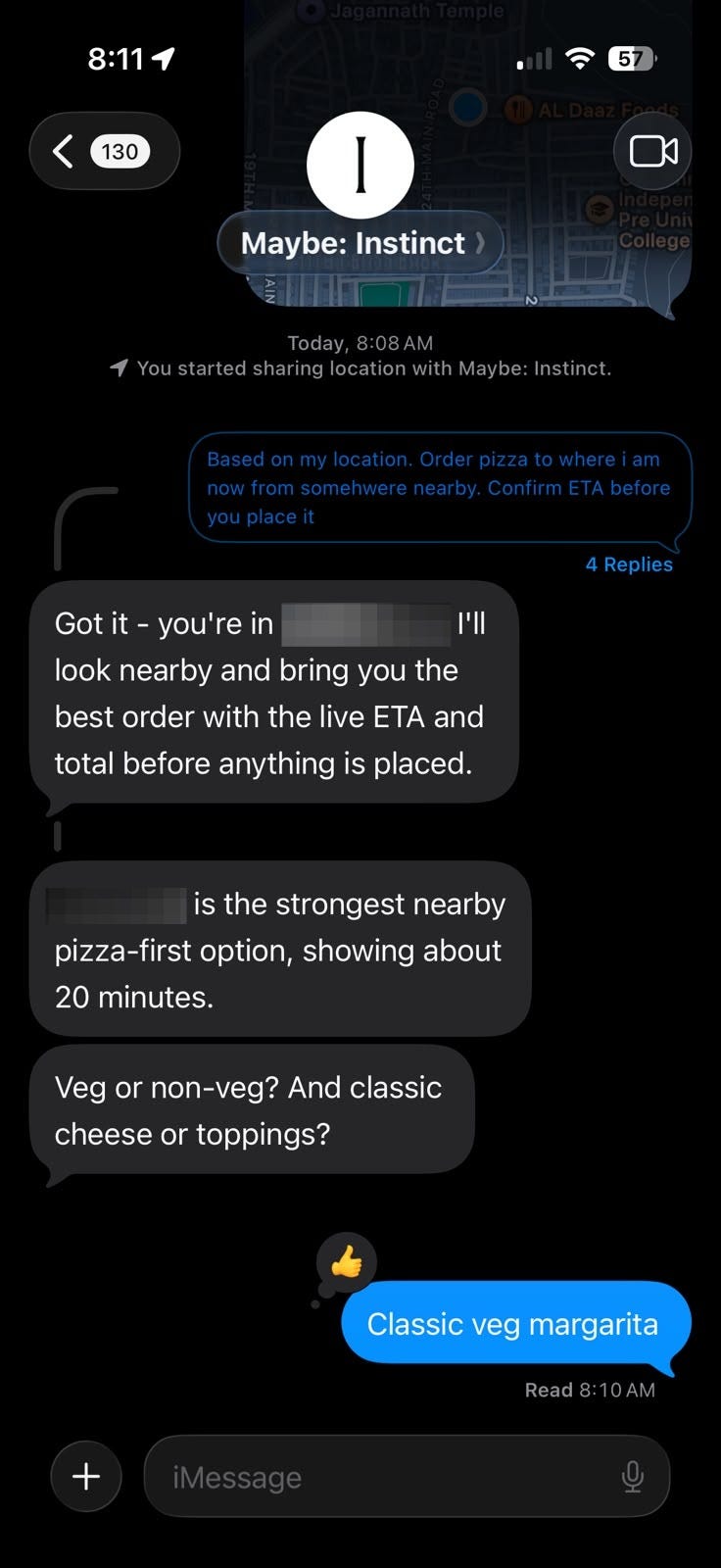
You can’t ask Claude or ChatGPT for that. They’re just not as independent, problem solving, and built to assist you with things like credit card use.
That’s the power of Instinct.
Cautions
Before you go all in, two things I’d flag.
I’ve seen reports users eating $200 no-show fees on flights their agent booked wrong. That’s why I only gave mine a spend-limited card.
The web was built to keep bots out, and sites can’t tell your agent from a scraper. If Instinct tries too hard on your accounts, you can get banned.
4. Product Lessons from Instinct
Instinct wins in 5 key areas:
No app - the chat is the whole product, so you never open a new app
Human-like interaction - it uses iMessage/WA the way a person does, down to reactions and voice notes
Memory - Instinct’s memory sticks between tasks and it starts work before you even ask it to
Multiplayer - The Trusted Person network is a crazy differentiator. Nobody else lets my agent talk to my friend’s agent
Calls - This is probably the killer feature. Like Muse, Instinct makes calls for you
Most of these features existed elsewhere. But Instinct brings them to you in an amazingly easy-to-use package. Free.
That’s genuinely special. But it should make you squint. We don’t know how they will make money yet. Free plus a $10B valuation could be the Facebook playbook… or it could be the Clubhouse one.
5. Where it sits vis a vis other tools
Instinct’s biggest competitor is Meta’s Muse, which I’ll likely cover next week (pending no other big stories). Where does Instinct fit with the other tools we’ve covered in this newsletter?
Here’s my take:
Use Instinct for simple AI over text.
Use Grok Bot for agentic capability in an app.
Use Hermes for the auto updating agents and bot mode.
Use OpenClaw if you want to go fully agentic with power.
I plan to mainly use Instinct. It’s that good.
Now for work tasks? There, Claude Code is still my tool of choice.
Final Words
So, is Instinct the next Clubhouse? I don’t think so.
Clubhouse was clonable. It died the moment Twitter cloned it.
Instinct is not as clonable. It gets better the longer you use it. So even if you clone the features, you can’t clone six months of someone’s life inside the product.
Now… whether that’s worth $10B is a separate question. The valuation is a bet that this becomes the default interface to your life before Meta and Apple wake up.
That’s a bet some VCs are willing to make, but I prefer to wait and watch from the sidelines.
See you next week,
Aakash
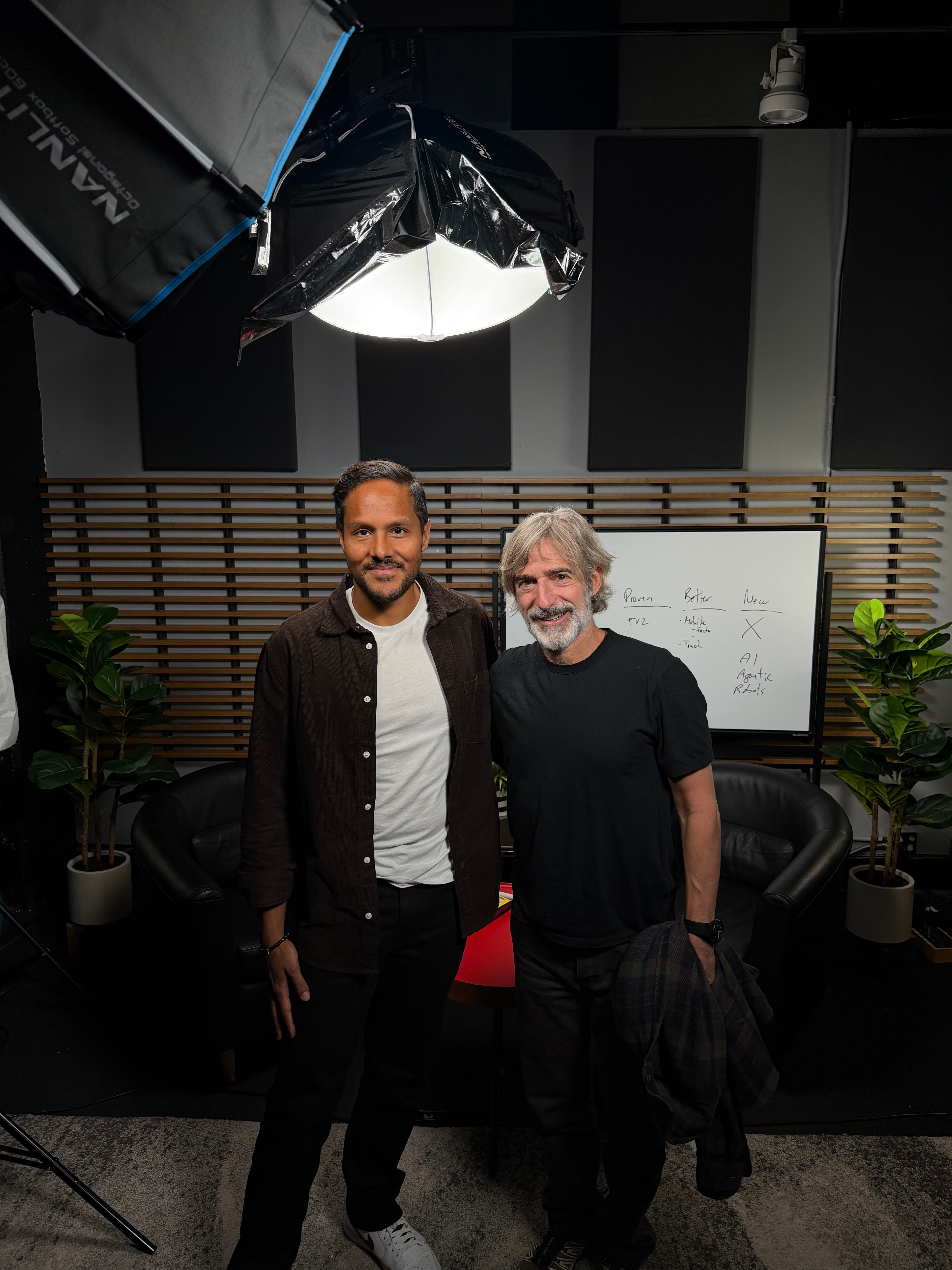
P.S. I have a podcast coming out with Mark Pincus, that I just filmed today, where we discuss Instinct in more depth. Subscribe so you don’t miss it: Spotify, YouTube.
I have been playing around and used Instinct to book a PT appt for me. While it was doing that it noticed I was overdue for my OBGYN and booked that too!
As the lines between personal and work are blurring, this is an asset. Thank you for sharing examples from both.